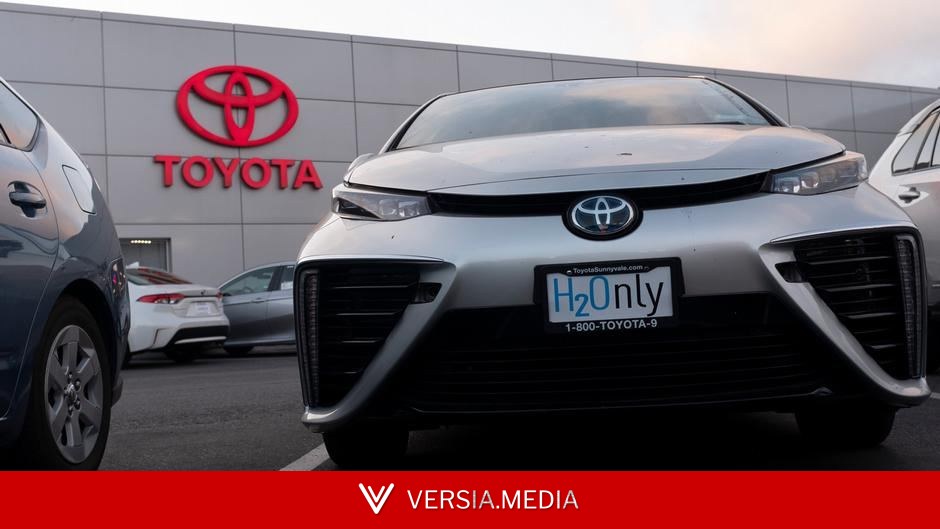
During a recent trip to Japan, German Transport Minister Patrick Schnieder examined hydrogen initiatives aimed at mainstreaming the fuel.
On Wednesday, German Transport Minister Patrick Schnieder arrived at Toyota’s fuel cell facility in a German BMW iX5 Hydrogen, only to later leave in a Japanese Toyota Crown FCEV. The vehicle selection was, of course, intentional, as both cars generate electricity from hydrogen via a fuel cell.
Automakers BMW and Toyota are currently working together to develop the third generation of this propulsion technology. Three BMW staff members have specifically relocated to Japan to take part in the project.
Both firms are supplying components to create a more compact and efficient fuel cell. After this phase is finished, BMW will produce this propulsion technology at a factory in Austria, while Toyota will do the same at a manufacturing site in Japan. BMW intends to launch its first hydrogen production model in 2028. Toyota will also update its two existing hydrogen production models with the new system. However, precise details remain undisclosed.
Complex hurdles ahead for Germany, Japan
"The partnership between Toyota and BMW on hydrogen is groundbreaking for the further advancement of this propulsion technology," Transport Minister Schnieder informed reporters following his visit to the city of Toyota. "We must make hydrogen ready for mass production so that we are not solely reliant on batteries and fossil fuels and can develop more extensive supply chains," the minister added. Germany and Japan, Schnieder noted, had been collaborating on this "extremely challenging task" since initiating their energy partnership in 2019.
Germany anticipates a significant rise in demand for green hydrogen generated using electricity from renewable sources by 2030. It will be unable to meet this demand domestically and will therefore need to import substantial quantities of hydrogen.
Could green hydrogen offer a pathway to cleaner transportation?
To view this video please enable JavaScript, and consider upgrading to a web browser that supports HTML5 video
Japan also intends to increase its hydrogen capacity to twelve million tons annually by 2040. However, it is additionally promoting the production of ammonia as a hydrogen carrier. There are plans to incorporate ammonia as a transitional fuel in conventional thermal power stations.
Hydrogen remains a niche fuel for now
The German minister’s trip to Japan demonstrated that both nations are still far from making green hydrogen a widely accessible fuel, particularly in industrial settings. Schnieder visited the world’s first terminal for liquid hydrogen in the port of Kobe, which has thus far been used only for testing. He then went to Kansai Airport in Osaka, where buses and forklift trucks operate on fuel cells, though solely as a pilot initiative.
Japan and Germany have recently strengthened their hydrogen collaboration. Last September, Kawasaki Heavy Industries, Toyota, Japanese electricity provider Kepco, Daimler Truck, Hamburg-based fuel supplier MB Energy, and the Port of Hamburg agreed to establish a commercial hydrogen supply chain.
Meanwhile, German and Japanese authorities are exploring ways to fund the increase in hydrogen production that will help mitigate price volatility. After all, green hydrogen will initially be considerably more expensive than fossil fuels. Siemens Energy and Toray aim to improve electrolysis technology for green hydrogen, while Thyssenkrupp Nucera is keen to enter the Japanese electrolysis market.
German refueling standards
Germany is ahead of Japan in terms of making hydrogen available for powering commercial vehicles. Earlier this year, Minister Schnieder allocated a total of €220 million ($255 million) to build up to 40 hydrogen filling stations across the country and put up to 400 hydrogen-powered trucks on the road. Meanwhile, Daimler Truck has started operating Germany’s first liquid hydrogen refueling station for trucks.
Daimler’s Japanese subsidiary Fuso has also introduced liquid hydrogen truck propulsion to Japan. However, Fuso recently merged with Toyota’s commercial vehicle subsidiary Hino. Now the new joint venture, called Archion, must coordinate its hydrogen truck offerings. Nearly a year ago, Hino launched the Profia Z heavy-duty truck, which runs on a fuel cell from Toyota’s Mirai hydrogen car. However, the truck is refueled with compressed hydrogen.
In Germany, the goal is for three-quarters of newly registered heavy commercial vehicles to run on emission-free fuel by 2030. "The majority will be battery electric, but a significant portion will operate on hydrogen," Minister Schnieder told reporters. Japan, in contrast, has not established any comparable targets.
Daimler aims to introduce its liquid hydrogen refueling system, developed jointly with Linde, to Japan with the assistance of the new Archion joint venture to make liquid hydrogen available for trucks there. So far, Japan only has filling stations for compressed hydrogen. Fuso’s H2FC truck — the first in Japan to run on liquid hydrogen — will therefore remain a concept vehicle for now.
This article was translated from German.