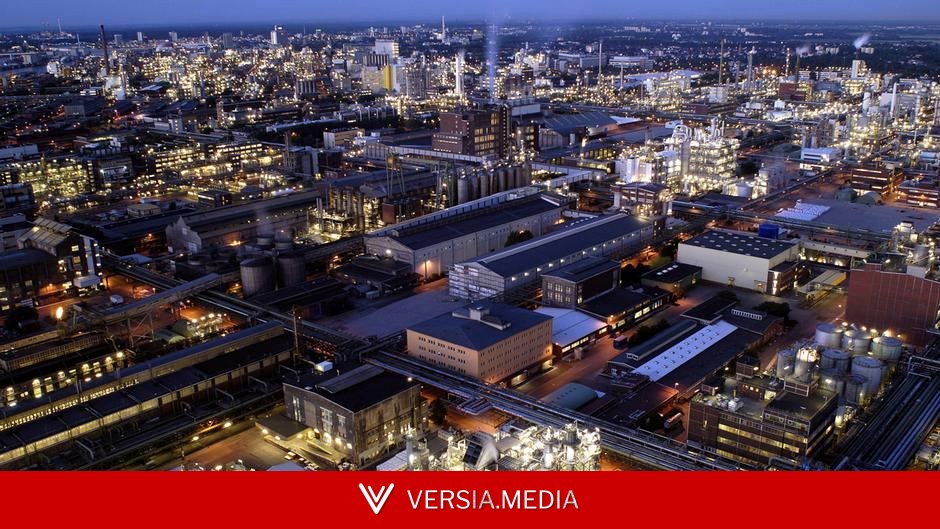
Burdened by high energy costs and regulatory pressures, Germany’s chemical companies are reducing domestic output while increasing their operations overseas. Can this trajectory be reversed?
Germany’s chemical industry is a fundamental pillar of the national economy, trailing only automotive and mechanical engineering. It generates hundreds of billions of euros in annual revenue and provides direct employment for roughly half a million people.
In recent years, however, the sector has faced a crisis, hampered by elevated energy expenses, mounting regulatory demands, a persistently sluggish economy, and fierce international competition.
Chemical manufacturing demands substantial energy, not only electricity but also heat, steam, and pressure. Consequently, rising energy prices undermine companies’ global competitiveness and profitability.
Since Russia’s full-scale invasion of Ukraine in February 2022 and the subsequent loss of inexpensive Russian gas, German chemical firms have confronted some of the steepest energy costs worldwide.
The US‑Israel conflict with Iran this year has compounded these difficulties. It sparked another surge in energy prices, disrupted supply chains, and led to shortages of essential raw materials.
“Energy prices, especially natural gas prices, have doubled since the war in Ukraine started,” said Christof Günther, managing director of InfraLeuna, a German infrastructure and services company that runs the Leuna Chemical Park, the nation’s largest integrated chemical site.
“And they [energy prices] have just doubled again temporarily due to the war in Iran. So, we are dealing with extremely high energy costs,” he told DW.
Overall revenue generated by German chemical firms has dropped by around 22% since 2022, reaching €220 billion ($256 billion) in 2025, according to the German chemical industry association VCI.
The trade group, representing roughly 2,300 companies, indicated there is no sign of a recovery, with stagnation or further production declines expected this year. It emphasized that lowering natural gas costs is crucial for strengthening Germany as an industrial hub.
VCI noted that natural gas serves not only as an energy source for the chemicals sector but also as a vital feedstock that cannot be replaced overnight, leaving companies highly vulnerable to sustained price pressures.
“Alternatives such as biomethane can support the transformation, but they are still in the ramp-up phase and are currently available only to a limited extent,” the association said in a statement to DW.
Anna Wolf, chemicals industry expert at the Munich-based ifo Institute, an economic think tank, said the industry has largely done what it can to address energy challenges, pointing to investments in energy-efficient production and recycling.
The burden now falls on policymakers, she stressed, to ensure that energy is available “in sufficient quantities, at internationally competitive prices, and through infrastructure that the chemical industry can actually rely on for its long investment horizons.”
Without reliable, affordable energy and the infrastructure to deliver it, “no other measure — whether on regulation, trade or innovation — will be sufficient to restore competitiveness,” the expert told DW.
Compounding the crisis is a prolonged economic stagnation in Germany and weak growth across Europe, leading to subdued demand for chemical products in the region.
“Market conditions have shifted to the detriment of the German chemical industry in recent years,” Martin Gornig, research director for industrial policy at German Institute for Economic Research (DIW Berlin), told DW.
In addition to the energy challenges, he explained, this is primarily due to weak economic demand for chemical products in Europe. “Should the domestic economy in Europe pick up again, the outlook for the German chemical industry will also improve.”
The weak business climate has already prompted many companies to delay investment, reduce production, and cut jobs in Germany.
German chemical giant BASF, for example, has embarked on a major cost-cutting initiative in its home market while investing aggressively abroad, particularly in China. The company has also outlined plans to shift certain back-office positions from Germany to Asian countries like India and Malaysia as part of a broader workforce restructuring.
Overall, the industry has lost over 13,000 jobs since 2022, reported chemeurope.com, a specialist portal for the chemical sector.
Despite the challenging conditions, Germany currently remains central to companies’ core chemical production operations.
A full-scale relocation abroad is unlikely, say experts, given the complex and interconnected nature of industrial processes and ties to other companies in the country.
However, if the operating environment does not improve, businesses are likely to expand production capacity elsewhere.
But ifo expert Wolf stressed that Germany and Europe can no longer rely solely on market forces and accept that strategically important sectors like chemicals will move abroad when they lose competitiveness.
“That logic worked in an open world economy with reliable partners, but reliable partnerships have become scarce,” she said.
In a world of increasingly fragile alliances and unreliable partners, losing industrial branches that are systemically relevant would risk undermining Europe’s security of supply, Wolf said.
To boost the sector, along with other energy-intensive industries, the German government wants to subsidize electricity costs.
It is also pushing for reforms to the EU’s carbon pricing system, which companies complain unfairly burdens them. Berlin aims to make changes to the scheme to ensure it also protects industrial competitiveness while pursuing climate goals.
The VCI welcomed the measures but said more is needed, urging tax incentives and guaranteed long-term gas supply. It also called for greater use of biomethane — a renewable fuel produced by removing CO2 and other impurities from raw biogas, which can be used as a substitute for natural gas.
It also called for addressing lengthy permitting procedures and growing regulatory burdens, saying they are holding back investment and production. “The industry urgently needs reliable and internationally competitive framework conditions. Isolated measures are no longer sufficient.”
Sami Behbehani contributed to this article.
Edited by: Andreas Becker