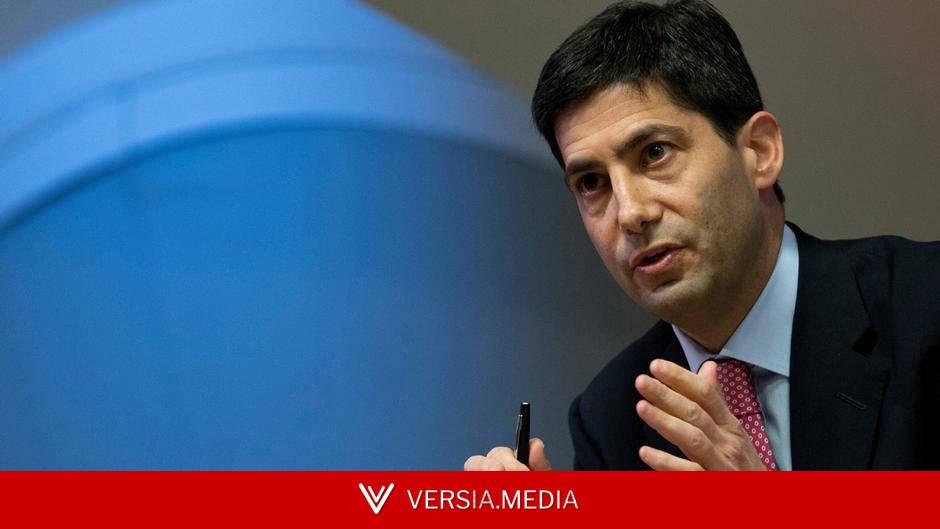
Never before has a chair of the US Federal Reserve sparked such intense debate. Who is Kevin Warsh? Can he safeguard the Fed’s independence, or will he become a puppet for Donald Trump?
Newly appointed Federal Reserve Chair Kevin Warsh vowed to uphold the central bank’s independence during his swearing-in ceremony at the White House on Friday.
This marked an uncommon procedure, as Fed chairs are typically not inaugurated at the White House, and presidents usually do not attend, given the Fed’s intended political independence.
During Warsh’s confirmation hearing, US President Donald Trump insisted that the incoming central bank leader would be “totally independent.”
However, some, particularly Democrats, have raised doubts about how independent Warsh will be at the helm of the world’s most influential central bank.
Among them is Democratic Senator Elizabeth Warren, who labeled Warsh as Trump’s “sock puppet” during his Senate confirmation hearing in April. Emphasizing that independence demands bravery, Warren asked Warsh: “Let’s test your independence and your courage. We’ll start with something simple. Mr. Warsh, did Donald Trump lose the 2020 election?”
Warsh avoided a direct reply, stating instead: “We try to keep politics, if I’m confirmed, out of the Federal Reserve.”
“His confirmation hearing did little to alleviate concerns,” Claudia Sahm, chief economist at New Century Advisors and a former Federal Reserve economist, told DW.
This skepticism was subsequently mirrored in Warsh’s confirmation vote — where only 54 senators supported him while 45 opposed — “the narrowest margin of any Fed chair,” Sahm noted.
Can the US Federal Reserve stay independent?
To view this video please enable JavaScript, and consider upgrading to a web browser that supports HTML5 video
A high-stakes appointment
The Fed chair ranks among the most influential figures in the US, managing the central bank’s decisions on interest rates, which affect not only the banking sector and the dollar’s exchange rate but also whether goods and services in the world’s largest economy become pricier or cheaper.
Those in this role are thus anticipated to ensure price stability, uphold confidence in the financial system, and protect the stability of the global economy.
Yet Trump has been clear about his expectations for Warsh, stating he would be “disappointed” if Warsh did not reduce interest rates immediately.
The president appears focused on the November midterm elections, hoping that lower rates will stimulate the US economy leading up to these key votes.
Warsh has publicly stated that Trump did not pressure him on interest rates.
“The president never once asked me to commit to any particular interest rate decision, period,” Warsh said during his confirmation hearing. “Nor would I ever agree to do so if he had,” the 56-year-old asserted.
Trump undermining central bank’s independence
Warsh’s predecessor, Jerome Powell, is well aware of what pressure from Trump entails.
The US president repeatedly hurled insults at Powell for not lowering rates, and even became the subject of a Justice Department investigation.
The Fed is meant to be politically independent, but any change to that status would have significant consequences, according to Kenneth Rogoff, an economist and professor at Harvard University.
“The independence of the US federal reserve is uniquely important in the global financial system. Because the dollar sits at the top of the global financial system. And when the US becomes unstable it affects everyone,” he told DW.
Trump’s trade policies and the Iran war have already eroded international confidence in the US president, but “when I talk to investors and ask them what they really pay attention to, they say: the independence of the central bank,” Rogoff pointed out.
Money and connections
Warsh, born in Albany, New York’s state capital, studied political science with a focus on economics and statistics at Stanford University. He then attended the prestigious Harvard Law School, earning a law degree in 1995.
Afterward, Warsh worked in investment banking at Morgan Stanley. In 2002, then-US President George W. Bush appointed him as his economic adviser. That same year, Warsh married Jane Lauder, heiress to the Estee Lauder cosmetics empire.
In 2006, at just 35 years old, Warsh was appointed to the Federal Reserve Board of Governors, becoming its youngest member ever. There, he gained a reputation as a monetary policy “hawk” for openly criticizing the policies of then-Fed Chair Ben Bernanke.
In response to the 2007-8 global financial crisis, Bernanke adopted an ultra-loose monetary policy, cutting benchmark interest rates to their lowest levels while initiating large-scale purchases of government bonds.
After disagreements with Bernanke, Warsh left the Fed in 2011 and subsequently worked in investment banking and at universities.
Warsh possesses a substantial fortune, estimated at around $200 million (€173 million), according to the Office of Government Ethics, a government agency that investigates conflicts of interest involving government employees.
This is in addition to his wife’s fortune, which Forbes magazine estimates at roughly $2 billion.
Will Warsh stand up to Trump?
The new Fed chief brings both experience within the central bank and an understanding of how Wall Street operates and what it desires. Therefore, he should recognize the need to avoid creating any perception that the central bank’s direction is being dictated by Trump.
If that perception takes hold, markets will react, Rogoff warned.
“If you try to get rid of the central bank’s independence, markets say, what are you planning to do? Are you trying to influence us? And they immediately drive up interest rates — which, of course, is the opposite of what the government wants.”
Sahm, meanwhile, believes that “up to this point, Warsh has had to impress the president to get the job.”
But now, he must convince the financial markets and the rest of the Federal Open Market Committee that he will steer the central bank effectively, she said. “It’s unlikely that he will keep everyone happy for long.”
Why US President Trump welcomes a weaker dollar
To view this video please enable JavaScript, and consider upgrading to a web browser that supports HTML5 video
What will happen to interest rates?
According to media reports, Warsh himself recently advocated for lower interest rates — a stance fully aligned with Trump’s views.
This is, however, puzzling, given that the economic environment would appear to suggest the opposite, as inflation is rising due to the war in Iran and higher energy prices.
If the Fed were to lower interest rates now, it would likely stimulate the economy but also further fuel inflation. Several members of the Fed’s 12-member rate-setting committee have therefore already opposed interest rate cuts.
Thus, even if Warsh genuinely wants to reduce rates in line with Trump’s agenda, he would need to persuade committee members to vote for a cut.
Furthermore, outgoing chair Powell — who incurred Trump’s wrath — has taken an unusual step by deciding to remain at the Fed. At his final press conference as central bank chair, he announced that he would stay on the Board of Governors — a move that would grant him an unusually influential voice on the body.
Powell’s case also illustrates how much things can shift. Trump, who now calls him “incompetent,” a “fool,” or even “corrupt,” was the one who nominated him for the Fed chair position in 2017.
This article was originally written in German
May 23, 2026: This article has been updated to include Trump’s remarks from Warsh’s swearing-in ceremony on May 22.