Spring Holidays in Germany: Pentecost's Meaning and Traditions
People arriving in Germany are often taken aback by the abundance of public holidays during the spring season. Pentecost is among them, yet its significance remains largely unfamiliar.
In Germany, spring is marked by a series of public holidays rooted in Christian tradition: Good Friday and Easter, commemorating Christ's crucifixion and resurrection; Ascension, marking Christ's journey to heaven; and Pentecost, regarded as the founding day of the Christian Church.
Also referred to as Whitsun or Trinity Sunday in certain religious denominations, it signifies the moment the Holy Spirit is thought to have come down upon the Apostles of Jesus, Mary, and other Christ followers, 50 days after Easter — hence its name, derived from a Hellenistic Greek term meaning "50th." Although the holiday holds importance for Christians, its origins lie in Judaism.
The aforementioned followers of Christ had assembled in Jerusalem to celebrate the Feast of Weeks (Shavuot in Hebrew), a harvest festival occurring seven weeks and one day after the first day of Passover, also observed as the day the Ten Commandments were revealed to Moses.
### Miracle of Understanding
"The disciples felt somewhat lost following the death and resurrection of Jesus, and then after the Ascension," explained Reverend Aljona Hofmann, a pastor at Berlin's Protestant Gethsemane Church. "They were uncertain about their next steps. They had enjoyed such a wonderful time with Jesus, who was no longer accessible, and they had retreated to a house in Jerusalem. Then the Holy Spirit came upon them, this power of God that […] simply overtook them, and they experienced a sort of energy, a kind of strength they had previously lost."
That strength motivated them to share their experiences with others. "It was truly a miracle of understanding," Hofmann told DW. "They each spoke their own language, yet they could still comprehend one another."
According to the biblical narrative, the disciples who had witnessed this miraculous event went out into the streets and began drawing a large crowd. They inspired roughly 3,000 people to also become baptized followers of Christ — the initial steps toward an organized church.
### Making the Abstract Tangible
As the church's birthday, Pentecost is observed across all Christian faiths, both Eastern and Western. In over 30 nations, it is recognized as a public holiday, one that non-believers simply enjoy as a day off during spring.
The color linked to Pentecost is red, believed to represent the joy and fire of the Holy Spirit.
In Italy, this concept is extended further and connected to roses, whose petals are frequently dropped from the ceilings of Catholic churches. The petals are intended to symbolize the tongues of flame that touched Mary and the Apostles during Pentecost.
One of the most notable examples of this practice occurs at the Pantheon in Rome, where firefighters release thousands of rose petals through the building's oculus at the conclusion of the Pentecost Mass.
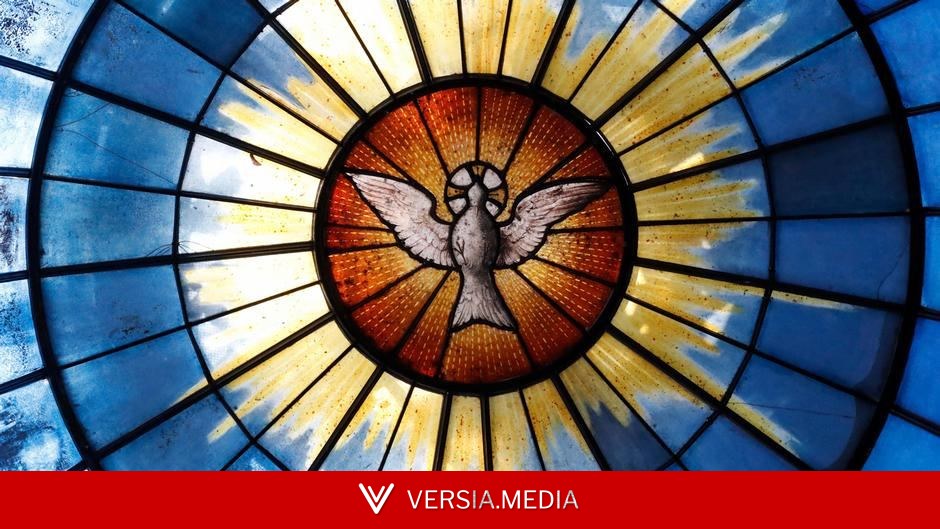
Certain Baroque churches in Austria, southern Germany, and France also feature openings in their ceilings, though much smaller than the Pantheon's oculus, known as "Holy Ghost Holes," which represent the descent of the Holy Spirit. Along with rose petals, some churches lower a dove figurine through the hole during Pentecost services, the dove being the primary symbol of the Holy Spirit in Christian tradition.
These customs are efforts to make the abstract ideas behind Pentecost more comprehensible. This abstract nature may be one reason it is less widely recognized than other Christian holidays.
"It's a festival where there's nothing tangible. How do you describe a ghost?" said Hofmann. "Christmas is very concrete: A child is born. That's familiar; we've experienced that in our families. Resurrection is harder, but the egg helps us a little, new life. But a spirit, how do you explain that?"
### Small but Significant Gifts
Furthermore, Pentecost is not linked to secular traditions that would easily lend themselves to commercialization. "There's a humorous saying that the gifts are the smallest at Pentecost," noted Hofmann. No Easter Bunny, no Santa Claus — it's simply the "gift of the Holy Spirit."
Hofmann's church has for years observed the holiday with an ecumenical celebration involving several different Christian denominations. It includes a religious service followed by, in typical German style, coffee and cake, and grilled sausages.
For her, the event embodies the "miracle of understanding" behind Pentecost: "I don't have to become like you. I don't have to speak your language for us to understand each other, but I can hold on to what's important to me, where I feel comfortable, where I am at home. And yet we can still come together. […] I think it's also a miracle that people draw closer and understand each other, despite all their differences."
In these deeply polarized times, those gifts may be the most vital ones.
Edited by: Elizabeth Grenier