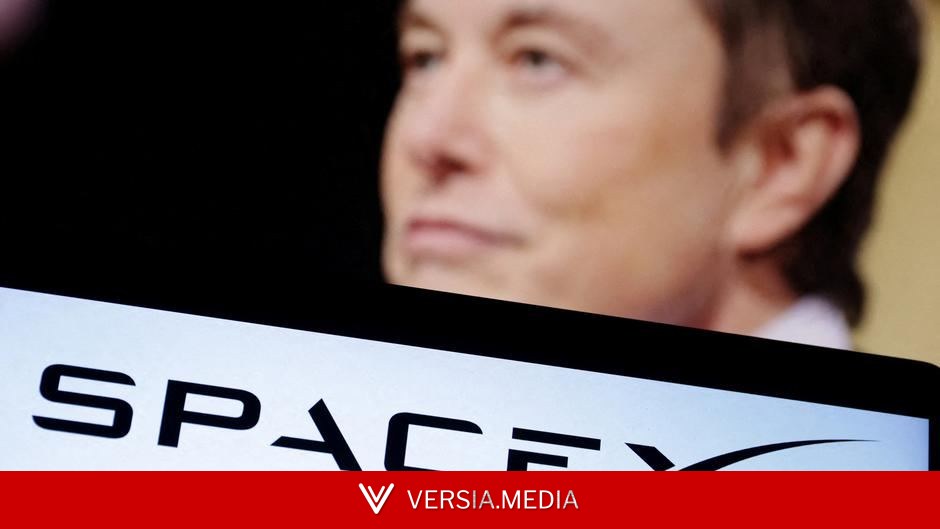
SpaceX Set to Launch Record-Breaking Public Offering, Sending Elon Musk's Fortune Skyward. DW examines whether the company's extraordinary goals are genuinely groundbreaking or simply another financial sinkhole for investors.
Elon Musk has a track record of transforming science fiction into tangible reality. The billionaire's enterprises—from reusable rockets to self-driving cars and humanoid robots—frequently accomplish what was previously deemed unattainable. With SpaceX's initial public offering (IPO), he is targeting even more ambitious milestones.
After remaining intensely private for 24 years, the company is now preparing to list publicly. In a lengthy S1 filing submitted to US regulators on Wednesday, SpaceX intends to raise approximately $75 billion (€64.5 billion) from new investors, giving the company a potential valuation of up to $1.75 trillion.
That is an impressive figure for a firm that continues to operate at a loss and one that Musk—already the wealthiest individual globally—will effectively retain control over.
Mars colonization, asteroid extraction, orbital AI data hubs
Musk envisions SpaceX doing far more than simply ferrying astronauts into orbit. He aims to develop the infrastructure needed to ensure humanity's survival beyond Earth. Musk has stated that the overarching objective is to establish self-sufficient cities on Mars capable of housing up to one million people.
To realize this, SpaceX plans to deploy Starship—its massive reusable spacecraft—for the first uncrewed missions by 2030. The one-way trip to the Red Planet spans an average of roughly 140 million miles and takes between six and nine months. These initial expeditions will test landing mechanisms and begin constructing basic facilities, with crewed journeys following several years later.
SpaceX also intends to leverage resources on celestial bodies closer to Earth to support humanity's multi-planetary expansion. Musk believes that asteroids, which travel through space on shifting trajectories, could eventually be mined.
The near-zero gravity on asteroids makes landing and extracting materials significantly easier and cheaper. However, analysts in the space industry have predicted that large-scale asteroid mining of platinum, nickel, gold, and ice (water)—all essential for sustaining life, building habitats, and producing fuel on Mars—will not be realized until the 2040s or beyond.
A critical initial milestone, however, will be the moon, which is just a three-day journey from Earth. SpaceX envisions building habitats, factories, and fuel depots on the lunar surface—a far more cost-effective option than launching vast quantities of materials from Earth.
Orbital data centers: Breakthrough or catastrophe?
To view this video please enable JavaScript, and consider upgrading to a web browser that supports HTML5 video
Musk also contends that space offers a solution to one of the most significant challenges facing artificial intelligence (AI): the immense power and cooling demands of massive data centers required to process billions of user requests simultaneously.
Rather than constructing additional energy-intensive facilities on Earth, SpaceX has proposed placing giant AI supercomputers in orbit on extensive satellite arrays.
These orbital data centers could harness unlimited sunlight for energy and the cold vacuum of space for free cooling, making large-scale AI training far more affordable and efficient than on our home planet.
Irremovable Musk—the world's first trillionaire?
If SpaceX's ambitions aren't already audacious enough, the IPO's plans to elevate Musk—already the world's wealthiest person—are truly extraordinary.
Musk currently holds an estimated 42% of SpaceX. At the targeted $1.75 trillion valuation, his stake alone would be worth approximately $735 billion. Combined with Musk's holdings in Tesla, xAI, and other ventures, the IPO would likely push his total net worth past the $1 trillion mark, making him the first trillionaire in history.
A special dual-class share structure grants Musk over 80% of voting power despite owning a much smaller portion of SpaceX equity. This arrangement effectively makes him impossible to remove as CEO, allowing him to pursue long-term, high-risk projects without pressure from short-term investors or activist shareholders.
Musk's ironclad control has drawn criticism before, most notably at Tesla, where shareholders sued over his massive compensation packages and potential conflicts of interest, arguing the board lacks genuine independence. Similar concerns have emerged regarding his control of the social media platform X, where decisions such as major layoffs and strategic shifts were made by him.
The blockbuster listing will also generate enormous wealth for early backers and executives. According to the Financial Times, SpaceX President Gwynne Shotwell and CFO Bret Johnsen would see their shares exceed $1 billion in value. Longtime investor Antonio Gracias could be sitting on $70 billion or more, while PayPal co-founder Luke Nosek's stake would be worth around $5 billion.
Record float, Wall Street's boldest wager
Wall Street is preparing for what could be the largest IPO in history, with Goldman Sachs serving as the lead underwriter.
If SpaceX does secure an additional $75 billion in funding, it would be nearly triple Saudi Aramco's previous record of approximately $29.4 billion in 2019. Before that, Alibaba's US listing was the largest share offering, raising $22 billion in 2014.
A $1.75 trillion valuation would place SpaceX among the Top 10 largest public companies globally, alongside Nvidia, Apple, Google owner Alphabet, and Microsoft.
This would represent a massive leap of faith by investors, as SpaceX remains deeply unprofitable, reporting a $4.94 billion net loss in 2025 due to heavy investments in Starship, satellite deployment, and AI resources.
Given the enormous hazards of operating in space, along with rapidly advancing AI, the IPO filing outlines the very real dangers SpaceX faces. These include "a unique range of space-related risks," including "radiation from solar and cosmic sources; micrometeoroids and orbital debris," and "human injury or death."
Wednesday's filing also warns: "We have a history of net losses and may not achieve profitability in the future."
The sky-high valuation has some analysts questioning whether SpaceX's ambitions are more fanciful than scientific—a debate that will only intensify once trading begins on the Nasdaq next month.
Edited by: Srinivas Mazumdaru