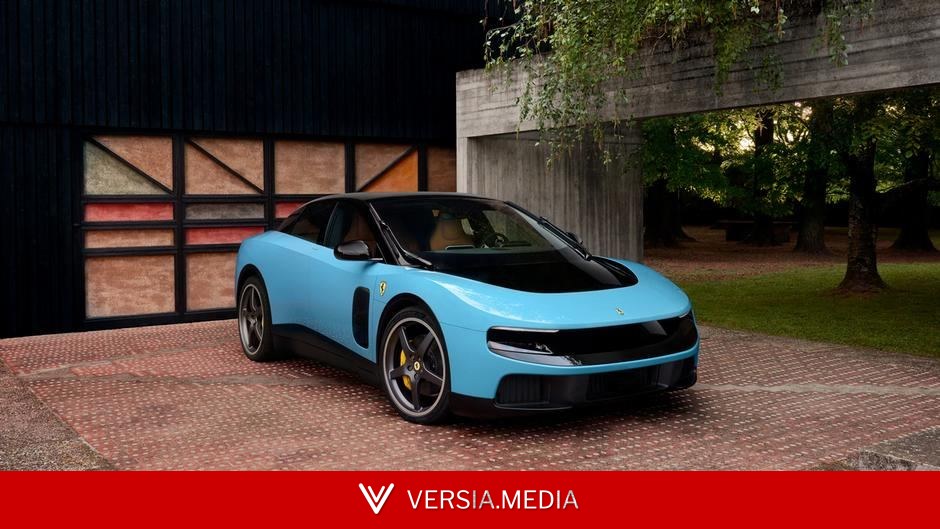
The Italian supercar manufacturer has unveiled images of what will be both its first fully electric vehicle and its first car capable of seating five people. The Luce targets a younger demographic and the increasingly competitive Chinese market.
Ferrari presented its first all-electric car to journalists in Rome this week, a four-door, five-seater model named the "Luce," developed with assistance from former Apple design chief Jony Ive and his collective LoveFrom.
The initial units of the Luce, which translates to "light" in Italian, are expected to be ready for delivery starting in the fourth quarter of 2026, with a price tag around €550,000 (approximately $640,000).
The unveiling occurs during a challenging period for automakers and their electric mobility strategies. Several manufacturers, including Ferrari, are scaling back their electrification targets due to factors such as headwinds in the major US market and rapidly intensifying competition from domestic producers in China.
That said, it also comes as the conflict in Iran and subsequent pressures on fuel prices serve as a reminder of some of the advantages of EVs.
How did observers and the market react?
The initial market response was one of skepticism.
When trading resumed in Italy on Tuesday morning after the Pentecost or Whitsun bank holiday, Ferrari's share price immediately dropped by around 6%, a loss of approximately €3.7 billion in market capitalization.
The stock more or less stabilized after the initial plunge.
However, at least based on some social media reactions, many people took more issue with the car's exterior styling and aesthetics than with its all-electric drivetrain or the strategic message it may or may not represent for Ferrari.
What did Ferrari say about the new Luce?
Ferrari F1 drivers Lewis Hamilton and Charles Leclerc, just back from Sunday's race in Montreal, Canada, unveiled the car at the event in Rome.
The launch occurs as Porsche, Honda, and to some extent Ferrari are looking to moderate their targets for transitioning to electric vehicles.
But as CEO Benedetto Vigna noted, given the long R&D timelines in the industry, "it's the result of five years of work."
EVs back in the fast lane as oil prices surge
To view this video please enable JavaScript, and consider upgrading to a web browser that supports HTML5 video
Still best known for sleek high-performance two-seaters with loud multi-cylinder petrol engines, Ferrari is hoping its first ever five-seater with a spacious boot (or trunk) will give it an opportunity to compete in markets like China, where EV adoption is already widespread and large combustion engine cars face heavy taxes.
"In our client base there are many ... who are still looking for something completely different, to be used in different moments of life," said Ferrari's chief marketing and commercial officer Enrico Galliera.
Vigna has also stated he expects half of the Luce orders to come from new clients.
What are some of the Luce's performance figures?
Despite the 2.2-ton car's weight, it still promises prancing horse performance, at least in a straight line and possibly in corners as well.
Four electric motors, one for each wheel, deliver more than 1,000 horsepower and also enable variable power delivery to enhance handling and cornering.
Ferrari says the Luce will reach a top speed of 310 kilometers (192.6 miles) per hour. As with all EVs, straight-line acceleration is rapid, with the car able to go from 0 to 100 km/h in 2.5 seconds.
The massive 122 kWh battery, accounting for a significant portion of the car's weight, provides a theoretical range of over 500 kilometers, according to Ferrari. At a fast charging station, the carmaker says it can charge from 10% to 80% in between 20 and 25 minutes.
Ferrari is attempting to preserve a traditional sound, however, by amplifying natural vibration noises from its EV powertrain in an effort to offer more acoustics in the cabin.
The glass-focused design aims to let in as much Luce, or light, as possible. But Ferrari has taken a more traditional automaker approach in the battle with Tesla and several Chinese EV makers, favoring multiple physical controls and dials in the cockpit over the all-digital touchscreen-driven methods of some of the more modern competition.
US turns its back on EVs
To view this video please enable JavaScript, and consider upgrading to a web browser that supports HTML5 video
Edited by: Dmytro Hubenko
Don't let the algorithm hide the news. If you rely on our team for trusted reporting, please take a moment to select us as your Preferred Source on Google by clicking here and hitting the "star" or "preferred" button, so you'll always see our verified news first.
Your feedback