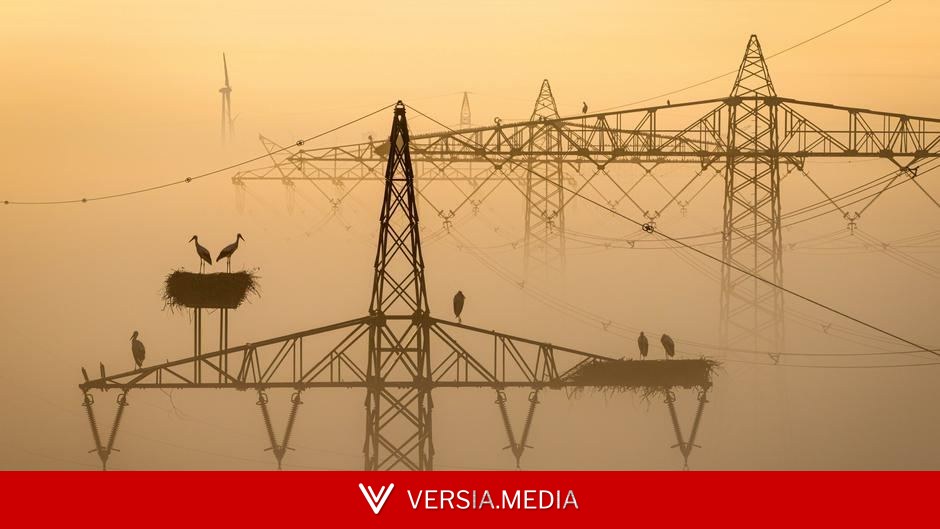
Solar and wind power generate large amounts of electricity — but not necessarily at the most convenient moments. Expanding battery storage capacity could assist Europe in stabilizing energy prices and replacing polluting fossil fuel sources, though obstacles remain.
During daylight hours, when wind speeds pick up and sunlight is strong, the electricity supply in Germany and various other European nations often exceeds demand.
Yet a lack of sufficient battery storage means this energy cannot be saved for later use. After sunset, natural gas plants are frequently required to fill the gap.
This situation must change if Germany aims to achieve climate neutrality by 2045. Large-scale storage systems for green electricity are vital for maintaining stable power prices and enabling a complete shift to renewable energy.
The European Union, which has established its own climate-neutral target for 2050, currently produces roughly half of its electricity from renewable sources. Across Europe, existing large-scale storage facilities have a combined capacity of around 14 GW, according to figures from the European Commission's Joint Research Centre.
In recent years, this expansion has picked up speed significantly: an additional 84 GW of large-scale storage capacity — a sixfold increase — is currently in the planning or construction stages and is anticipated to become operational within the next few years.
This trend reflects a global pattern, according to research firm Bloomberg New Energy Finance. A recent analysis indicated that the most rapid growth in large-scale storage facilities is expected in Asia, particularly in China and India. In Europe, both Germany and Italy, nations with considerable renewable energy production, are also key markets for new storage.
Part of this swift growth is due to declining costs. Over the past few years, the price of lithium-ion batteries has fallen by roughly 20% annually. By 2030, according to an EU forecast, battery costs are expected to drop by half compared to 2022 levels.
When smaller, private storage systems and large-scale facilities are combined, the capacity in the EU has increased tenfold since 2022. However, to meet the bloc's climate objectives, that figure would need to rise by another factor of 10, reaching around 750 GW — a target that remains distant.
Investment in batteries can help keep power prices stable
The cost of renewable energy is particularly low during the day, sometimes even falling below zero, often due to the excess power generated by wind and solar. This leads some renewable plants to be temporarily taken offline to compensate, reducing profits for energy producers.
When gas and coal power plants come online in the evenings to compensate for the energy shortfall, this drives prices back up, explained Dirk Uwe Sauer, a professor and storage systems expert at Germany's RWTH Aachen University.
"If we look at these prices, for example, from last year, we see that around midday the average price of electricity was not much more than €0.03 ($0.04)," he told DW. "In the early evening, it was closer to €0.18."
This significant difference has made investing in battery storage technology attractive from an economic perspective — especially at a time when natural gas costs have surged due to the conflicts in Ukraine and Iran.
Sauer noted that each additional storage unit can help reduce price spikes, benefiting both the renewable energy industry and individual consumers. Until recently, the expansion of renewables in Europe has been hindered by a slow approval process, lengthy planning phases, and major difficulties connecting battery storage to the grid.
Better batteries key for energy transition
"Every year, we spend around €80 billion to import energy from abroad. That's a major dependency, and renewable energy could help us break free from that," said Sauer. For this to happen, he added, the buildout of battery storage facilities and electricity grids must be viewed as a whole.
"Alongside wind and photovoltaic facilities, we have to build local power grids to distribute power directly and storage facilities to keep it for later. Both are absolutely essential," he said.
However, part of the issue lies with Europe's existing electricity grid. Many systems are over 40 years old, and most are not designed to handle large amounts of green electricity and transport it where it's needed. Grids in Germany, and across Europe, need to be modernized and linked to wind parks, solar farms, and storage facilities.
The European Commission has previously stated that the EU would need to invest around €580 billion ($675 billion) to upgrade its grids by 2030. But progress has been inconsistent, even in Germany. The federal government has been planning to build some 16,000 kilometers (10,000 miles) of power lines for years; currently, only 20% is operational. However, the permitting process has recently been streamlined to accelerate the process. Though investment in improved grids is picking up, the €580 billion goal appears unlikely. Data from the European Union Agency for the Cooperation of Energy Regulators shows an injection of some €35 billion in 2024; by 2027, that is expected to reach €47 billion.
EU working to secure future of electricity
Industry analysts do not expect the ongoing war in Iran to have a major impact on the growth of the battery sector and grid expansion, despite global energy instability.
Bloomberg BNEF reports that the three-month-old conflict has so far had minimal effect on the battery storage market, most of which is based in China. The war has pushed electricity prices up, with shipments of fossil fuels stuck in the Strait of Hormuz, which could mean short-term profits for battery storage facility operators. But Sauer said that alone was not enough to support sustainable growth in the sector.
"Temporary crises [such as Iran] are generally not a good basis to make investment decisions on products that will be in use for many years," he said. And despite an increase in investment, he still sees signs of uncertainty in the market.
By the time large-scale facilities being planned today are actually built and connected to the grid, the Iran war and the energy crisis will be long over, said Sauer. That is why governments needed to set long-term goals. "Electricity grids are built for the next 40 or 50 years."
Just as important for EU member states, alongside political will, is access to lithium and other metals needed for battery production. The bloc has been prioritizing the development of its strategy for raw materials, supporting domestic production of rare earths, reducing dependence on China, and developing secure supply chains. Additionally, the EU wants to promote the recycling of critical raw materials like lithium, nickel, gallium, and cobalt.
This article was originally written in German.
Pakistan's solar boom shields some from energy shocks
To view this video please enable JavaScript, and consider upgrading to a web browser that supports HTML5 video
Your feedback