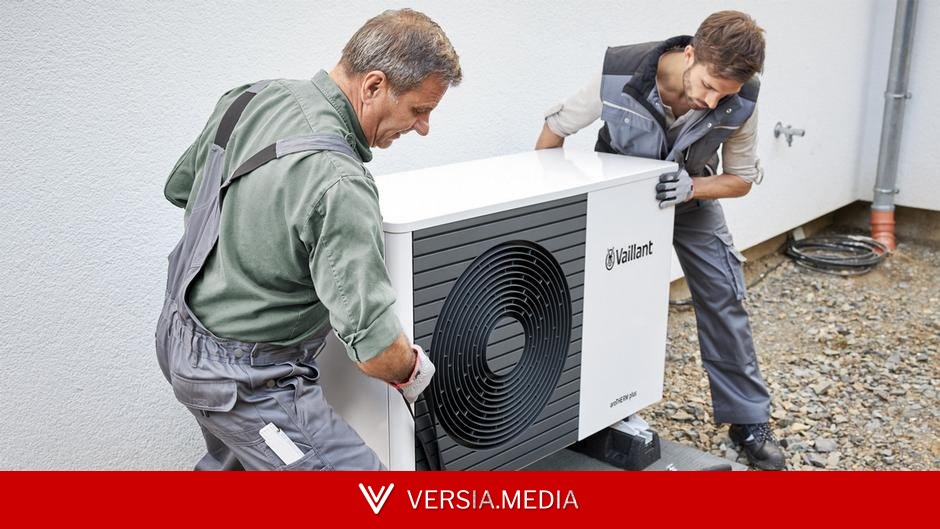
The conflict in the Middle East is endangering fossil fuel supplies and driving up energy prices in Germany. Could this lead to a spike in demand for heat pumps?
Germany's coalition government, comprising the Christian Democrats (CDU) and Social Democrats (SPD), is attempting to overturn a key provision of the heating law introduced by the prior administration.
The original legislation mandated that all heating systems installed in the coming years must derive at least 65% of their energy from renewable sources.
Under the new proposals, however, oil and gas heating systems with significantly lower proportions of climate-friendly gases would still be permitted in existing structures for an extended period. The cabinet approved the plan based on a draft bill submitted by Building Minister Verena Hubertz (SPD) and Economy Minister Katherina Reiche (CDU).
Under the proposed legislation, new heating systems would only be required to use a minimum of 10% renewable energy.
Why heat pumps are all the rage
To view this video please enable JavaScript, and consider upgrading to a web browser that supports HTML5 video
Adviser: 'Impractical piece of legislation'
The new legislation, referred to as the "Building Modernization Act," is designed to replace the current "Heating Act." The government aims to push it through parliament before the summer recess in mid-July.
Many observers believe this timeline is far too ambitious, especially given that the draft law has sparked not only support but also intense criticism.
One of the most prominent critics is the National Regulatory Control Council (NKR), an independent advisory body to the German government.
Its chairman, Lutz Goebel, described the draft bill in remarks to the newspaper Bild as "one of the weakest and most impractical pieces of legislation presented to the National Regulatory Control Council in recent years."
He stated that portions of the text were "barely comprehensible" and cautioned that difficulties with implementing the law were probable. According to Goebel, "laws like this contribute to growing frustration among citizens toward the state and politicians."
New heating law to reduce rigid rules
Others have defended the proposal. Carsten Rolle, who oversees energy, mobility, and environmental issues at the Federation of German Industries (BDI), said the "Building Modernization Act is better than its reputation," according to a press release.
Peter Adrian, president of the German Chamber of Industry and Commerce (DIHK), also called the draft law "overall a step in the right direction." He noted that it would reduce rigid requirements and provide companies "more flexibility on the path toward climate neutrality in the building sector."
Frederik Lippert of heating systems manufacturer Vaillant stated that "some of the changes could help calm the debate." This includes eliminating the 65% rule, which many in the market perceived as a form of coercion.
Is the new law a climate policy failure?
For Julius Neu of the German environmental organization BUND, the proposed law amounts to "a declaration of bankruptcy in climate policy."
"By abolishing the 65% rule, the most effective instrument of the heating transition is being scrapped," he told DW. He argued that this would "artificially prolong fossil-fuel technologies and leave people trapped by rising gas costs."
Manufacturers of heat pumps share that criticism.
"The federal government is drastically lowering the requirements for new heating systems from 65% renewable energy to initially just 10%," Katja Weinhold, spokesperson for the German Heat Pump Association, told DW. "In light of the crisis in the Middle East and its impact on energy prices, Germany's energy security, and climate targets, this sends entirely the wrong signal."
A spokeswoman from the communications department at Robert Bosch GmbH said the industry, above all, needs planning certainty.
"To achieve final clarity, it is crucial to complete the legislative process quickly," she said. "The same applies to subsidies — reliability is essential for them to have the desired effect."
Weinhold argued that the current debate should focus less on political targets and more on which solutions make technological and economic sense. Heat pumps, she said, are "an energy-efficient and high-quality technology that can make heating cleaner, cheaper and more independent in the long term."
She said consumers need clear and easy-to-understand information about the long-term risks associated with fuel availability and rising energy costs. At the same time, stable subsidy programs are essential to encourage investment in modern, future-ready heating technologies, she pointed out.
New tech and big ideas for the green energy transition
To view this video please enable JavaScript, and consider upgrading to a web browser that supports HTML5 video
A boost for renewable energy in Germany?
Heating systems manufacturer Vaillant remains broadly optimistic, according to Frederik Lippert: "We expect the transformation of the heating market to continue even under the new law."
He added that current geopolitical developments are likely to accelerate the trend. The Iran conflict and the disruption of shipping through the Strait of Hormuz, he said, have once again exposed how heavily Germany and Europe still rely on fossil fuel imports. As a result, demand for renewable energy — including heat pumps — is expected to continue rising.
Julius Neu of the environmental organization BUND shares that view: "One hopes that the current energy crisis linked to the Iran conflict will encourage many people to choose heat pumps despite this irresponsible draft legislation."
This piece was originally published in German.