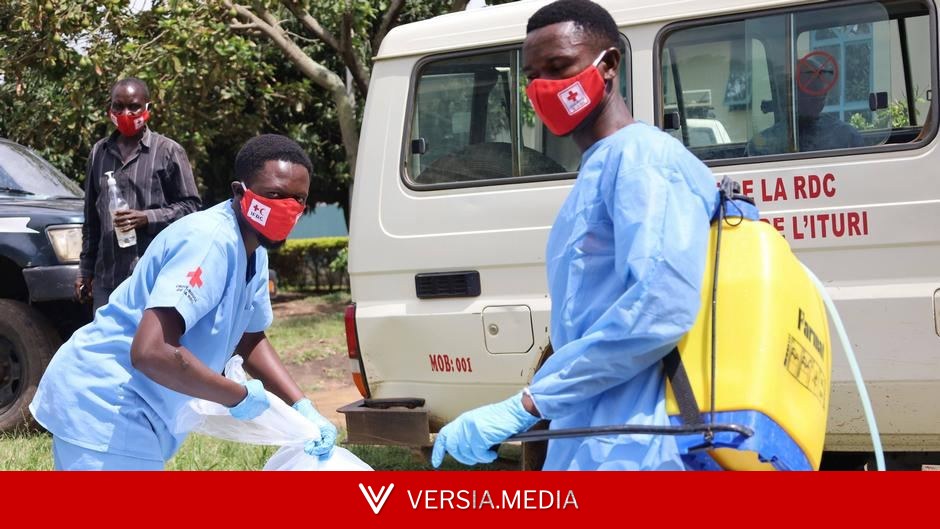
The virus is transmitted through direct person-to-person contact. However, what makes it particularly deadly is that it survives in human remains, and funeral rituals often occur precisely when bodies are at their most contagious.
A fresh Ebola outbreak is spreading in the Democratic Republic of Congo. Genetic data indicates it had been circulating for weeks, possibly months, prior to being identified. The strain is currently active, and much regarding its particular behavior remains unknown.
Comprehending why the virus spreads in the way it does starts with how it enters the body. Unlike respiratory viruses that are airborne, Ebola requires a more direct method.
How Ebola virus enters the body
The virus requires direct entry via mucous membranes in the mouth, nose, or eyes, or through cuts and wounds on the skin. Unbroken skin acts as a barrier, but any break becomes an entry route.
David Heymann, an epidemiologist at the London School of Hygiene and Tropical Medicine who first studied Ebola in 1976, describes transmission in realistic terms: "The Ebola virus is spread from person to person by body fluids. So that means by blood, by saliva, possibly by feces, by urine, and also we now know in persons who are recovered through the semen."
The virus targets these particular pathways because they offer direct access.
Infected individuals release enormous quantities of virus in these fluids.
Healthcare workers managing bodily excretions without protection are at heightened risk.
Family members tending to sick relatives during the late stages of illness, when viral load is highest, are also extremely vulnerable.
WHO chief warns of Ebola epidemic
To view this video please enable JavaScript, and consider upgrading to a web browser that supports HTML5 video
What happens inside? A systemic attack
The virus does not strike indiscriminately.
Bodo Plachter, professor of virology at the University of Mainz in Germany, clarifies the process: "The virus will always replicate at the site of entry in the lymph nodes, but then it spreads throughout the body and gets carried away by cells through the bloodstream to different organs."
Critically, it first targets the body's immune defenders—the very cells intended to identify and destroy intruders. Once these are incapacitated, the immune system is unable to mount a defense.
The outcome is devastating: the viral load becomes immense, and healthcare workers and family members are exposed to exceptionally high concentrations of infectious material.
Symptoms: How the disease progresses
Heymann, who has observed Ebola both clinically and epidemiologically for decades, describes a disease that conceals itself.
The early symptoms are nearly indistinguishable from common illnesses.
He explains: "The initial signs and symptoms are like any other minor disease, like a cold, an infection, even like malaria. Then, in some instances, people begin to feel better. After that, they then begin with a hemorrhagic disease where blood begins to ooze out from different body orifices."
That apparent recovery is the trap. By the time the disease is definitively diagnosed, patients are at the peak of infectiousness. "The people who are most infectious are the people who have the most virus in the solution or the body fluid that infects. So, if there's blood contamination of a person who's dealing with a patient, that will be full of virus," he says.
This timing creates a critical vulnerability: healthcare workers and family members face the highest exposure precisely when the diagnosis becomes certain.
Why Ebola remains infectious after death
Death does not neutralize the virus. When an individual dies from Ebola, their corpse contains elevated levels of viable virus. Bodily substances such as blood, tissue fluid, and gut secretions remain present. The body thus stays moist, especially in warm and humid climates.
Heymann describes what occurs: "There's a ritual of cleaning the body and doing other things."
"And that virus is present in the body secretions and solutions that people may come in contact with," he adds. "And usually, the body is still quite warm, and the virus is still living."
The virus persists as long as it stays moist within bodily fluids.
On the molecular level, Plachter describes a virus as a complex structure of multiple macromolecules held together by moisture. "If somebody dies, there is enough fluid still available, so the virus is stable inside the body."
This is why the timing of funeral practices is significant. In parts of West Africa, families wash and handle bodies within days of death—the period when the virus remains most hazardous.
One Health: Pandemic prevention research in Africa
To view this video please enable JavaScript, and consider upgrading to a web browser that supports HTML5 video
What comes next in the disease outbreak
This outbreak is challenging to contain. People moving across borders spread the virus to other nations, while traditional burial practices involve contact with infectious corpses.
Heymann explains: "It will be very difficult to stop because of the mobility of people, because of the misunderstanding about burial and the violence that's occurring, because of civil war, and because of just lack of trust of the people in the area of outsiders."
The "misunderstanding about burial" is tied to specific customs. Safe approaches exist: gloves and masks, along with careful handling and washing of bodies. These require community acceptance and the involvement of local leadership.
History provides a counterexample. In 1977, the second Ebola outbreak in Congo was contained when a physician recognized it early and isolated the patient correctly. No additional cases occurred.
However, the current situation is more complex. The outbreak is taking place in regions with considerable population movement and ongoing conflict.
Research itself is limited. The virus can only be safely studied in high-level biosafety laboratories, of which there are very few globally. For this outbreak strain, key questions remain unanswered.
Both experts emphasize what matters: early detection, proper infection control, and community understanding. But in areas with mobility, conflict, and distrust, achieving all three simultaneously could be exceedingly difficult.
Bundibugyo Ebola: New vaccines and treatments still months away
There is a new complexity to this outbreak: the vaccines that have previously been effective against Ebola do not work on this strain. The cases in Congo involve Bundibugyo, a form of the virus distinct from earlier variants. The approved vaccines—Merck's Ervebo and another developed for the Zaire strain—were designed to target different versions of the virus.
The WHO is considering whether to use Ervebo anyway, despite minimal evidence it works against this strain.
Treatment options currently appear little better, with no approved drugs existing for Bundibugyo.
But there is progress: Oxford University and India’s Serum Institute are developing a vaccine using COVID-vaccine technology. Human trials could potentially begin within months.
Additionally, scientists in China are testing an experimental mRNA vaccine designed to work against multiple Ebola strains simultaneously, including Bundibugyo.
Despite the progress, however, it could be months or even years until effective vaccines are developed.