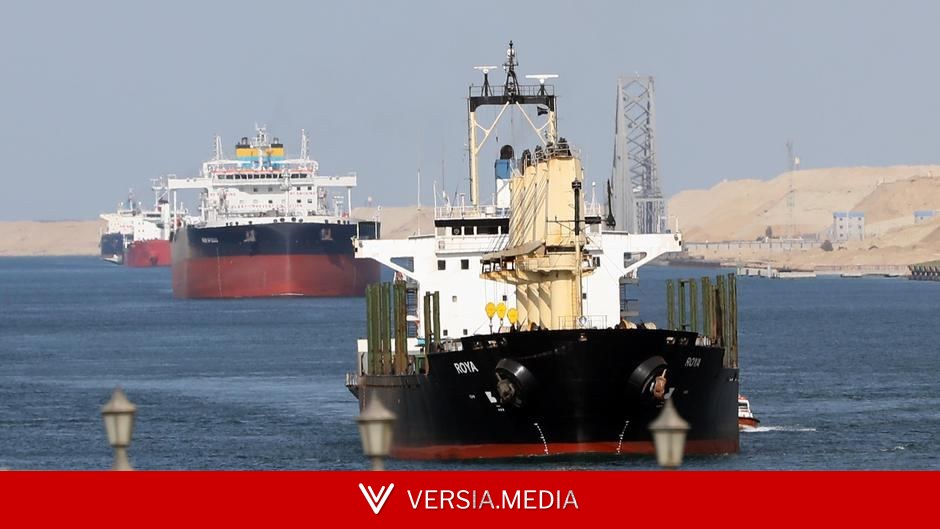
Iran has faced widespread criticism for demanding up to $2 million per vessel to transit the Strait of Hormuz. DW examines why Egypt can impose fees for the Suez Canal and Panama for its waterway, but Iran cannot.
The Iranian government has been accused of extortion and threatening global energy security following reports that Tehran has started charging up to $2 million (€1.7 million) per ship for "safe passage" through the Strait of Hormuz.
The strait, the world's most critical energy corridor located between Iran and Oman, carried one-fifth of all oil and gas consumed globally prior to the Iran war.
Iran's administration has justified these fees as war reparations for damage caused by US-Israeli attacks on the country, as well as payment for "navigational services," environmental protection, and enhanced security.
The government declared it was developing a joint protocol with Oman requiring ships to obtain permits before crossing the strait.
While some Asian shipping companies and smaller operators have quietly paid up, major global players are refusing to do so. The Institute for the Study of War (ISW) think tank labeled the charges a maritime "protection racket."
The United States and China agreed on their joint opposition to the levy, Reuters news agency reported earlier this month, citing a US State Department official. Gulf nations have also rejected the move.
Maritime experts maintain there are valid reasons why Iran cannot impose fees in Hormuz, while other vital chokepoints—such as the Suez Canal and Panama Canal—levy similar tolls for passage through their waterways.
Can Iran control flow of data along with flow of oil?
To view this video please enable JavaScript, and consider upgrading to a web browser that supports HTML5 video
What are the rules for straits?
Under international maritime law, natural straits used for shipping are governed by a specific set of rules aimed at protecting global trade and freedom of navigation.
The United Nations Convention on the Law of the Sea (UNCLOS) grants vessels—and aircraft—from all nations the right of so-called transit passage through international straits that connect two parts of the high seas.
To qualify for transit passage, a vessel must move through the strait without delay and without anchoring, except in emergencies.
These transits must be permitted without interference from the coastal state, according to UNCLOS rules.
Coastal states can only charge limited service fees, such as for pilotage and towing.
Why can canal operators charge fees?
Canals like Suez and Panama are man-made waterways constructed, owned, and maintained by sovereign states at significant expense.
Egypt generates annual revenues of around $4 billion in fees for ships transiting the 193-kilometer (120-mile) Suez shortcut.
The 1888 Constantinople Convention, signed by major powers at the time, explicitly allows the Egyptian government to levy tolls to cover maintenance, operations, and upgrades.
Meanwhile, the Panama Canal Authority, which operates the US-built canal on behalf of Panama, is also permitted to charge fees under separate treaties.
Completed in 1914 to connect the Pacific and Atlantic Oceans, the Panama Canal requires extensive ongoing maintenance, including constant dredging to address sedimentation and landslides.
Both canal operators typically charge less than half the fees that Iran is reportedly imposing.
Are there any exceptions?
Grey areas do exist where fees can be charged for passage along straits and even oceans.
Russia, for example, imposes icebreaker escort fees, pilotage, and service tariffs on the Northern Sea Route (NSR) along the country's northern coast.
The NSR offers a much shorter route between Europe and Asia than the Suez Canal. It runs through the Arctic Ocean, linking the Atlantic to the Pacific via the Barents Sea and Bering Strait.
The route is primarily used in summer when the ice melts and is frequently transited by ships from Russia, China, and South Korea.
Moscow treats large sections as internal waters or ice-covered areas under UNCLOS Article 234.
Canada has similar sovereignty claims over the Northwest Passage, a sea route through the Canadian Arctic Archipelago linking the Atlantic and Pacific Oceans. From time to time, the Ottawa government considers charging fees, only to face US opposition.
Another long-standing example is the Turkish Straits. The Bosporus and Dardanelles, which connect the Black Sea to the Mediterranean through Turkey, are governed by the 1936 Montreux Convention.
Under this treaty, Turkey must allow freedom of passage for merchant ships and can only charge limited service fees for navigation aids and lighthouses, not full transit tolls.
How is this dispute likely to play out?
The Hormuz charging dispute remains a major obstacle in ongoing peace talks between the US and Iran aimed at reopening Hormuz.
Washington insists the strait must fully reopen as international waters, allowing ships from all nations to pass without Iranian control, fees, or special permission.
"The Strait is going to be open to everybody; it's international waters," US President Donald Trump told reporters during a White House cabinet meeting on Wednesday. "We'll watch over it, but nobody's going to control it."
He also criticized Oman's apparent involvement in Tehran's plans, stating: "Oman will behave just like everybody else, or we'll have to blow them up."
Washington continues to urge shipping companies not to pay the tolls and has warned that firms that do could face secondary US sanctions for doing business with Iran.
While the broader US naval blockade of Iranian shipping remains in effect during negotiations, the US and the United Nations are working on a plan to protect shipping once the war is over.
This includes the use of multinational naval patrols, increased monitoring, and demining operations in the strait.
Edited by: Rob Mudge
Your feedback