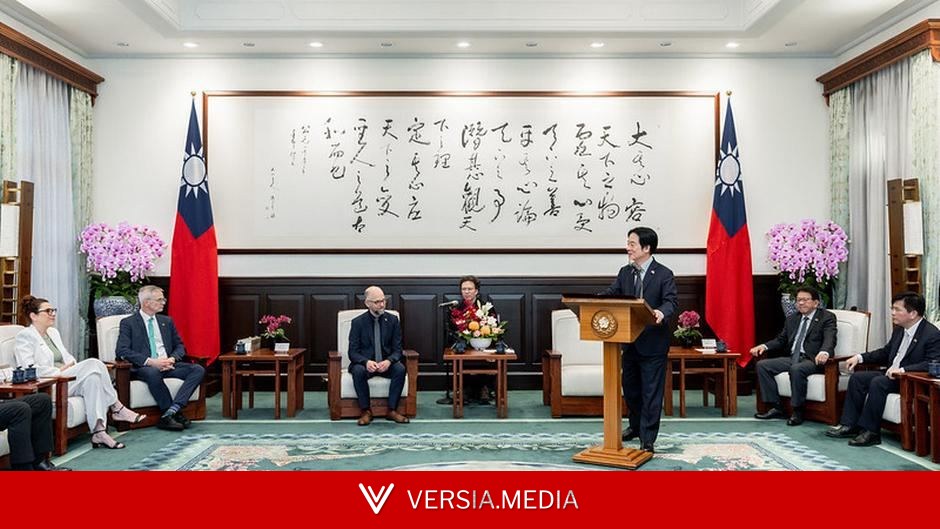
A German delegation, the Berlin-Taipei Parliamentary Friendship Group, recently made a trip to Taiwan, which has drawn condemnation from Beijing. Two lawmakers informed DW that the visit was crucial for expanding economic collaborations.
While German Economic Affairs Minister Katherina Reiche is in Beijing on an official visit, a delegation from the Bundestag, Germany's lower parliamentary chamber, is currently in Taiwan.
The Berlin-Taipei Parliamentary Friendship Group, a cross-party coalition of legislators dedicated to fostering international exchanges, has traveled there to "bolster economic and cultural cooperation with one of the region's most significant democratic allies," according to a statement from the Bundestag.
Till Steffen from the Green Party is heading the five-person delegation, which also includes lawmakers Klaus-Peter Willsch and Markus Reichel from Chancellor Friedrich Merz's conservative Christian Democratic Union (CDU), along with Rainer Kraft from the far-right Alternative for Germany (AfD) and Mandy Eissing from the Left Party.
The nine-day trip has provoked objections from Beijing. Chinese Foreign Ministry spokesperson Mao Ning stated that China has consistently opposed any form of official interaction between its diplomatic partners and Taiwan.
Beijing regards self-governing Taiwan as a breakaway province that will eventually be "reunified" with the mainland.
German lawmaker brushes off Beijing's criticism
"It is in Germany's interest to maintain a balanced situation and not rely exclusively on China," said delegation head Steffen. Economic reliance on China—such as in electric vehicle batteries—has placed Germany in a tough spot, he added.
"It is fine to conduct business with Beijing, but we must not become dependent on China," Steffen remarked. "That's why it's essential to simultaneously nurture close ties with other nations. Therefore, it is positive that we are undertaking a joint research initiative with Taiwan on future battery technology."
The AfD's Kraft noted that prior to Germany's reunification in 1990, China maintained diplomatic relations with both the Federal Republic of Germany (FRG) and the German Democratic Republic (GDR) concurrently.
Although Germany does not have formal diplomatic ties with Taiwan, it sustains economic, cultural, and research connections with the island.
Kraft also underscored the economic angle.
"It is highly important for Germany to be a partner to Taiwan," he told DW. "Taiwan is a global frontrunner in the semiconductor industry. Semiconductors are vital for the future economy—for artificial intelligence and data centers. Given our economic hurdles, Germany cannot afford to pass up the chance to stay economically robust in the years ahead."
Economically intertwined
Taiwanese semiconductor giant TSMC has been constructing a new facility in the eastern German state of Saxony since 2024.
Alongside German firms Bosch, Infineon, and NXP, chips for the European market are slated for production in the city of Dresden starting in 2027.
The total investment amounts to €10 billion, which the AfD's Kraft views as a successful illustration of how Taiwanese investors are generating new, high-quality jobs in Germany.
Taiwan's President William Lai Ching-te also commended the TSMC project in Dresden.
"This milestone not only strengthens industrial collaboration between Taiwan and Europe. It also represents a contribution from Taiwan and Germany to safeguarding global supply chains and the shared set of democratic values," Lai said while welcoming the German delegation.
Lai thanked the Berlin–Taipei Parliamentary Friendship Group for its backing in assisting Taiwan to achieve broader international engagement.
"Based on its own historical experience, Taiwan, like Germany, cherishes universal principles such as democracy, freedom, and the rule of law," Lai stated.
"In light of the rapidly evolving international landscape, we recognize that the rules-based global order can only be preserved through cooperation among partners and peoples," Lai added. In doing so, he referenced mainland China and deliberately refrained from using the terms "country" or "nation."
Balancing peace and deterrence over Taiwan
Beijing has expressed a preference for "peaceful reunification," but it frequently employs threatening rhetoric and has not excluded the use of military force if Taiwan were to declare independence.
"Chancellor Merz always says: 'We want to be able to defend ourselves so that we never have to.' And that applies to Taiwan as well," said delegation head Steffen.
Merz was alluding to the heightened security threat from Russia and the United States' diminished willingness to support Europe in the event of a conflict.
"Of course Taiwan must prepare itself. But the biggest danger for Taiwan is that other nations look away. And that is precisely what we will not do," Steffen vowed in an interview with DW.
"We will not do any favors for those who seek to harm Taiwan. We will keep Taiwan in our focus, and we will collaborate with Taiwan. This will be mutually beneficial."
Germany and Taiwan have not altered their stances, he added.
"It is China that has shifted, and the United States. There is no alternative to closer cooperation across numerous areas between Germany and Taiwan."