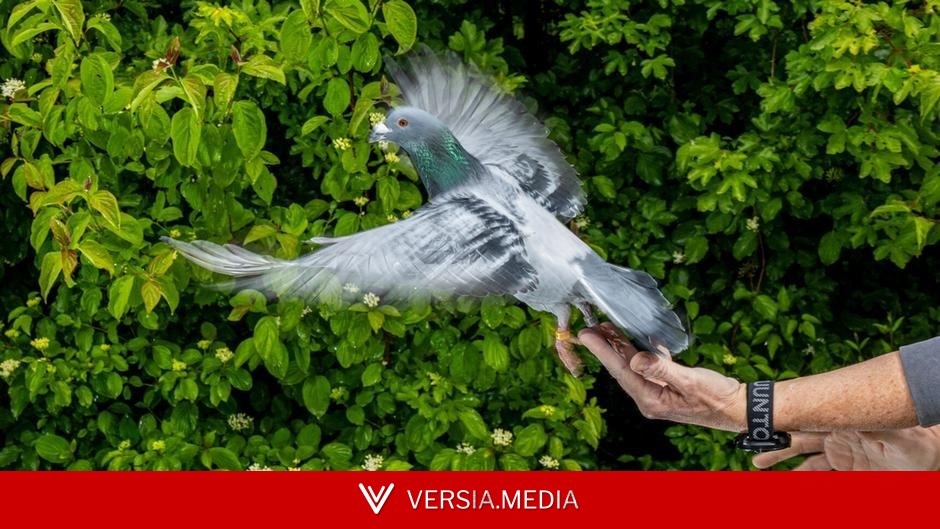
A research team in Germany has released fresh findings on how pigeons rely on magnetic fields for navigation when visibility is poor. A crucial element of the long-sought explanation may be found in an unexpected organ: their livers.
Whether by day or night, in rain or sunshine, and no matter where they are set free, trained pigeons can navigate back to their home over distances of up to nearly 1,000 kilometers (around 600 miles).
It is a capability that humans have exploited since ancient times. And for roughly a century, scientists have recognized that magnetoreception plays a role in the birds' navigational toolkit.
This week, a research team from the University of Bonn and the Max Planck Institute of Animal Behavior reported in the journal Science that a central component of the secret to homing via magnetic fields may reside in the birds' livers.
India: Meet the woman passionate about pigeon racing
To view this video please enable JavaScript, and consider upgrading to a web browser that supports HTML5 video
What did the study find?
The study notes that the "mechanisms underlying" the reception of magnetic information in the rock dove, or Columba livia, "appear to be numerous and are still being discovered."
Certain physical connections in more obvious locations—such as the beak, eyes, and brain—have already been identified.
"Here, we used physical, morphological, functional, and genomic assays to identify the presence of superparamagnetic macrophages in the liver," the researchers write.
Macrophages are immune cells that break down old red blood cells. In this process, they accumulate iron, potentially enabling them to respond to magnetic fields.
"We found that after macrophage depletion, pigeons flying under overcast conditions lacked their usual orientation capabilities," they said.
When the sun was visible, the birds' orientation remained unaffected, indicating that visual and solar-based cues served as another of the pigeons' navigation methods.
However, given the birds' inability to navigate magnetically without assistance from their livers, the researchers concluded: "We propose that in homing pigeons, superparamagnetic macrophages in the liver are required for finding magnetic direction."
What did the researchers say?
Martin Wikelski, Director at the Max Planck Institute of Animal Behavior, stated that "what looks like a 'gut feeling' in bird navigation may actually have a physical basis."
The immune cells in question are situated near nerve cells in the liver. The researchers hypothesize that this could be how they transmit information to the pigeons' brains.
"We didn't expect immune cells to act like sensors for magnetic fields at all. Our results reveal a previously unknown mechanism for magnetic perception in animals," said co-senior author of the study Christian Kurts, Director at the Institute of Molecular Medicine and Experimental Immunology at the University Hospital Bonn.
Despite their surprise that the answer appeared to lie in macrophages, the scientists knew before the study that certain organs were especially worth investigating.
"We had some clues that the liver and spleen have magnetic properties, because they break down red blood cells and so store much iron in the body," said first author Clivia Lisowski, from the University of Bonn and the University Hospital Bonn, who led the immunological work.
How homing pigeons' skills have been known and exploited for millennia
It is unclear when or how it all started, but humans have utilized pigeons' homing abilities since antiquity.
The birds and their navigational skills appear across ancient cultures, whether in the Noah's Ark story or in Greek mythology, where the birds were depicted as divine messengers linking the heavens and the earth.
Ancient Greeks used pigeons to deliver news of Olympic winners and victories in battles. The Romans employed a pigeon network to speed up communication across their vast military empire.
Even in more modern times, as technology began to replace them, pigeons' usefulness persisted.
They helped launch the Reuters news agency. In 1850, Julius Reuter in Belgium used pigeons to carry news and stock prices between Brussels and Aachen, Germany, because it was still the fastest available method.
Pigeons carried messages from the front lines back to command posts during World War I and were considered legitimate targets for snipers.
In World War II, British military intelligence's obscure subsection MI14(d) ran Operation Columba, named after the birds' scientific name.
More than 16,000 pigeons previously used by hobby sports enthusiasts were airdropped into occupied France or other nearby countries in canisters. Locals were urged to fill out an accompanying questionnaire about German troop strength and movements, as well as other information about their area. They could then release the bird to carry the intelligence back to Britain. The operation gathered actionable intel on German garrison locations, U-boat pens, and coastal invasion defenses, among other things.
How to control Berlin's pigeon population?
To view this video please enable JavaScript, and consider upgrading to a web browser that supports HTML5 video
Don't let the algorithm hide the news. If you rely on our team for trusted reporting, please take a moment to select us as your Preferred Source on Google by clicking here and hitting the "star" or "preferred" button, so you'll always see our verified news first.
Edited by: Karl Sexton