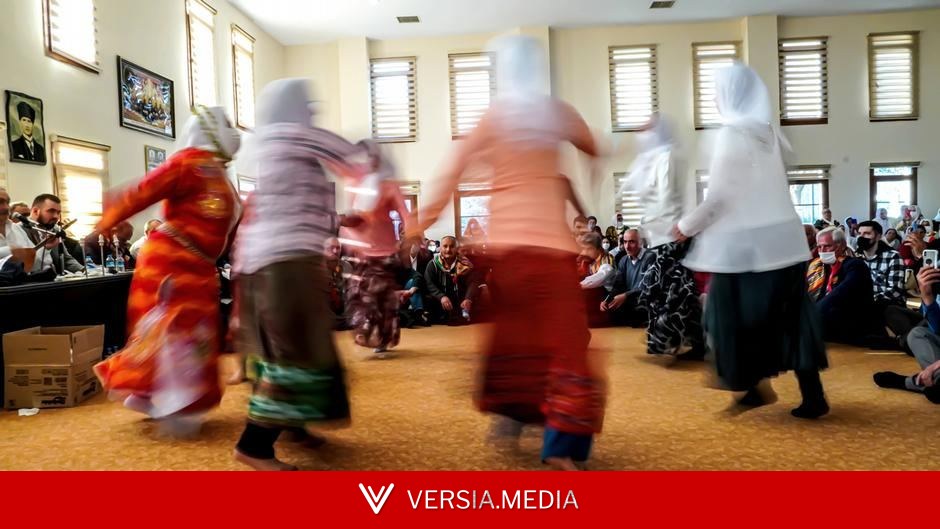
The Alevis represent the fourth-largest religious community in present-day Germany. What are the core principles of their belief system? And how are they working to maintain their distinct cultural identity?
Alevis account for approximately 13% of Muslims residing in Germany today. Members of this religious group were historically concentrated in rural Anatolia, Turkey, where they transmitted their spiritual doctrines and rituals through oral tradition.
As Turkey experienced a rural-to-urban shift starting in the 1950s, coupled with growing urbanization and migration to Europe, numerous Alevi village communities vanished — and along with them, the understanding of their faith in many areas.
Alevism emerged beginning in the 13th century. Nowadays, Alevis form the second-largest religious community in Turkey, following Sunni Islam. The Alevi population includes Turks, Kurds, and members of other ethnic groups such as the Zaza.
The Alevi faith originated from a blend of Central Asian shamanism, Shiite Islam, and Muslim mysticism. Alevis revere the Prophet Muhammad, as well as his cousin and son-in-law, the first Imam Ali, and the Twelver Shiism tradition, while also highlighting ethical and mystical teachings.
Alevis practice their religion in Alevi cemevi, the primary venue for Alevi worship. Their faith upholds values like humanism, equality, and tolerance, which are traditionally conveyed to the community through parables, tales, and songs.
Alevism distinguishes itself from Sunni Islam through its rituals, such as the Cem ceremony, which is attended by both men and women, and the Semah ceremony, where worshippers dance in circles accompanied by a long-necked lute. These distinctions from Sunni Islam led to Alevis facing persecution during the Ottoman Empire (1299 to 1922), the predecessor state of modern Turkey.
Today, Alevis continue to encounter distrust in contemporary Turkey, where Sunni Islam predominates. This situation also affects the Bektashi, followers of one of the largest mystical Alevi dervish orders from Anatolia, whose philosophy is heavily shaped by the veneration of Caliph Ali. Tens of thousands of Alevis lost their lives and their villages were destroyed in the 1937/38 Dersim massacre carried out by the Turkish military.
A pivotal moment for Alevis
Numerous pogroms targeting Alevis during the 1990s — particularly the 1993 Sivas arson attack that resulted in 35 fatalities — represented a turning point in Alevi self-organization, triggering a rise in the establishment of political associations in Istanbul as well as in German cities such as Hamburg, Cologne, and Berlin, which are home to many migrant workers from Turkey.
Currently, there are roughly 200 Alevi organizations throughout Germany. Most are consolidated under the umbrella group Alevi Community Germany (AABF, Almanya Alevi Birlikleri Federasyonu). The Alevi religious community holds full recognition in the German states of North Rhine-Westphalia and Berlin, which confers specific rights and responsibilities. For instance, the Alevi-Bektashite Cultural Institute in North Rhine-Westphalia is a non-governmental organization aiming to establish a venue for scholarly pursuits and the honoring of cultural traditions.
Gülizar Cengiz, a member of the Bektashi order, serves as chair of the institute.
"Our guiding principle is the saying of Muslim mystic Haji Bektash," Cengiz told DW. Bektash stated that "the end of every path is darkness if it is not the path of knowledge."
Cengiz notes that unfortunately, a great deal of knowledge regarding this religious philosophy and Alevi culture has been lost over the centuries. That is why, she added, "we want to counteract this with celebrations and ritual gatherings."
A particularly vital element of the institute's work, which opened in early 2026, therefore involves building and maintaining an archive of historical manuscripts, as well as video and audio recordings of Alevi religious rites and gatherings.
Safeguarding and advancing Alevi culture
"A community that has no history and no memories of the past runs the risk of disappearing," Cengiz told DW, highlighting that many Alevis had burned or buried handwritten documents such as letters and diaries out of concern they could provoke hostility or outright attacks.
Today, the academic study of Alevism is widely welcomed among Alevis in Germany. Cem Kara, a professor of Alevi Theology at the University of Hamburg, states that "there is a great need for concrete knowledge, and scientists have a special role to play here."
His Institute for Alevi Theology, founded in 2024, is one of the first academic institutions globally focused on this faith. It trains teachers involved in Hamburg's special program for interdenominational religious education and other religious educators elsewhere. Starting in 2027, it is also anticipated to educate theology students.
Thus far, limited research has been dedicated to Alevism.
"There has been isolated research, mostly in the context of Ottoman and Turkish history," Markus Dressler, a professor of modern Turkish studies at Leipzig University's Institute of Religious Studies, told DW.
Dressler leads a long-term research project on the ethnohistory of Alevi communities in Anatolia between the 16th and 20th century, which was initiated in 2026.
"We try to collect data from different sources, bring it together and make it legible," he says. "This includes historical data from Ottoman registers, but also Alevi manuscripts and documents, inscriptions from mausoleums and gravestones, as well as ethnologic data, which belongs to oral history."
Databases compiled in this manner offer a long-term perspective that enables the examination of Alevi settlement areas in Anatolia and the relevant actors. This data can also be used to deconstruct major narratives and analyze the oppression and discrimination experienced by the Alevi.
"The Alevi faced discrimination and oppression in the Ottoman Empire," Dressler says. "It still exists today, but it did not happen uninterrupted and did not apply to all groups that call themselves Alevis today. You have to look at the specific historical context, region and groups."
This article was translated from German.