It began as a school initiative aimed at promoting local enterprises in a remote area of Bavaria. Today, the "Chiemgauer" currency is helping to reduce emissions.
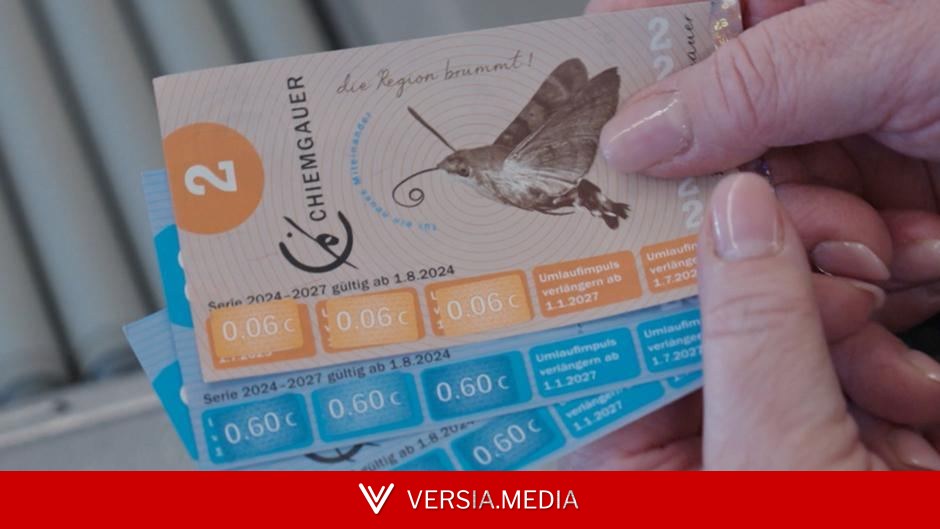
Step into a bakery or bookstore in Bavaria's Chiemgau region, and you may notice a customer paying with what appears to be toy money—vibrant bills decorated with grasshoppers, ladybugs, and other insects.
"An estimated 10 to 15% of customers pay this way," one bookstore owner told DW.
Locals refer to it as the "Chiemgauer"—a currency they created themselves.
As unusual as it sounds, it supports a small-scale financial system that has been operating for over two decades—and has recently transformed into a tool for lowering carbon emissions in this scenic corner of southeastern Germany.
A classroom experiment that spiraled beyond expectations
The Chiemgauer was launched in 2003 at a nearby high school, where economics instructor Christian Gelleri and his students were seeking a way to assist local businesses that were losing customers to shopping centers and large chains.
Their answer was a new currency, intended to keep money flowing within the area. They printed it, distributed it, and gradually locals began using the Chiemgauer while shops started accepting it.
Slowly, a classroom concept grew into a financial network.
"Five million Chiemgauers are being spent annually now," said Gelleri, who still leads the association that manages the currency, Chiemgauer e.V. Today, €1 is equivalent to one Chiemgauer.
At the group's office in the town of Traunstein, nestled in the Alpine foothills, Gelleri opens the vault to reveal thick piles of banknotes.
"These are more than 200,000 Chiemgauers, worth the same amount in euros," Gelleri said with pride. These notes are now produced by a professional firm and include watermarks and anti-counterfeiting features.
Under German law, printing and using currency other than euros can be a criminal offense. However, because the Chiemgauer is limited to the region and used by only around 4,200 people and 300 businesses, Germany's central bank, the Deutsche Bundesbank, permits it. Those wishing to use the currency must register with the Chiemgauer association.
How a small trick keeps this money circulating
A stroll through Traunstein's shops with their colorful fronts illustrates how the system operates. At an organic grocery store, a customer pays for cheese and sausages with a 50-Chiemgauer note. "I run an organic food store myself and partly use the Chiemgauer earnings for my own purchases," he told DW.
The same goes for a vendor selling Mediterranean treats from a market stall. "We use our Chiemgauer earnings to pay the supplier we buy our fresh ingredients from," she explained. This way, the money circulates, either in cash or electronically via a special card that works with regular bank accounts.
To keep a note valid and the Chiemgauer moving, holders must buy a small stamp every six months. The stamp for a 10-Chiemgauer note costs about €0.30 ($0.35), for example. After three years, bills expire entirely. Private users cannot convert Chiemgauers to euros. Businesses can convert the funds, but pay a 5% fee to do so. That fee then covers the currency's operations and supports local nonprofit groups.
Buy balcony solar, get free Chiemgauers
In recent years, Gelleri and the Chiemgauer organizers have added an environmental aspect to their currency. Residents can now earn bonus Chiemgauers by making climate-friendly decisions—whether that means repairing jeans instead of buying new ones, using car-sharing services, or insulating homes with natural materials. These actions are rewarded with bonuses ranging from one to 200 Chiemgauers.
"The owner of this set of solar panels got 100 Chiemgauers," said Gelleri, pointing at two panels set up in a backyard in Traunstein. "In 20 years, this balcony power set will save 11 tons of carbon dioxide."
Local residents and businesses fund the rewards by contributing to a shared pool to offset their emissions—a kind of mini emissions trading system. For every ton of carbon offset through the fund, 9 tons are saved through the climate-friendly behavior it encourages.
Similar climate bonus schemes have since spread from Bavaria to four more regions across Germany. Over the past four years, it has saved 12,800 tons of CO2 in total—equivalent to the emissions of around 2,000 German cars over the same period, according to independent auditors TÜV Nord.
A small, global trend
The Chiemgauer is far from unique. Around 300 "complementary currencies"—named for the way they operate alongside a country's official currency—exist worldwide. Most are concentrated in Europe and Brazil, where the focus is on boosting the local economy and welfare. But as a side effect, they also cut transport emissions.
"The currencies push local shopping, which then makes the supply chains shorter, because vendors purchase locally produced goods," said Ester Barinaga, who researches complementary currencies at the University of Lund in Sweden. According to the MIT and the International Energy Agency, freight transportation makes up 8% of global greenhouse gas emissions.
Some of these currencies are designed specifically to encourage environmentally friendly behaviors. In the Spanish city of Viladecans, for example, the "Vilawatt" rewards residents for saving energy. In Indonesia, the Philippines, and elsewhere, "Plastic Bank" tokens are given to people who collect and hand in plastic bottles for recycling.
Yet all these currencies have their limits, and the Chiemgauer is no exception. Clothing, electronics, and most manufactured goods are still produced abroad and imported. Fewer than 1% of people in the region participate in the system. And if it were to grow much larger, Germany's central bank could step in to regulate it.
Even so, for Barinaga, complementary currencies carry an important lesson—however small they may be in the grand scheme of things.
"Money can be designed," she said. "If money is created to reward pro-environmental behaviors, then you're going to have more people behaving pro-environmentally."
Edited by: Jennifer Collins
Inside the German town where people print their own money
To view this video please enable JavaScript, and consider upgrading to a web browser that supports HTML5 video