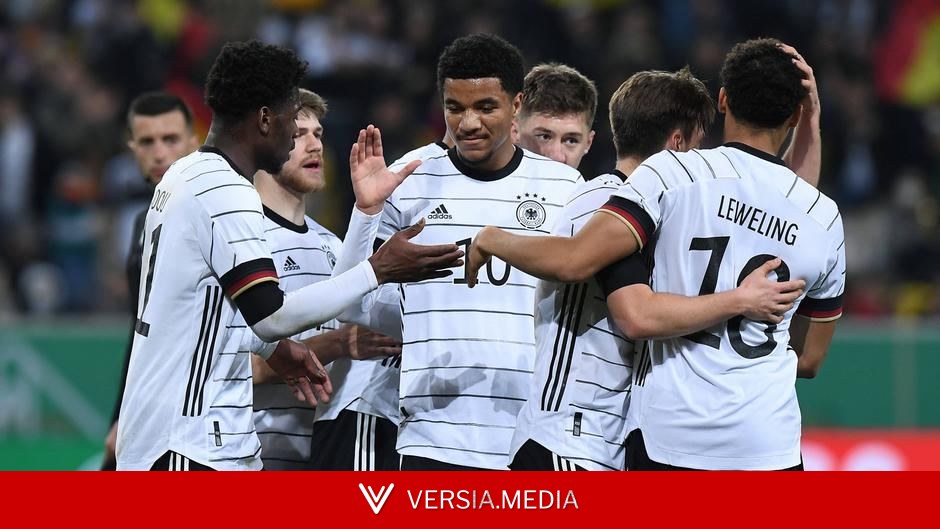
Many young German footballers are opting to represent other nations instead of Germany. DFB Director Andreas Rettig is seeking to reverse this trend and is advocating for a compensation fee.
Among the top young talents at this summer's World Cup are Bayer Leverkusen's Ibrahim Maza and Malik Tillman, Eintracht Frankfurt's Can Uzun, and Bayern Munich's domestic double winner Josip Stanisic. Also included are Juventus' Kenan Yıldız and PSV's Paul Wanner. Despite being born in Germany or having completed their academy training in the country, none will be donning the German jersey on the global stage this summer.
Each holds dual citizenship and has chosen to represent Turkey, Algeria, the USA, Croatia, or Austria. Whether driven by sporting ambition, emotional ties, family connections, or a desire to advance their own careers, their decision represents a deliberate rejection of Germany. This trend has alarmed German FA (DFB) Director Andreas Rettig.
Are Germany's finest young players choosing to compete elsewhere?
Most of the players mentioned are regular starters for their clubs, with some ranking among the best in their positions. As Rettig points out, youth internationals spend between 50 and 70 days per year under the DFB's supervision, meaning all could have played a significant role for the German national team.
"Over 40% of children under the age of five in Germany have a migrant background. This grants them the ability to choose one country over another," Rettig told DW.
He fears this statistic will inevitably lead to a growing number of potential international players willing to change their national affiliation.
"We need to take this issue seriously to avoid a scenario where many of the players we trained here go on to seek their fortunes elsewhere," Rettig stated.
'Moving in the wrong direction'
Last year, Rettig introduced his concept of a "training compensation" system aimed at altering the current situation.
"Training must be worthwhile—both for the trainee and the trainer," the 63-year-old emphasized. "I would like to see us create a system where training is rewarded, allowing us to reinvest that compensation back into grassroots development."
The concept is straightforward. The precise daily training costs per player would be calculated, forming the basis for a compensation claim. This information would be shared transparently with all involved parties, with the goal of raising the threshold against countries poaching players from other nations.
Rettig stressed that his aim is not simply to secure financial gain for the DFB, but to benefit the entire football ecosystem.
"We need to increase awareness that every association must invest in training," said the DFB director, noting that some national associations "allocate more resources, time, and effort into scouting players than into training their own."
Rettig views this as a step in the wrong direction and hopes that a transparent training compensation system, as he proposes, would curb such behavior and encourage greater investment in domestic youth development.
'The eagle on the chest is no more important than the crescent moon'
High-profile examples, such as Maza, who earned 13 caps for Germany's youth teams but chose to represent Algeria, US international Tillman (21 youth caps for Germany), or Özcan, who accumulated an impressive 61 youth caps for Germany but will head to the World Cup with Turkey, have ignited considerable discussion within the DFB. Nonetheless, Rettig emphasized that he respects every choice, as long as it isn't made impulsively.
"We are not claiming that the eagle on the chest holds more significance than the crescent moon or any other national emblem," Rettig explained. "I simply want to make a strong appeal that such a decision [to switch national allegiances] should not be based solely on the question: 'Where can I get playing time faster?'"
Instead, he believes it is vital to provide players with a credible long-term perspective.
"I don't think it would be wise to offer young players false hopes too early," said Rettig.
After all, a player's development path is rarely straightforward, and not every player will feature in a Champions League or World Cup final by age 17. For this reason, Rettig would like to see more patience from players when contemplating a change of nationality.
Decision must come from the heart
"Playing for one's country is the highest achievement a player can strive for," Rettig said.
"It should be a heartfelt decision—one made in favor of the country with which one feels the strongest connection."
The DFB's ultimate aim is to reach a point where young players emerging from its system never even consider switching national associations in the first place.
"We need to strengthen this emotional bond—to intensify our efforts across all age groups," Rettig told the Kölner Stadt-Anzeiger.
Next step: FIFA
For Rettig's plan or any similar initiative to take effect, FIFA would need to implement new rules on a global scale. The DFB's next move will be to formally present its proposal to football's international governing body. Although the timeline remains unclear, Rettig is optimistic that his idea will receive a fair assessment. After all, Germany is far from the only nation affected by "nation-hopping."
"Surely, even FIFA has no interest in seeing the sense of identification with—and the overall value of—its own competitions undermined by an increasing number of nationality switches," he said.
This article was adapted from German.