Mozart's music conveys a sense of lightness and beauty. During periods of war and destruction, people frequently turn to the ideals of the classical era. However, is this merely a way to flee from reality? The Mozartfest Würzburg presents a range of perspectives.
When the world appears to be crumbling, people search for something to grasp. "Now, more than ever, with the world beset by crises and on the verge of being consumed by war, there is an increasing longing for harmony," states Evelyn Meining, the artistic director of the Mozartfest Würzburg.
Over the centuries, the brilliance and elegance of Wolfgang Amadeus Mozart's music has often offered solace in times of hardship—and it continues to do so today. "As a composer, he serves as a symbol, especially during moments of overstimulation and division," Meining explains to DW. This is why the theme of Germany's largest Mozart festival this year is "Evoked Beauty: Mozart the Idol."
Mozart as a modern-day icon
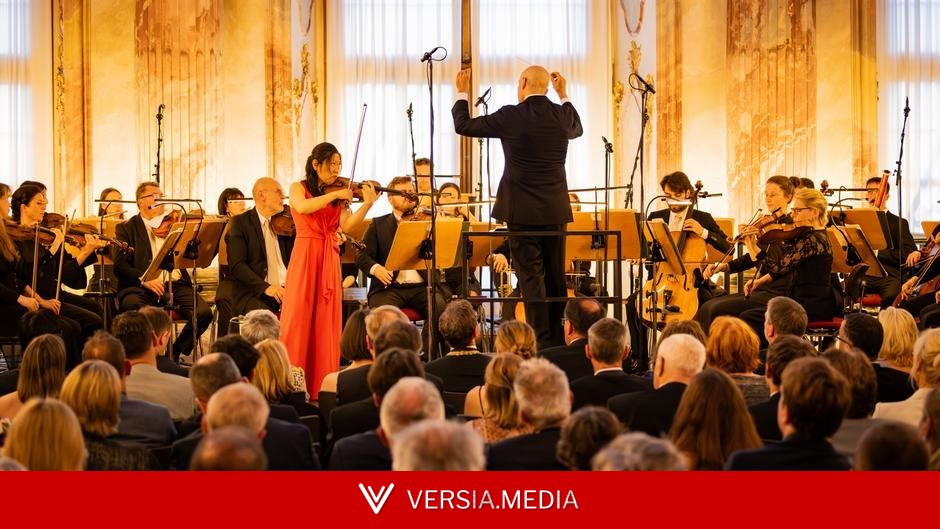
The festival's opening concert, featuring the Mozarteum Orchestra Salzburg, showcased just how impactful and stirring Mozart's music can be. The Salzburg ensemble performed Mozart's penultimate symphony in G minor.
The program also featured contemporary works by Maurice Ravel and Sergei Prokofiev, both of whom held Mozart in high regard.
Ravel regarded Mozart as the "idol of a past era." According to Evelyn Meining, "He shared Mozart's belief that music must captivate."
Ravel's piece "Le Tombeau de Couperin" pays tribute to the Baroque composer François Couperin. "It is a musical composition of beauty defined by clarity, grace, and melodic simplicity, much like Mozart," Meining notes.
Ravel composed the piece between 1914 and 1917 during World War I and dedicated it to friends who had lost their lives in the conflict.
Sergei Prokofiev also admired Mozart's classical symphonies for their grace. He penned his Second Violin Concerto in the mid-1930s. After returning from exile, he arrived in Russia under Stalin's regime, a time marked by widespread arrests and atrocities against the population. A successful example of this is his Violin Concerto, which Chinese violinist Tianwa Yang performed as a soloist, mesmerizing the audience from its gentle opening to its turbulent finale with the beauty and emotional intensity of her playing. She received thunderous applause.
Mozart as a crisis hero
Although Mozart's music is often seen today as beautiful and airy, it is carefully crafted and frequently challenging to perform. "During his lifetime, Mozart's music often puzzled, even unsettled and overwhelmed listeners," says Evelyn Meining, pointing to its increasingly dissonant sounds and intricate structure.
After Mozart's death in 1791, his wife Constanze elevated him to the status of a genius. "He was celebrated as a national cultural icon, a figure around whom people could unite during a period of national fragmentation."
At the start of the 19th century, Europe was shaped by the collapse of the old feudal order following the Napoleonic Wars. Citizens sought freedom and national unity, while princes aimed to restore absolute rule.
In the 20th century, after the collapse of old Europe due to the world wars, Mozart became a symbol of yearning. "Many artists and intellectuals were seeking something that represented balance, order, and humanity, something that would provide them with stability amid collapse and horror." Mozart brought light into those dark times, Meining asserts.
Connecting with Mozart
Solo violinist Tianwa Yang still views Mozart and his music as an idol today: "For us musicians, he is someone who is not of this world. Someone from another universe." Nevertheless, she believes one should not be paralyzed by reverence for this idol. "When you listen to the music and enjoy it, you feel a bond with the composer and think you understand him, which may not be accurate. But there is a certain connection with him when playing the music, and that is what matters."
This year, Tianwa Yang is the featured artist, or "Artiste Etoile," of Mozartfest. She not only performs classic works but also emphasizes contemporary music. Renowned composer and clarinetist Jörg Widmann specifically wrote Etude No. 7 for solo violin, also known as the Jupiter Etude, for Yang. He, too, often returns to the classics, this time with Mozart's Jupiter Symphony. Like the G minor Symphony, it is among Mozart's most famous compositions. The piece will be premiered on June 26 in Würzburg.
Using humor to dethrone Mozart?
As an idol, Mozart is not immune to criticism, and his music can also be made accessible to younger audiences.
In his humorous lecture-performance "Nothing Is Sacred," German-Turkish-Armenian composer and writer Marc Sinan reveals the mechanisms of power, culture, and history behind the untouchable "saints on pedestals" of music history: Mozart, Bach, and Beethoven. He gently chips away at their pedestals.
Thanks to his German father, Sinan was introduced to the classics from an early age. Alongside the Eliot Quartet, he challenges these musical titans. "And through his non-European background, he links his inquiries to the contemporary reality of a migration society," says artistic director Meining. "He is curious about what the musical histories of other countries look like." Nonetheless, Evelyn Meining hints that Mozart will ultimately endure and will not be toppled from his pedestal.
This article was originally written in German.