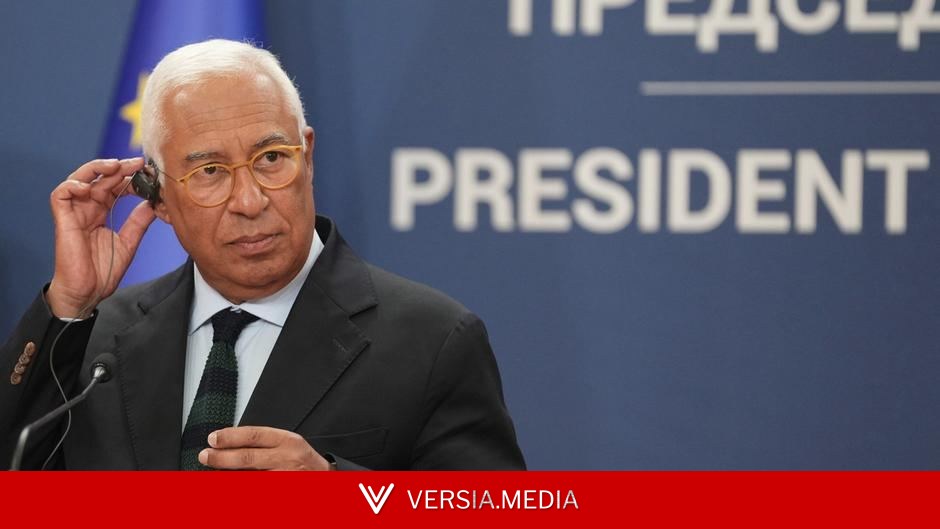
European Council President Antonio Costa stated that fresh approaches must be identified to accelerate the accession of Western Balkan nations into the EU. His remarks come ahead of an upcoming summit scheduled in Montenegro.
The European Union must identify methods to expedite the membership process for six Western Balkan candidate countries, European Council President Antonio Costa declared on Thursday.
"For us, enlargement, particularly to the Western Balkans, represents the most significant geopolitical investment the European Union is undertaking," Costa stated during a joint press conference with Serbian President Aleksandar Vucic in Belgrade.
Albania, Bosnia-Herzegovina, Kosovo, North Macedonia, Serbia, and Montenegro have been pursuing membership in the bloc for an extended period but have yet to fulfill the rigorous requirements.
EU leaders convening to identify methods of making process 'faster and better'
"Tomorrow, European leaders will meet with Western Balkan leaders to discuss how we can refine our methodology to advance more quickly and effectively," Costa said, emphasizing that this did not imply making the process "simpler."
Costa further noted that to "enhance mutual trust," there should be no "sense of frustration from the acceding countries" nor from the EU.
"Enlargement is not a fantasy but something that could become a reality in the years ahead," Costa asserted. "To achieve this, we must work more diligently and swiftly."
The EU-Western Balkans summit begins in Tivat, Montenegro, on Friday, offering leaders a chance to evaluate progress along the path toward EU membership.
Costa has been touring Western Balkan candidate states ahead of the Tivat summit and, on Thursday, informed Serbia's populist president that his government needed to enhance democratic reforms while aligning its foreign policy with that of the EU.
Belgrade has already received warnings that it could forfeit approximately €1.5 billion ($1.8 billion) in EU funding if it fails to halt democratic regression.
Tensions among candidate states
Meanwhile, disputes between the candidate states themselves risk overshadowing the summit.
Host nation Montenegro on Wednesday prohibited 87 Serbians from entering the country, citing security concerns. The individuals had arrived in Tivat on an Air Serbia flight, with security agencies reporting they possessed communication gear and banners reading "Serbia wins."
Following the ban on the Serbian citizens, Serbia's security agency cautioned Vucic against traveling to Montenegro for Friday's summit, citing security risks.
Serbia's Security and Information Agency (BIA) stated on Wednesday that a trip to Montenegro poses a significant security threat for Vucic due to "hostile activities by foreign intelligence services and the presence of a criminal group there."
Two decades after breaking away from the state union with Serbia, Montenegro is regarded as a leading Western Balkan candidate for EU membership but continues to struggle with corruption and Belgrade's political sway.
Edited by: Sean Sinico