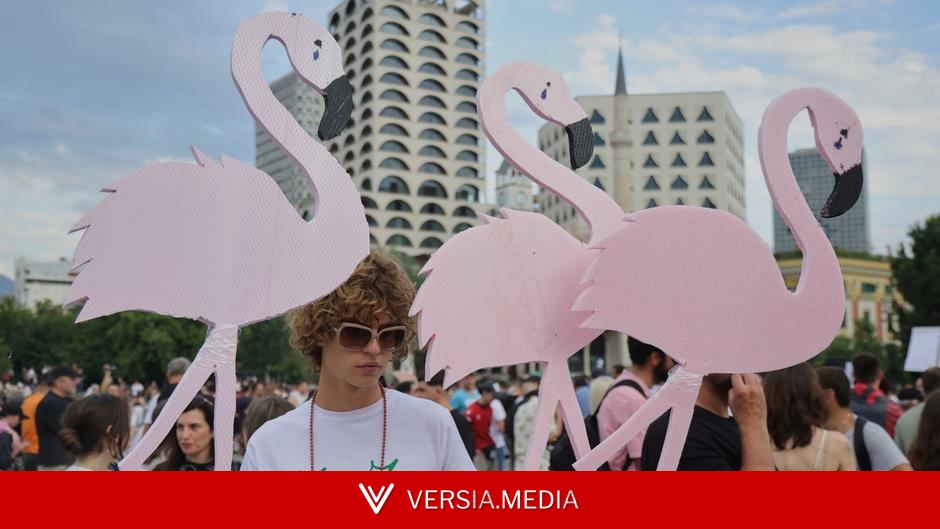
Donald Trump’s son-in-law has been associated with a major development project on Albania’s protected coastline, which has sparked protests and drawn scrutiny from the European Union over concerns about threats to flamingos and vulnerable habitats.
Bulldozers, barbed-wire barriers, and security personnel dragging demonstrators across the beach are not the images Albania hoped would make headlines just days after receiving encouraging signals from Brussels regarding its progress in EU accession talks.
Yet that is exactly what unfolded in the Narta Lagoon area, a protected landscape along the nation’s southern coast.
At the heart of the dispute is the proposed Zvernec Peninsula development, a tourism initiative connected to Jared Kushner, the son-in-law of US President Donald Trump. What began as a conflict over building in a protected zone has evolved into a broader discussion about development, environmental conservation, and Albania’s path toward Europe. Just 8 kilometers (5 miles) from the city of Vlora, developers are planning what could become one of the largest tourism ventures in Albania’s history. The company behind it claims the project could exceed €4 billion ($4.6 billion) and generate over 10,000 jobs. Prime Minister Edi Rama has called it a strategic investment that could elevate Albania to the top tier of global tourism.
Why is the Kushner-linked resort facing protests?
Pishe Poro–Narta is one of Albania’s most significant protected coastal areas. Its lagoons, wetlands, pine forests, and sand dunes support hundreds of species and serve as a crucial stopover for migratory birds traveling between Europe and Africa, including protected pink flamingos.
On the morning of May 30, activists walked through pine forests and sand dunes to reach the construction site. They were met by construction equipment, newly installed fences, and private security guards.
Videos shared on social media showed demonstrators being forcibly removed from the area, sparking public outrage. In the days that followed, thousands joined solidarity protests in Tirana under the slogan “Albania is not for sale,” demanding that the project be stopped.
Environmental groups have also called for full disclosure of documents related to the project, arguing that key decisions have not been made transparently to the public.
For over a decade, Besjana Shehu, a conservationist and co-founder of the Albanian Ornithological Society, has worked to protect the wetlands, forests, and lagoons of Pishe Poro–Narta. But she said the scenes that unfolded on May 30 marked a turning point in a much longer struggle over the area’s future.
“This is not simply a local dispute over a fence, a road or a construction site, but also about how decisions like this are being taken, and the lack of transparency surrounding them,” she told DW.
“What is at stake is the ecological integrity of more than 18,000 hectares of one of Albania’s most important natural corridors.”
Rama: ‘We must enter the Champions League of global tourism’
For over an hour on Monday, Rama devoted much of a public address to the controversy surrounding the Zvernec Peninsula project.
The prime minister condemned the private security guards who were filmed dragging a protester across the sand, calling their behavior “disgusting.” But his remarks left little doubt that he had no intention of stepping back from the project.
“What do I need power for if I have to abandon the vision I have shared with you all these years?” Rama asked. “We must enter the Champions League of global tourism,” he said, arguing that Albania should move beyond mass tourism and compete for a more exclusive, high-end market.
Referring to the protected status of the lagoon, he argued that the area falls under a category where conservation can coexist with economic activity. Rama also stressed that the project remains in a procedural phase. According to the prime minister, no final environmental permit has yet been issued, while both the environmental impact assessment and the architectural design are still under development.
Trump-Kushner plans put Albania’s coast in the spotlight
To view this video please enable JavaScript, and consider upgrading to a web browser that supports HTML5 video
Could the resort harm Albania’s EU ambitions?
Pishe Poro–Narta is not just another protected area, and the project comes at a particularly sensitive moment for Albania’s EU accession process.
The natural area has already been proposed for the Emerald Network, an ecological network based on the Bern Convention, and it is expected to become part of the Natura 2000 network once the country joins the European Union. According to the European Commission, the way the area is managed has become a test of Albania’s capacity to preserve such sites as a future member state.
As part of the closing benchmarks for negotiations on environment and climate change, Albania must demonstrate its ability to protect designated habitats and prevent the deterioration of species and ecosystems.
Against this backdrop, the European Commission has said it is “closely following the developments” in Pishe Poro–Narta. In comments to DW, the commission reiterated that the repeated extension of Albania’s strategic investments law “continues to raise concerns about possible environmental impacts, particularly in protected areas” and stressed that “EU standards must therefore be fully taken into account in this project.”
‘Last intact living delta’ in the Mediterranean
Few people have followed the ecosystem more closely than Ulrich Eichelmann, head of Riverwatch and coordinator of the Save the Blue Heart of Europe campaign. He was among the leading voices behind the campaign that helped secure national park status for the Vjosa, Europe’s last wild river that flows through Albania.
“The Vjosa Delta is the last intact living delta in the entire Mediterranean,” he told DW.
Across much of the Mediterranean Sea, dams, coastal development, and decades of human intervention have transformed rivers and coastlines. According to Eichelmann, the Vjosa Wild River National Park remains one of the last places where these natural processes still function largely undisturbed.
“It is a remnant, an example of how our world looked a hundred years ago,” he said.
For Eichelmann, the debate ultimately raises a broader question that extends well beyond Albania’s borders. “Is there anything that we don’t want to destroy?” he asked. “This is something that the international community must fight for.”
Edited by: Jess Smee