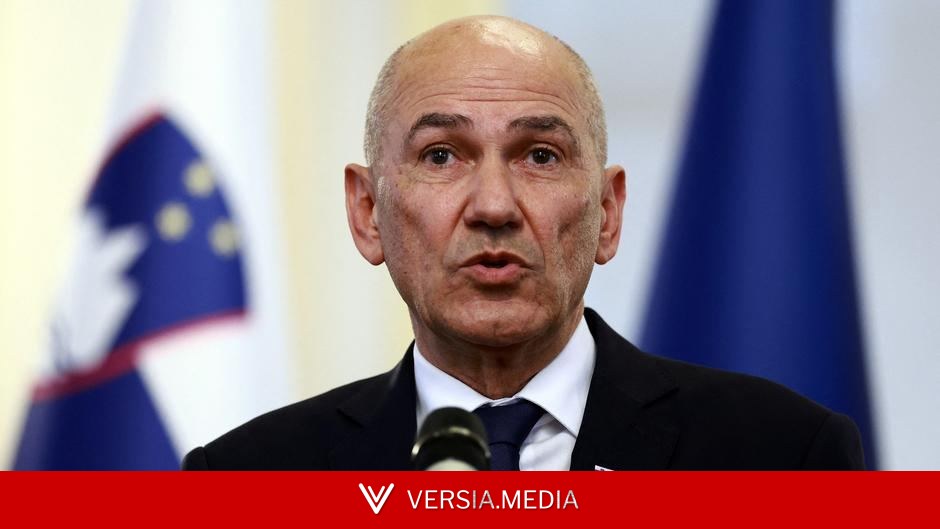
The newly formed coalition government in Slovenia, led by seasoned politician Janez Jansa, is already advancing contentious policies that some observers warn could exacerbate societal divisions.
Janez Jansa is a long-standing figure in Slovenian politics. He held the position of defense minister in the country's first independent administration in 1991 and has now returned to the role of prime minister for a fourth time.
Since his appointment on May 22, he has sparked debate on both historical and contemporary issues—ranging from the treatment of Nazi collaborators executed without trial at the close of World War II to tax reductions that trade unions argue will disproportionately benefit the wealthy at the expense of public services.
His right-wing Slovenian Democratic Party (SDS) consistently secures roughly a quarter of the vote in parliamentary elections. Additionally, unlike center-left parties, it has remained a constant presence on Slovenia's political landscape for over three decades.
Endurance and expertise
This blend of resilience, organizational strength, and experience has enabled Jansa to assemble a new governing coalition, despite the SDS finishing second to the center-left Freedom Movement in March's parliamentary election.
Former Prime Minister Robert Golob was found lacking in his ability to negotiate the agreements necessary to retain power.
"He was certainly in a position to form a coalition of the center-left with some right-leaning elements, but he lacked the skills and capability to do so," said Ali Zerdin, editor of the weekend supplement of Slovenia's top-selling newspaper, Delo.
"On the other hand, we have the veteran of Slovenian politics, Janez Jansa. He knows all the strategies needed to build a coalition to govern Slovenia," Zerdin told DW.
Far-right backing raises concerns
The makeup of the new government, approved by the Slovenian parliament on Thursday (June 4), has drawn considerable attention.
The conservative New Slovenia was widely expected to join a Jansa-led coalition. However, the center-right Democrats had previously split from the SDS and tried to present themselves as a distinct moderate option.
Meanwhile, the backing of the far-right populist Resnica party has triggered alarm in certain circles.
Its leader, Zoran Stevanovic, had signed a pledge not to join a government headed by Jansa, but he accepted SDS support to become parliamentary speaker and reciprocated by directing his MPs to vote for Jansa as prime minister.
What influence will Resnica have?
It remains unclear what level of influence Resnica might exert over policy, though there is an implicit threat that it could withdraw its support if it disagrees with the new government's direction.
The party's own platform is distinctly fringe: anti-vaccination, advocating for a referendum on NATO membership, and skeptical of the European Union.
Combining those views with Jansa's longstanding alliance with former Hungarian Prime Minister Viktor Orban raises the question of whether Slovenia might soon replace Hungary as the EU's chief troublemaker. However, new Foreign Minister Tone Kajzer insists the reality is quite different.
"The European Union is the fundamental concentric circle of Slovenia's political, economic, and overall environment," Kajzer told DW on Thursday.
"There is no doubt that Slovenia would act as a disruptor or anything of the sort. And the political parties forming the core of the coalition are 150% clear on that. My first trips will, of course, be to our European partners," he said.
Politics of division
But even if the new government avoids causing friction in Brussels, the same is unlikely to hold true at home.
During Thursday's debate to confirm his government, Jansa stated that he aimed for a "systematic and boring mandate."
However, the legislation that the new administration began pushing through the National Assembly even before it was officially sworn in shows that divisive politics remain a key part of Jansa's approach.
An omnibus bill containing controversial tax cuts has angered Slovenia's trade unions. They have been attempting to trigger a referendum on the legislation.
Meanwhile, human rights activists are calling for a referendum on changes to the Parliamentary Investigation Act, which they argue "open the door to the establishment of a political police."
Controversial legislation
Another contentious law involves the reburial of people killed in post-World War II reprisals, including those summarily executed as Nazi collaborators.
The legislation proposes transferring them to the most prestigious cemetery in the capital, Ljubljana. It also calls for an annual day of remembrance for these "victims of communist violence."
Ljubljana's mayor, Zoran Jankovic, insists he will try to block the plans. He argues that resistance fighters who defeated Nazism and fascism should not be equated with individuals who were "sworn to the Nazis."
Tone Kajzer, however, believes the reburial is simply the correct course of action.
"I think it's a basic civilizational foundation," he said. "All people killed deserve a grave. Those individuals did not have a trial. So, it's difficult to claim they were all Nazi collaborators. This is an ideological cultural struggle that certain political forces in Slovenia wish to use to divide people. We are going to close this chapter of our truly painful and traumatic history—I don't see anything controversial in this."
Is the fear of polarization justified?
In his first parliamentary address, Jansa preemptively criticized protesters, stating that the future would be determined by elected bodies, "not on the street, which proclaims itself to be the voice of the people, but has never been weighed."
In fact, the previous Jansa administration (2020–2022) virtually invited protests through its attacks on civil society, public service media, and immigration.
Ali Zerdin says such policies simply do not reflect the views of most Slovenians: "There is a lot of talk in Slovenia about deep polarization, a huge gap between right and left. But if you look at the distribution of values in Slovenia, you will see that they are more or less centrist," he said.
Nevertheless, indications suggest that the new government will pursue its own agenda. The administration's first action was to remove the Palestinian flag that had been flying outside the main government building since 2024.
It was as if the great survivor was announcing himself with a signature bold move: Janez Jansa is back.
Edited by: Aingeal Flanagan