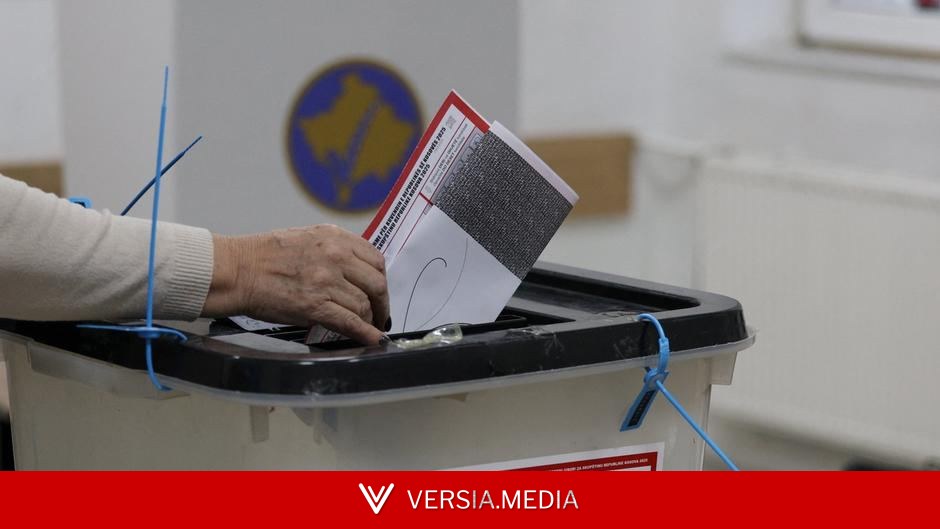
Sunday's Election in Kosovo: Third Vote in 16 Months Marked by Former Allies' Rift, Serbia Dialogue Stalemate, and EU Path Hurdles
The ongoing election campaign in Kosovo is defined not only by the typical rivalry among competing parties, but also by the breakup of one of the nation's most significant political partnerships in recent years: that of Prime Minister Albin Kurti, who has been in office since 2021, and former President Vjosa Osmani.
Osmani received the prime minister's endorsement when Kosovo's parliament elected her as president in 2021.
At that time, the pair were viewed as a driving force for transformation and anti-corruption efforts in Kosovo. Now, they find themselves as opponents.
### No Parliamentary Agreement
When Osmani's tenure concluded earlier this year, Kurti withheld his support for a second term.
Kurti has stated that "the president should be a figure who unites and represents," and that, in his opinion, Osmani harbors political aspirations to join a political party and seek direct voter backing.
In response, the prime minister nominated candidates from his own party, Vetevendosje. However, opposition lawmakers failed to support these nominees.
Sunday's snap general election—Kosovo's third in less than 16 months—was prompted when the country's parliament failed in April to elect a new president for a second time.
Osmani is now a parliamentary candidate for her former party, the Democratic League of Kosovo (LDK).
At an election campaign rally, she told supporters, "You vote to decide whether Kosovo will be a state of its citizens or a state of only one man."
### What Caused the Kurti-Osmani Alliance to Sour?
"Kurti and Osmani are politicians with contrasting ideological outlooks, who were brought together for the political synergy of the moment, seen by citizens as the hope for change, particularly against corruption," political analyst and journalism professor Arben Fetoshi told DW.
Fetoshi added that, although the two differed on foreign policy and coordination with international partners, they experienced no major conflicts during Kurti's four-year government term.
"Therefore, their rivalry in the current race mainly arises from the lack of support for Osmani's second mandate, but it does not exclude the personal dimension and each individual's ideological orientation," he said.
### Political Gridlock
Analysts note that for a country still working to strengthen democratic institutions, move closer to the EU, and advance dialogue with neighboring Serbia, the seemingly endless cycle of elections in Kosovo underscores another major issue: the political class's inability to forge institutional compromise.
Kurti's Vetevendosje has won several elections since 2021, most recently securing 51% of the vote in the last election on December 28—about 30 percentage points ahead of its nearest competitor, the Democratic Party of Kosovo (PDK). This has given Kurti a substantial edge over his political opponents.
Political scientist Artan Muhaxhiri says the wide electoral gap between Kurti's Vetevendosje and opposition parties has created a new political imbalance where neither side can push through solutions.
He warns that if the election results do not bring significant changes, the current deadlock could persist.
### Impact on Foreign Relations
The consequences of the current situation extend beyond domestic politics.
Relations between Kurti's government and Western partners have been strained in recent years, particularly due to tensions in northern Kosovo—where over 90% of the population are Kosovo Serbs—and the Kurti government's unilateral actions there despite criticism from both Washington and Brussels.
These actions include closing parallel Serbian structures operating in Serb-inhabited areas of Kosovo, such as Serbian post offices, offices issuing various Serbian documents for Kosovo Serb citizens, and municipal facilities.
As a result, Kosovo has faced punitive measures from the EU and a noticeable cooling of relations with some allies.
### Kosovo, Serbia, and the EU
Kosovo is the only Balkan country that still lacks EU candidate status.
EU officials have repeatedly stated that Kosovo's European integration depends on the success of dialogue with Serbia to improve both bilateral relations and the lives of citizens in both countries.
Artan Muhaxhiri confirms this, adding, "Naively ignoring this position only deepens the current stagnation, kicking away hundreds of millions in financial injections [of support from the EU] and numerous opportunities for political and economic recovery."
There have also been disagreements over how the dialogue with Serbia is managed.
However, Arben Fetoshi says the deadlock in the EU-mediated dialogue with Serbia cannot be understood without considering Serbia's approach in this process.
"The deadlocks in the Brussels dialogue have another dimension due to Serbia's aggressive approach and expansionist goals. [Serbia's] hybrid interference in Kosovo—especially in elections—aims to control the representation of the Serb community in order to continue using it as an instrument against Kosovo," he said, adding that the EU's neutrality in the normalization process between the two neighbors has not been successful.
### Escalation of Political Rhetoric
Another feature of the June 7 election campaign is the hardening of political language—not only at election rallies but also on social media.
Alban Zeneli, professor of journalism at the University of Pristina, told DW that this shift toward harsher language is being used as an electoral tool.
"Politicians are using this language, which is extremely polarizing and includes insults, labeling and simplifications, as an electoral tactic to 'divide and rule.' In this way, they polarize and divide society in order to gain more support," he told DW.
"This language has serious consequences for society, also dividing it on issues that are not very political, such as the economy, security and education policies," he said.
Zeneli added that after almost two years of national and local election campaigns, the rhetoric has escalated, resulting in "physical clashes, threats and online violence against political opponents."
### What Kosovo Needs from This Election
Analysts who spoke to DW agreed that, despite the parties' promises of economic development, wage increases, or strategic investment, a key question in this election campaign remains whether Kosovo's politicians are ready to build the culture of compromise they currently lack.
But even more important than that is the question of whether Sunday's election will finally give Kosovo a political elite capable of governing, cooperating, and returning the country to the path of reform, dialogue, and European integration.
Edited by: Aingeal Flanagan
Your feedback