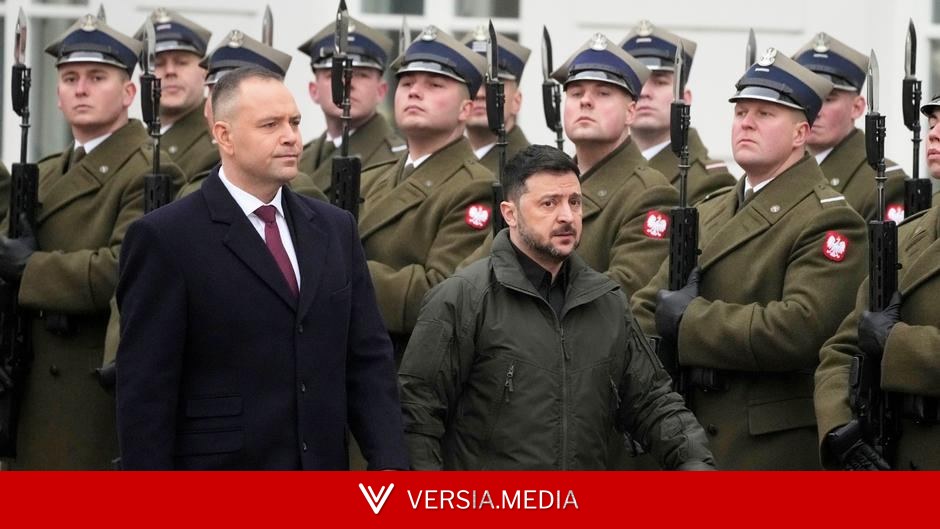
Ukraine's President Volodymyr Zelenskyy has provoked anger in Poland by selecting a name with Nazi associations for a Ukrainian army unit. Can Polish Prime Minister Donald Tusk resolve the situation?
On May 26, Ukrainian President Volodymyr Zelenskyy issued a decree granting a special forces unit of the Ukrainian army the honorary title Heroes of the UPA, stating it was "to restore the historical traditions of the national army."
However, the decree has created serious strains with Poland, a key ally of Ukraine in its conflict with Russia.
After Nazi Germany attacked the Soviet Union in 1941, the partisan Ukrainian Insurgent Army (UPA) was established to fight for an independent Ukrainian state — initially as an ally of Germany. To expel the Polish population from regions it claimed for Ukraine, the UPA committed war crimes against ethnic Polish civilians, including the massacres of Poles in Volhynia and eastern Galicia, a region now split between Poland and Ukraine.
The reaction of Poland's right-wing conservative president Karol Nawrocki to Ukraine's decision to bestow this honorific title on the unit was accordingly harsh.
"Unfortunately, President Zelenskyy has shown that Ukraine, in terms of mentality — glorifying bandits, murderers from the Ukrainian Insurgent Army — is not ready to be part of the European family," he said on May 29 in Warsaw, as reported by Polish TV channel Polsat. "In the European family, you cannot glorify bandits [who] murdered women and children, murdered Poles."
Nawrocki stated he was taking steps to strip Zelenskyy of the Order of the White Eagle, Poland's highest honor. The award jury is scheduled to discuss the matter on June 8.
Nawrocki 'inflaming anti-Ukrainian sentiment'
The military alliance with Ukraine was a cornerstone of Polish foreign policy under former President Andrzej Duda, who awarded the Ukrainian leader the order in 2023. Military and political support from Warsaw significantly contributed to Ukraine's success in repelling Russia's attacks during the early phase of the war in 2022.
Unlike his predecessor, Nawrocki has not hesitated to criticize Ukraine, as was evident in his 2025 election campaign. He has expressed doubts about Ukraine's prospects for joining the European Union, and has criticized the social support provided to Ukrainian refugees in Poland, which he deemed overly generous.
One year after his election, Nawrocki has yet to make an official visit to Kyiv, instead choosing to host Zelenskyy in Warsaw in December.
"Nawrocki has used the opportunity to inflame anti-Ukrainian sentiment," the Polish daily Gazeta Wyborcza wrote on June 1. "He has been handed a pretext and is ruthlessly exploiting it."
Tusk tries to limit damage
Donald Tusk, Poland's pro-European prime minister, has taken initial steps to contain the fallout. He emphasized that Zelenskyy's decision had breached Poland's "historical sensibility." Every nation, Tusk said, was entitled to its own interpretation of the past, but Zelenskyy and "our Ukrainian friends" should demonstrate greater awareness of "what this grim legacy of the UPA means from the perspective of every Pole."
Tusk has distanced himself from Nawrocki's proposal to strip Zelenskyy of the order. "If we quarrel about the past, someone else will win the future," he warned, suggesting that if Poland and Ukraine continued down this path, "the Kremlin will truly have reason to rejoice."
Other representatives of Poland's ruling center-left coalition have also voiced their outrage at Kyiv's decision to name the unit after the Heroes of the UPA. However, they also called for efforts to prevent any escalation.
"Our reaction should not be hostile, but it should be tough," Piotr Zgorzelski, the deputy marshal of the Polish parliament, told broadcaster TVN on June 2. Zelenskyy, he said, was attempting to rally nationalist forces in Ukraine to his side, and in doing so was disregarding Polish sensitivities.
Historic tensions between Ukraine and Poland resurface
The Ukrainian Foreign Ministry issued assurances on May 29 that the new name was not directed at Poland. In a statement reported by the Polish news agency PAP, it said that for Ukrainian soldiers "the struggle of the UPA symbolizes exclusively opposition to Moscow's imperial policies."
Disagreements about the past have long overshadowed relations between Poland and Ukraine. Following the collapse of the Russian Empire at the end of World War I, Poland and Ukraine both claimed regions that belonged to Poland until the late 18th century, but where the majority of the population was Ukrainian.
In 1918, the two countries fought several bitter battles, particularly for the city of Lviv (Lwow in Polish). Western Ukraine became part of the Second Polish Republic, while the east of the country fell under Soviet rule.
The number of victims of the massacres committed by the UPA during World War II, which Poland has described as a genocide, is estimated at over 100,000. As many as 20,000 Ukrainians were killed in reprisals by Polish partisans. After 1945, the UPA continued to resist the sovietization of Ukraine until well into the 1950s. This is why it is still revered there as a symbol of resistance to Russia.
When Russia launched its full-scale invasion of Ukraine in February 2022, Polish–Ukrainian disputes over the past receded into the background. Initially, there was enthusiasm in Poland for its neighbor's fight against the aggressor, and the country took in over 1 million Ukrainian refugees.
Now, however, the mood has shifted for the worse. Right-wing Poles in particular are critical of social security benefits for Ukrainians in Poland — and question Warsaw's ongoing military support for Ukraine.
Tusk's dilemma
Nawrocki is also attempting to gain domestic political ground with his criticism of Zelenskyy. His move is aimed at Tusk — because if Nawrocki, as Poland's president, decrees that the Ukrainian leader should be stripped of the order, the prime minister must countersign the decree.
If Tusk does proceed with the decree, he will harm the relationship with Ukraine — and Poland's security depends on the success of its eastern neighbor in the war against Russia. If, on the other hand, Tusk refuses to sign, the Polish right will label him a traitor who disregards Poles' feelings.
The dispute comes at a sensitive moment: On June 25 and 26, the fifth Ukraine Recovery Conference is scheduled to take place in the Polish city of Gdansk — an international conference that is vital for the reconstruction of Ukraine.
This article was originally written in German.