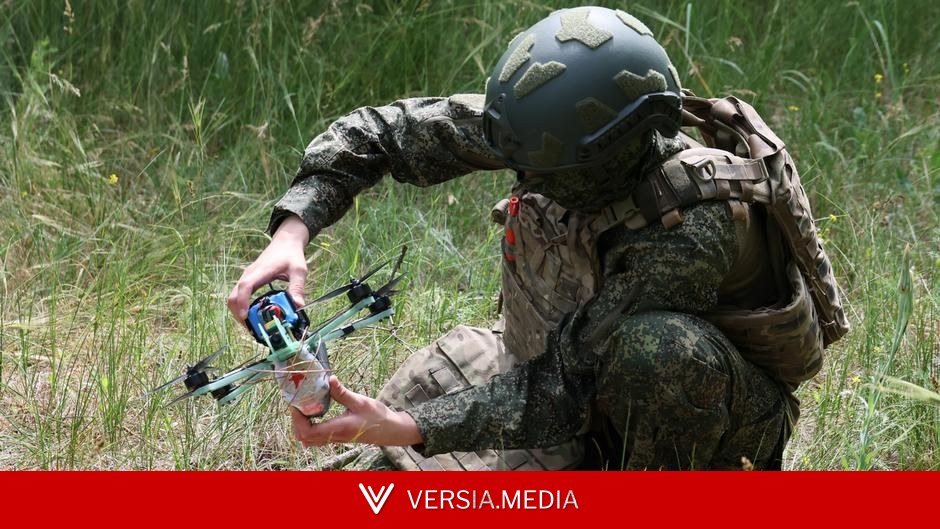
The EU's 21st sanctions package includes a provision to deny entry to any individual who has served in Russia's armed forces amid the invasion of Ukraine. It will also focus on the so-called shadow fleet, banks, and cryptocurrency.
European Commission President Ursula von der Leyen unveiled plans for the EU's next sanctions package against Russia in response to its invasion of Ukraine in Brussels on Tuesday.
The proposals, which need endorsement from the governments of member states, include an effort to bar Russian military personnel from entering the EU.
The bloc is also preparing additional restrictions on various industrial sectors, the banking industry and cryptocurrency assets, as well as Russia's so-called "shadow fleet" of vessels accused of aiding in circumventing sanctions on items such as oil sales.
What did von der Leyen say about the Russian troop entry ban?
Von der Leyen informed reporters in Brussels that the ban would apply to anyone who had been part of the Russian Armed Forces since Moscow's full-scale invasion of Ukraine in February 2022.
"We propose for the first time to ban from entry into the European Union anyone who has served in the Russian Armed Forces since the beginning of the war," von der Leyen stated.
"Europe stays off limits for anyone who has participated in the invasion of Ukraine, simple as that," she added.
What other sanctions is the EU planning?
Von der Leyen also suggested measures targeting Russia's financial, energy, and fishery sectors.
This would include a proposal to maintain the current price cap on Russian oil until January next year, despite recent oil price increases triggered by the conflict in Iran and the broader Gulf region. The cap—currently prohibiting purchases at prices above $44.10 (€38) per barrel, well below market rates—would rise with global prices without this adjustment.
"Our oil price cap has a built-in adjustment mechanism to follow the market. It was not made for market shocks like the one caused by the closure of the Strait of Hormuz," von der Leyen said.
Could Russia save the global economy?
To view this video please enable JavaScript, and consider upgrading to a web browser that supports HTML5 video
The sanctions would target an additional 31 Russian banks, and also add 30 more ships to the 632 already listed as part of the Russian "shadow fleet."
Von der Leyen stated that the EU was also going after more metals and alloys used in the aerospace and defense industries.
The bloc's foreign policy chief Kaja Kallas said that "brick by brick, we are collapsing the foundations of Russia's war economy."
Zelenskyy attends Nordic and Baltic summit amid drone alerts
Also on Tuesday, Ukrainian President Volodymyr Zelenskyy met with leaders of Nordic and Baltic states in Tallinn, Estonia, attending the Nordic-Baltic Eight (NB8) summit as a guest.
Denmark, Estonia, Finland, Iceland, Latvia, Lithuania, Norway, and Sweden are members of the group.
Zelenskyy also held bilateral meetings with some of the countries' prime ministers in Tallinn, as well as with Estonian President Alar Karis.
"We will discuss how we can strengthen Ukraine's defense capabilities, increase pressure on Russia, and make Europe as a whole safer," Estonian Prime Minister Kristen Michal said ahead of the summit.
The Nordic and Baltic states are among the strongest supporters of Ukraine amid the Russian invasion. Finland and Sweden, neutral throughout the Cold War, are also the newest NATO members, having joined the alliance in response to the war.
The visit follows a series of recent incidents where Ukrainian drones had strayed into the airspace of Baltic states or Finland. Kyiv and the NATO members accuse Russia of scrambling the aircraft's navigation systems.
Kyiv has been targeting sites in northwestern Russia, notably its major Baltic oil terminals of Primorsk and Ust-Luga, more frequently in recent weeks.
Zelenskyy said online that Ukraine would offer to send drone interception specialists to the affected countries to assist, noting that Kyiv had already provided a similar service to Gulf states amid Iranian drone attacks.
"We sent our expert teams, who provided training on how to act in the circumstances of various threats. And these are pretty fast and effective solutions," he said.
Lured into war: Russia's foreign fighters in Ukraine
To view this video please enable JavaScript, and consider upgrading to a web browser that supports HTML5 video
Don't let the algorithm hide the news. If you rely on our team for trusted reporting, please take a moment to select us as your Preferred Source on Google by clicking here and hitting the "star" or "preferred" button, so you'll always see our verified news first.
Edited by: Jenipher Camino Gonzalez