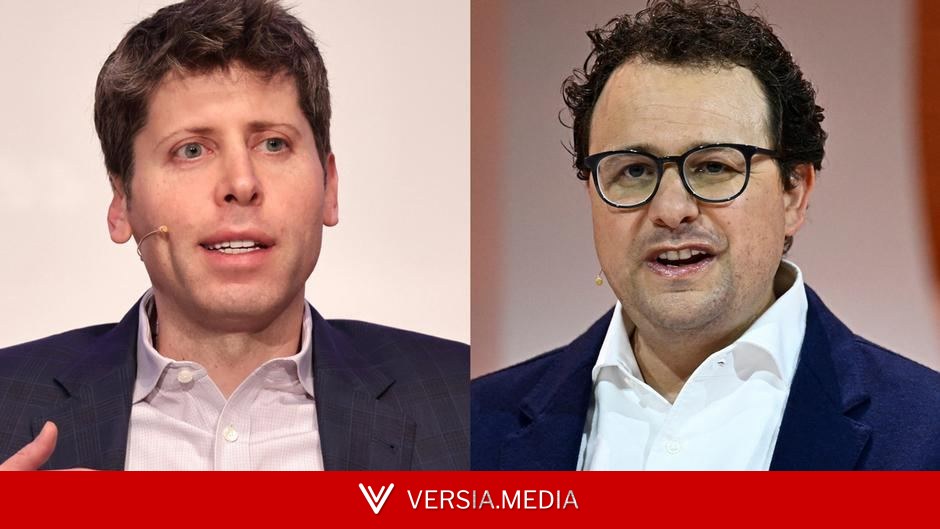
The rivalry between Sam Altman and Dario Amodei is entering a fresh chapter. Both AI executives are planning public stock offerings and aim to leverage the proceeds to outpace one another in the quest to develop superintelligent AI.
It possesses all the elements of a Hollywood screenplay: two driven tech enthusiasts locked in a high-stakes contest for supremacy in artificial intelligence (AI), complete with unexpected twists.
Consider Dario Amodei, CEO of Anthropic, who recently urged the AI industry to halt development, cautioning that humanity might lose command of the technology.
What made the appeal notable was its timing: just days earlier, his company had submitted documents to the US securities regulator, the SEC, to initiate an IPO — a first public sale of company shares on the stock exchange. Anthropic's maneuver caught rival OpenAI off guard. ChatGPT's owner only revealed its own intentions to go public a week later.
The timing appears strategically chosen. Stock markets are thriving, and AI is ubiquitous. Anthropic is currently valued at $965 billion (€836 billion); OpenAI at $852 billion (€738 billion). A successful IPO could elevate both into the exclusive circle of trillion-dollar companies, a group currently occupied by only a handful of firms, including Nvidia, Apple, Alphabet, Amazon, Meta, and Tesla. For context: Siemens, Germany's largest publicly listed company, is valued at roughly $230 billion.
Where does all the money go?
Research firm Gartner estimates that global AI spending will surpass $2.5 trillion this year alone, with the largest portion directed toward infrastructure, primarily the construction and leasing of massive data centers that supply the raw computing power AI systems require.
Until now, both companies have financed themselves through private investment rounds, attracting capital from corporations and venture funds that wager on their future success. According to Harrison Rolfes, an analyst at PitchBook, a US-based provider of data and research, OpenAI has raised $186 billion since its founding; Anthropic has raised $127 billion.
Anthropic or OpenAI: Who has the better prospects?
Most financial analysts give Anthropic the advantage on the stock market. "Anthropic is the better IPO story right now, and the numbers make the case," Rolfes told DW. Anthropic is expected to generate $47 billion in revenue this year, well ahead of OpenAI's projected $30 billion, something it will achieve with less total capital raised.
Anthropic also has a stronger presence in the corporate market. "Over 1,000 enterprise customers are each spending more than $1 million annually" on Anthropic, Rolfes noted.
Does AI pose a security threat?
To view this video please enable JavaScript, and consider upgrading to a web browser that supports HTML5 video
OpenAI, by contrast, leads the consumer market through ChatGPT, which has over 900 million weekly users. The issue: most of them use it for free. "Monetizing a free user base at scale is a fundamentally different and more difficult problem," said Rolfes.
Pedro Domingos, emeritus professor of computer science at the University of Washington, largely concurs. "They're in the lead with business customers, where the most money is likely to come from. But things are still very fluid."
Anthropic has stronger demand, he said, but less computing capacity. "Maybe OpenAI should sell compute to Anthropic, but [the two companies] hate each other too much for that," Domingos told DW.
For now, both firms rely heavily on computing resources borrowed from larger partners. OpenAI depends on Microsoft, which holds a stake in the company. Anthropic draws on Amazon and has recently also tapped Elon Musk's Colossus data center.
Amodei and Altman: Two egos, one race
The rivalry is also deeply personal. In 2021, Dario Amodei left OpenAI because he was dissatisfied with the direction Sam Altman was steering the company in — too much emphasis on profit, not enough on responsibility. Since founding Anthropic, Amodei has positioned himself as a cautious voice in the industry, advocating for strong AI regulation to guard against risks.
He also established a firm boundary with the US military: Claude, Anthropic's AI, would not be used for mass surveillance of American citizens or autonomous weapons systems. The Pentagon responded by classifying Anthropic as a "supply chain security risk," a label typically reserved for foreign companies.
Sam Altman has moved to fill the void. OpenAI software is now set to be deployed by the Pentagon, and Altman's company is increasingly seen as the industry's "bad guy."
That's a striking reversal. When OpenAI was founded in 2015 as a non-profit, responsible AI development was its defining mission — a vision compelling enough to attract top engineers away from Google.
Some experts suspect that Amodei's cautious public stance is, at least partly, a marketing strategy. Domingos believes the pressures of rapid growth will eventually test Anthropic's self-image as the "good guys."
"They'll have to make hard choices and adapt," for example, on the use of AI for military purposes, he said. Anthropic's CEO "will ultimately do what needs to be done, and some Anthropic staff will leave in fury at the betrayal" — just as Dario Amodei and others once left OpenAI.
The race for AGI
At its core, said Domingos, both companies are chasing the same goal: Artificial General Intelligence, or AGI — a system capable of performing any intellectual task as well as or better than a human can.
Both companies' CEOs "think it's close, and whoever gets there first will have such an advantage that they'll sweep the board." Domingos called this reasoning "dubious, but it's what they believe."
PitchBook's Rolfes urges caution about declaring any winner too soon.
"Getting there 'first' doesn't win the battle," he said. Turning AI into lasting profit requires broad adoption, the trust of enterprise customers, and solid margins. "The real battleground isn't ChatGPT versus Claude, it's which AI engine gets embedded inside the world's largest companies."
This article was translated from German.