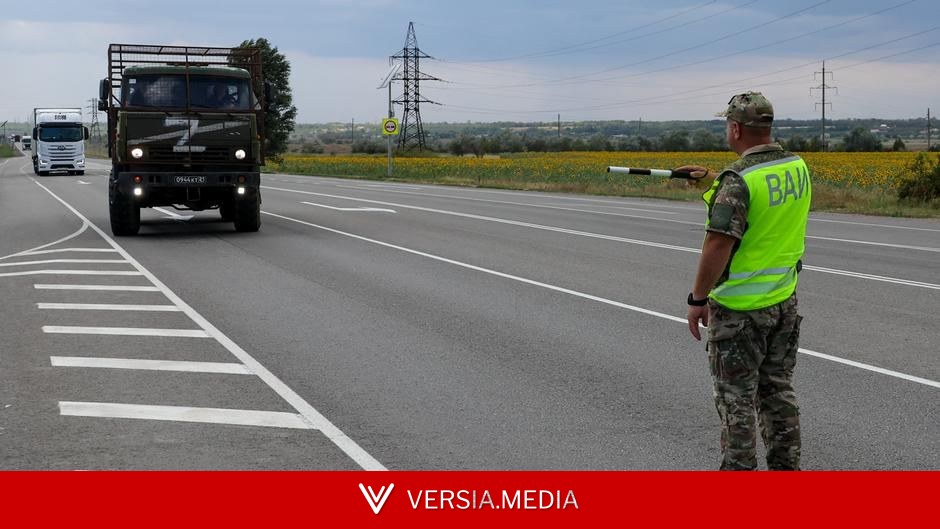
Russian troops depend on supplies transported via the land corridor to Crimea, but Ukrainian forces are now capable of launching targeted attacks along this vital route. Experts suggest this points to a growing vulnerability among Russian forces.
Ukrainian troops are vying for control over key supply routes used by the Russian military in the occupied territories of Ukraine. According to Ukrainian military officials, newly developed medium-range weapons are now reaching Russia’s logistics routes beyond the front lines.
Ukrainian drones have reportedly been conducting surveillance and strikes in the vicinity of Mariupol. This would imply that sections of the land corridor linking Russian-occupied Ukrainian territory with the Crimean Peninsula, roughly 160 kilometers (99 miles) away, are now under fire control. As evidence, the Ukrainian military has released numerous online videos allegedly showing charred Russian military vehicles along the road that traverses occupied areas in southern mainland Ukraine toward Crimea.
"During the bloody and protracted war from 2022 to 2026, the establishment of a land corridor to Crimea was seen as Moscow's greatest potential achievement," wrote Ihor Lutsenko, a soldier in the Ukrainian army and co-founder of the Air Intelligence Support Center, in a Facebook post.
"But it is now evident that this is a temporary gain," he added, noting that "in reality, Ukrainian drones are already hovering over the corridor, which civilians are no longer permitted to use. Crimea is becoming an overseas territory for Russia. Of course, we won't stop there."
A turning point in the war in Ukraine?
According to Mykola Bielieskov, an adviser at the Ukrainian National Institute for Strategic Studies, full control over Russian supply routes remains a distant goal. "If we had complete control, Russian troops in the south would experience a different situation," Bielieskov told DW. However, he acknowledged that vulnerability among Russian forces is on the rise.
Bielieskov stated that photo and video evidence suggests Ukrainian attacks have become more successful at medium range. "The Russians are less active now, even though their area of operations is quite extensive and there have been intense attacks," he said, adding that "we cannot yet speak of a turning point; it simply means that the situation is not worsening for us."
New military technology offers Ukraine a reprieve
Experts attribute the Ukrainian military's progress to technological advancements. Among other equipment, Ukrainian defense forces now possess drones from the Ukrainian manufacturer Wild Hornets, which are outfitted with built-in AI systems.
However, this provides operators with only a limited window of opportunity, as military expert and historian Mykhailo Zhyrokhov explained. The author of numerous publications on military aviation and conflicts in the post-Soviet region anticipates that Russia will soon prepare additional mobile fire groups and a comprehensive protection strategy for the roads along the Crimean corridor, complete with nets to counter drones.
Nevertheless, Zhyrokhov noted that it benefits Ukraine if Russia is compelled to adopt such countermeasures. "Every defensive measure requires resources, and this places an additional strain on the Russians," he told DW, adding that Russian forces will be forced to allocate funds and divert resources to safeguard this route.
In his view, the effectiveness of Ukrainian attacks currently depends on the element of surprise, which will eventually diminish. "As soon as something effective emerges, countermeasures follow," he said. Four years of war have demonstrated this, Zhyrokhov observed.
"That is why this moment must be exploited to the fullest, while the Russians have not yet established effective air defense along this section of the front," he stated.
Increasing Ukrainian pressure
Zhyrokhov outlined several specific measures to intensify pressure on the Russian army's logistics.
The first is to expand drone attacks, which have already proven effective. The second step is to equip drones with heavier warheads to destroy Russian armored vehicles. Finally, Zhyrokhov suggested targeting new objectives, pointing to the infrastructure along the hundreds of kilometers of the route. Attacks on gas stations and repair shops could disrupt the Russian army's logistics more systematically than the destruction of individual vehicles, he argued.
Military expert Bielieskov emphasized additional factors, noting that many tasks must be carried out simultaneously on the front lines. "No matter how advanced the technologies are, they cannot achieve their full potential without specialists," he said, explaining that robot-assisted warfare still heavily relies on human personnel.
"In my opinion, this is precisely where one of the greatest limitations lies," he added, noting a shortage of trained personnel in all units involved in medium-range operations.
According to the expert, all of these challenges contribute to the broader personnel shortage at the front, meaning that even the most effective technological solutions cannot reach their full potential.
Is Ukraine's new confidence a turning point in the war?
To view this video please enable JavaScript, and consider upgrading to a web browser that supports HTML5 video
This article was originally published in Ukrainian.