As the Trump administration dismantles numerous environmental safeguards, some Christian leaders are urging their congregations to fulfill the biblical call to be responsible caretakers of the land. Yet many others remain quiet.
After a period of decline, the Christian population in the United States has leveled off. However, as they gather for Sunday services, only a minority will hear discussions about the state of the planet that Scripture calls them to manage.
A 2025 study reveals that while nearly 90% of US faith leaders across major Christian denominations acknowledge at least some degree of human-induced climate change, just about half have ever addressed it with their congregations.
Styliano Syropoulos, a co-author of the study and an assistant professor at Arizona State University's School of Sustainability, pointed to various factors contributing to this gap.
"Just because they care about it doesn't mean they feel obligated to talk about it," Syropoulos said, noting that pastors may feel unprepared to raise the subject. "Or some might feel it's not their role. Climate change, at least in the US, is a heavily politicized issue."
'Second Coming capitalism'
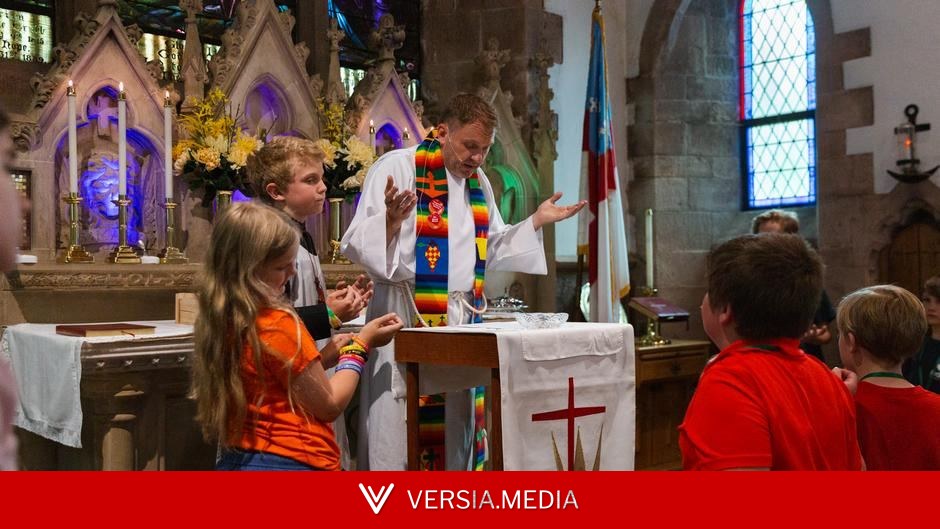
That reality is not lost on Reverend Bradley Mattson of the Hope Episcopal Church in Pennsylvania, who views the divided opinions on climate change in the United States as a reason to address the topic rather than avoid it.
"I would say that political forces in this country and in other countries around the world may work very hard to distance the human impact piece on our climate," he said. "They are working actively to say: 'There's nothing we can do about it. Let's slash, mow and spray and let's just go ahead and do whatever we want.'"
US turns its back on EVs
To view this video please enable JavaScript, and consider upgrading to a web browser that supports HTML5 video
Under the current administration, the United States serves as a clear example. From hindering renewable energy growth to promoting the extraction and use of polluting fossil fuels, President Donald Trump has rolled back literally dozens of rules designed to protect not only the nation but also the global community from environmental harm.
"Any of us have the capacity to go too far with power, and we need to keep ourselves in check for that," Mattson said. "I think certain groups of people use power for unbridled consumption, and there's just no Jesus in that."
Mattson noted that some people adopt a "Second Coming capitalism" worldview: the belief that we can consume freely "because eventually God will come back, destroy the Earth and make it new."
He explained that this narrative stems from a misinterpretation of Genesis, originally written in Hebrew, where the instruction to "fill the Earth and subdue it" is understood as permission for exploitation—"just plow it down." The passage, he argued, is actually a call to be responsible stewards.
Mattson takes that stewardship duty seriously. He has engaged his church in climate advocacy, reforestation, and protection of the Great Chesapeake Bay Watershed, which spans six states, including New York. For the most part, his congregation supports these efforts.
But that is not the case for every pastor seeking to introduce environmental care to their community.
Pushback against climate in church
One state away, in Maryland, Brother Ken Taylor's attempts to weave environmental and climate awareness into his sermons at Saint Nicholas Lutheran Church in Huntingtown have elicited mixed reactions.
"There's a very loud minority of people, who, when we have dedicated a series of Sundays or a teaching series about climate, that say: 'Why are you bringing so much politics into the pulpit?'" Taylor said.
Some have directly told Taylor they are leaving his church because they found the approach too heavily focused on environmentalism. And while the backlash initially surprised him, it has not deterred him from promoting climate action.
Taylor's congregation plants native species to combat erosion, has installed water dispensers and bins for hard-to-recycle items, and is engaging in clean water protection initiatives.
He said he understands that faith leaders can easily feel unprepared to discuss climate topics due to a lack of knowledge. Or to face challenges from the pews—which is where the concept of a congregation becomes valuable.
"We have to lean on the full community of people who care about this in order to move the needle at all," Taylor said. He added that he has often invited members of his flock to address the congregation.
Starting small with respect
In Pennsylvania, Mattson said that when he joined the Hope Episcopal Church six years ago, he began by incorporating care for the planet in modest ways that congregants could appreciate rather than forcing a full climate agenda on them. One example was simply offering people freshly grown vegetables.
"And then we did pollinators, and then we did herb gardens," Mattson said. "And then we started to talk to some granting organizations around environmental work and expanded into land stewardship, watershed protection."
Mattson is thankful that his congregation has embraced him and his methods, which include recognizing that preaching is not the most effective approach when it comes to climate and the environment.
"We tend to approach the life of faith from a position of running towards light, not away from darkness," he said. "I didn't tell you to not run your gasoline lawnmower, if that's all you have. I didn't tell you that you were evil because you had a gasoline lawnmower. What I said was: Think about pollinators. You know, Jesus said: Consider the lilies of the field. Consider them. Just think about it."
Edited by: Jennifer Collins
This article was adapted from a DW Living Planet podcast. To listen to the full episode, click here .
Hawaii cuts emissions in historic climate settlement
To view this video please enable JavaScript, and consider upgrading to a web browser that supports HTML5 video
Your feedback