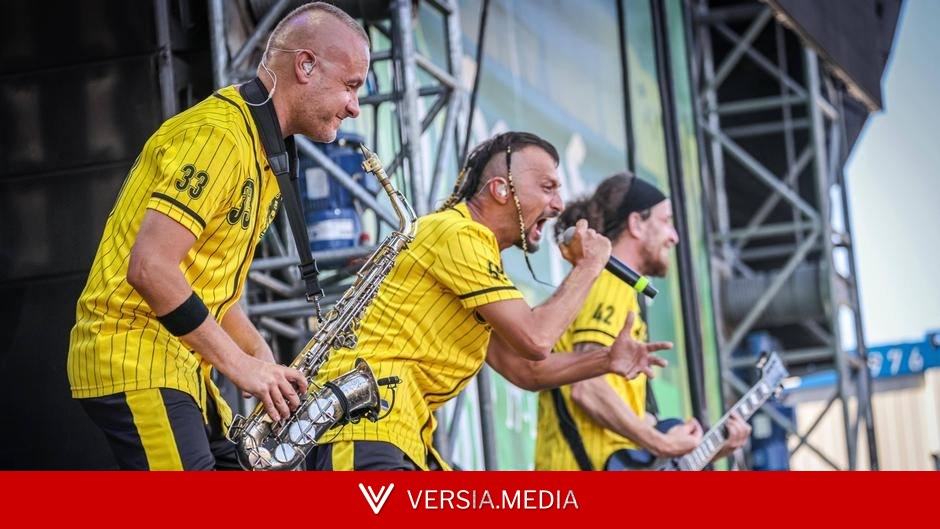
Some have already dubbed it the unofficial anthem of the 2026 World Cup. So how did a melody over a decade old sweep through the Balkans—and beyond—with such force?
Many likely never heard the chorus "I am from Bosnia, take me to America" until the Bosnian national team stunned Italy in a playoff final back in March. That victory propelled the small Balkan nation into the World Cup for only the second time since gaining independence in 1992.
Thousands of fans at the match in Zenica roared out the song, just as they did when the team was celebrated in a square in the capital, Sarajevo, just hours later.
But if you had spent time in Bosnia over the past 15 years, chances are the tune would have felt oddly familiar. The song, originally titled "USA," was actually released by the Bosnian band Dubioza Kollektiv some 15 years ago. And it initially had nothing to do with football whatsoever.
'Typical Balkan experience'
"It's from our album Wild Wild East from 2011," band member Vedran Mujagic, who plays bass, told DW of the song, now known as "I am from Bosnia, take me to America."
"It's about a typical experience of someone from the Balkans, going abroad in search of a better life—in this case, chasing the 'American dream.'
"But then, faced with the reality of immigrant life, life in the diaspora, he kind of realizes that it's not all perfect there, and he decides there's no place like home, and he returns."
The band had been performing the song at concerts for years when, to their amazement, it surfaced during Bosnia's two-legged World Cup playoff semifinal against Wales, which set up a date with Italy.
"Of course we're watching that game. And then we saw a big, big banner that supporters rolled out during the match, and it read, 'I'm from Bosnia, take me to America,'" Mujagic recalled.
"And at that moment, it felt almost like science fiction because we needed to beat Wales—which, of course, we did."
By the Italy match, the song had long been established as the "Dragons'" unofficial hymn.
The icing on the cake came after that game, when some of the players stormed Bosnia coach Sergej Barbarez's press conference singing the song.
Updated World Cup version
"Ten days later, we decided to actually do a supporter's version with changed lyrics and to address some of these football, subculture feelings and emotions that surrounded qualification for the World Cup," Mujagic said.
Interestingly, while the original version was entirely in English, much of the new version is sung in Bosnian. The lyrics play on local stereotypes and urge on the national team, while lamenting what remains a sore point among fans old enough to recall the 2014 World Cup.
"And that goal against Nigeria wasn't offside," they sing.
It wasn't. Video footage shows Edin Dzeko was clearly onside when he scored, but there was no VAR (video assistant referee) at the time, and after the goal was disallowed, momentum shifted, and Bosnia lost the match. They also failed to advance from their group.
And while the new version being mostly in Bosnian might seem like a hurdle to international success, it has simply taken off. Mujagic thinks he knows why.
Striking a chord
"I guess it has to do with the music video we shot for it, which features the band members playing football in a neighborhood courtyard with neighbors grilling meat and having, like, this regular Balkan fun," he said.
The video, shot on a mobile phone, seems to have resonated particularly in South America.
"A lot of people recognized that this looks like some of their neighborhoods, like a favela in Brazil or this looks like Chile because it's the same thing," he added.
There's also something slightly subversive about the low-budget production.
"It is like a response to this hyper-stylized aesthetic that FIFA music promotional videos have," Mujagic explained, adding that it struck a chord with those frustrated by the modern, money-driven game.
The diaspora experience in reverse
As for the newfound success of the national team, the majority of whom weren't actually born in Bosnia, Mujagic gives all the credit to coach Barbarez and sporting director Emir Spahic.
"Spahic and Barbarez did an excellent job by recruiting and creating a team out of all these kids that grew up in the diaspora. They're the ones whose parents went seeking the 'American Dream' or were refugees during the war," he said.
"It's like they (the children) have different experiences, and they experience even this song in a completely different manner," he added.
There's little doubt that when Bosnia-Herzegovina kick off their World Cup campaign against co-hosts Canada in Toronto on Friday, this song will echo through the stands.
Edited by: Matt Pearson
Maida Besirevic and Mehmed Smajic of DW's Bosnian service contributed to this report.