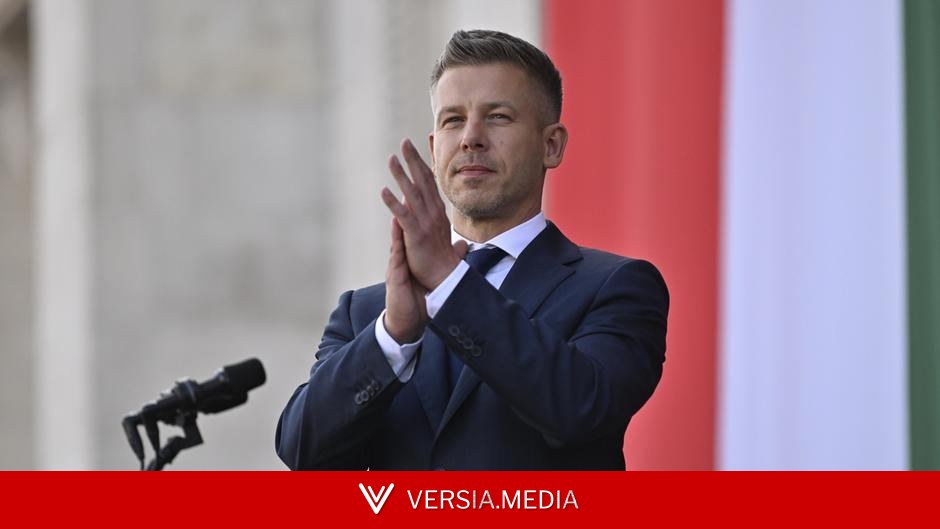
Hungarian Prime Minister Peter Magyar announced an agreement with Kyiv regarding the rights of the Hungarian minority in Ukraine. This development clears the path for Ukraine to begin European Union accession talks — a scenario that was unimaginable under Hungary’s previous prime minister, Viktor Orban.
For Hungary’s former authoritarian leader, Viktor Orban, Ukraine was an “evil empire,” a mafia state rife with human traffickers, drug dealers, and arms merchants.
He and his administration even alleged that Ukraine intended to launch an attack on Hungary. Statements of this nature likely played a role in Orban’s decisive defeat in April.
Thus far, his successor has also refrained from expressing unconditional backing for Ukraine. Despite condemning Orban’s anti-Ukrainian rhetoric as falsehoods and diversionary tactics, Peter Magyar has likewise declined to supply military assistance to Kyiv.
At the same time, he has also voiced criticism of Russia.
Minority rights for Hungarians in Transcarpathia
However, last week, Magyar announced a change in Hungarian policy toward Ukraine that he characterized as “historic.” In a Facebook video, he declared that the two nations had reached a deal concerning the rights of the Hungarian minority in the western Ukrainian region of Transcarpathia.
He stated that “in three weeks we managed to achieve what Viktor Orban couldn’t do in 10 years” and added that Ukraine was ready to guarantee numerous rights to its Hungarian minority, particularly in education and language.
He indicated that a declaration would be signed shortly and that Ukraine had pledged to implement the measures in the near term. Once this occurred, he said, the Hungarian government would consent to opening the initial set of negotiations on Ukraine’s accession to the European Union.
During his first month as Hungarian prime minister, Magyar has already described several things as “historic.” Upon closer examination, the specifics may be more nuanced.
For example, Magyar stated that “100,000 Hungarians are regaining fundamental rights,” but many of the language rights in education that he presented as new already exist. Members of national minorities in Ukraine already have the right to receive education in their language if it is not Ukrainian. In such cases, they must attend classes where Ukrainian language, literature, and history are taught in Ukrainian.
New Hungarian Prime Minister Magyar takes on Orban’s legacy
Minority language, not just Ukrainian, place name signs
What is new is that under the agreement, Ukraine will permit the use of minority languages in public administration. This will result in bilingual signs for place names or on government buildings. The use of minority languages will be allowed in public institutions if a minority constitutes over 10% of the local population. However, this is a requirement for EU membership, not the outcome of a “historic negotiation” by Magyar.
But one likely result that was probably sought by representatives of the Hungarian minority in Transcarpathia is that minority schools will be preserved even if only a few children and young people remain. The number of ethnic Hungarians in the region has dropped sharply, particularly since Russia’s full-scale invasion of Ukraine. Optimistic estimates now place it at around 80,000.
Ukraine-Hungary deal a ‘very important and truly historic step’
Laszlo Zubanics, one of the most prominent figures of the Hungarian minority in Transcarpathia and the head of the Hungarian Democratic Federation in Ukraine, is pleased about the agreement.
“This is a very important and truly historic step,” he told DW.
“The last time a joint Ukrainian-Hungarian working group on minority issues met was in 2011. In future, this working group will convene whenever problems arise. Furthermore, the current agreement will clear the way for the opening of EU negotiation chapters,” he said.
Zubanics noted that although several minority rights already existed in Ukraine, the existing legislation would be enhanced and made more explicit.
He welcomed the fact that it would become easier to put up signs in minority languages in government offices and state institutions. “Until now, that required special decisions by councils but now it will become automatic,” he told DW. He expressed hope that the new legislation would be in place by the end of 2027 at the very latest.
Magyar to meet Zelenskyy in near future
Magyar announced a few days ago that he was ready to meet Ukrainian President Volodymyr Zelenskyy, but it remains unclear when exactly and whether the latter will agree to his request to meet in the western Ukrainian town of Berehove, which lies on the border with Hungary.
However, what is clear is that this will be a historic meeting after a decade and a half of very strained relations between the two states, which date back well before Russia’s full-scale invasion of Ukraine.
A recent report by the Hungarian news portal Telex revealed just how hostile Orban was: It disclosed that a high-profile anti-terrorism operation against a Ukrainian cash-in-transit armored vehicle in Hungary in early March — and the seizure of approximately €70 million (approx. $81 million) and nine kilograms of gold — did not target suspected money launderers as stated officially but was a politically motivated action, whose timing was coordinated by Orban himself for campaign purposes.
Magyar has condemned this way of doing politics in no uncertain terms on several occasions. The agreement between Ukraine and Hungary could now mark the beginning of a new chapter of constructive relations. “The foundation for a proper partnership has been laid,” said Zubanics.
This article was originally published in German.