Beyond a headline-grabbing bronze piece, contemporary artworks in an exhibition at Bellevue Palace draw attention to political power before the state building shuts down for renovations.
Why is a sex doll located in the German president's primary official residence?
Positioned in a suggestive pose, the green bronze cast replicating the torso of a Japanese sex doll has made headlines and captured attention on social media.
The sculpture by Alexandra Bircken, named "Eva," is only one of many contemporary artworks displayed in the highly symbolic political space tied to the German presidency and state ceremonies, Bellevue Palace.
The two-week temporary exhibition, called "Freiraum Kunst" (Art as Free Space), takes place from June 13 to 28.
"We need art," German President Frank-Walter Steinmeier told the press during a preview before the exhibition's opening. "A democracy without free art loses its capacity for self-criticism, and art without freedom loses its social relevance."
Organized by the city's Academy of Arts under the president's patronage, the temporary exhibition can be viewed as Steinmeier's farewell to Bellevue Palace.
The Berlin building has been largely cleared out in anticipation of its upcoming closure, creating room for the special exhibition. Bellevue Palace is scheduled to undergo eight years of renovations. Since Steinmeier's second and final term ends next year, he is not expected to return to the residence before the work is finished. He will relocate to an interim residence near Berlin's central train station.
Democracy requires artistic voices
The contemporary art show, featuring video and audio installations, photography, and traditional oil paintings, aims to encourage reflections on democracy, representation, power, and public life.
Freedom of art, guaranteed by Germany's constitution, is one of the strongest fundamental rights in the country's legal system.
Even before entering the building, Christian Awe's large installation of the word "Freiraum" ("free space") on the palace roof serves as the exhibition's overarching statement on artistic freedom.
Upon entering the foyer, one hears a repeatedly uttered "Hallo." It comes from a performance staged by artist Jochen Gerz in 1972, titled "Rufen bis zur Erschöpfung" (To Call Until Exhaustion).
In the performance, the artist repeatedly called out his hellos into the emptiness until his voice gave out. The work can be interpreted as a commentary on the limits of speaking out, especially in an era where social media encourages the constant pursuit of attention. In a democratic context, when citizens' calls go unheard, frustration builds, and this can lead to a sense of societal exhaustion.
A painting at the entrance by street artist El Bocho, titled "Die Bundespräsidentin" (The Female President), imagines a woman serving as Germany's ceremonial head of state.
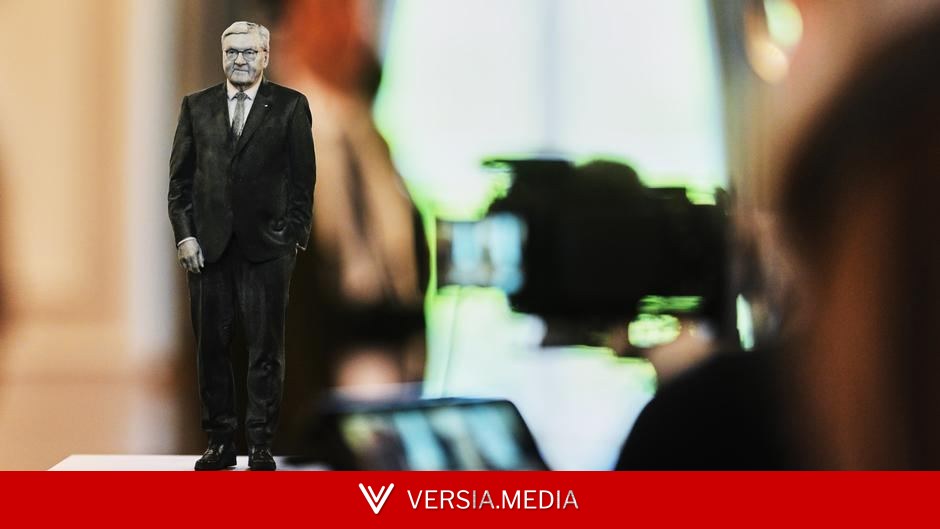
Artist Karin Sander created a miniature version of President Steinmeier. Her 36-centimeter (14-inch) tall sculpture stands on a pedestal in the political speeches room.
Meanwhile, "Eva," the provocative bronze sculpture, confronts visitors with questions about the body, gender, sexuality, and women's objectification. The fact that an intimate subject is displayed in the formal setting of a state palace creates tension and raises questions about the representation and control of bodies in society.
The exhibition also includes works by well-known artists, such as Katharina Grosse, Wolfgang Tillmans, and Monica Bonvicini.
The 18th-century Prussian royal Bellevue Palace became the official residence for Germany's president in 1994.
Normally, the president's official seat is not freely accessible to the public, which is why the exhibition is also seen as a rare opportunity to get a glimpse inside the building.
The website to book one of the 35,000 free tickets crashed just a few hours after it went live last month. All tickets to the show are currently sold out, but some slots might become available at the last minute due to cancellations. Edited by: Brenda Haas