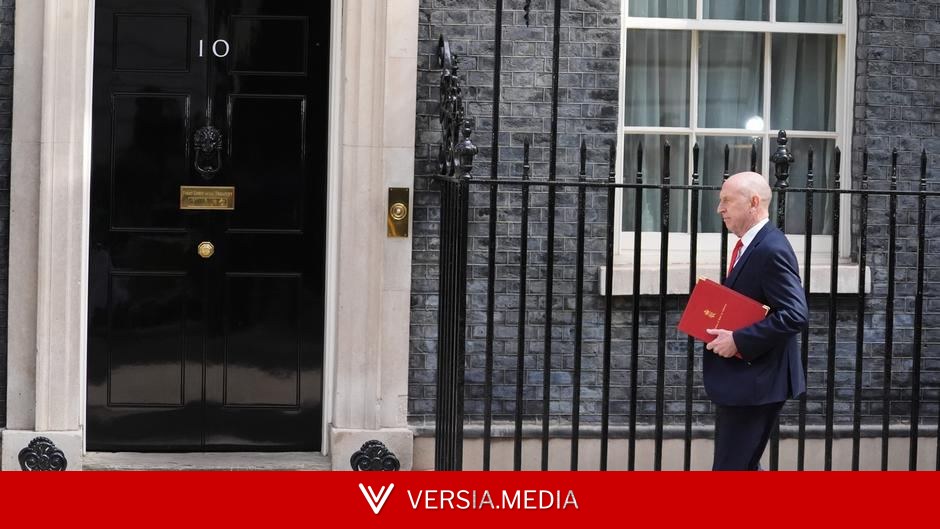
Britain's defense secretary has unexpectedly resigned from his position, stating that the government's proposed increases in defense spending over the next several years are insufficient. This development adds further strain on beleaguered UK Prime Minister Keir Starmer.
UK Defense Secretary John Healey released his resignation letter at midday on Thursday, stepping down amid a disagreement over military expenditure plans for the coming years.
This surprising resignation increases pressure on the embattled UK Prime Minister Keir Starmer, who in recent weeks appeared to have navigated the worst of a controversy surrounding a possible challenge for the leadership of the Labour Party.
Al Carns, the UK's armed forces minister, also stepped down on Thursday, along with Healey's aide Pamela Nash.
The UK's Defense and Finance ministries had been engaged in negotiations for months regarding the pace of increasing defense spending in the coming years.
This conflict pits constrained public finances and sluggish growth projections against NATO's objectives to sustain rising European defense expenditures.
What did Healey say when he submitted his resignation to Starmer?
Healey, a longtime close associate of Starmer's and the shadow defense secretary in opposition before Labour's electoral victory in July 2024, began his resignation by stating, "This is a letter I never expected to write, and I do so now with great reluctance."
He expressed pride in the UK's existing rapid defense spending increases but noted that the most recent agreement on a Defense Investment Plan (DIP) for expenditure through 2035 "falls well short of what is required for defense and the country at this dangerous time."
He indicated that the increases projected by 2030 are minimal compared to the spending already assured by the end of 2027.
Despite "the scale of the challenge and the rising demands on defense," Healey informed Starmer that "you have been unable, and the Treasury has been unwilling, to commit the resources that the nation needs to defend the country at this time of rising threats."
NATO's recently elevated target for its members envisions them allocating 3.5% of GDP to defense by 2035—amid Russia's invasion of Ukraine and a persistent but growing US desire to redeploy some of its military assets in Europe.
"You know what defense needs," Healey said to Starmer in his letter. "You made the argument for this powerfully at the Munich Security Conference back in February. Without a DIP that meets the moment in this way, I am being forced to make decisions that would reduce the readiness of our Forces and increase the risk to personnel on operations, and could make the country less safe."
Starmer appointed former army officer Dan Jarvis as Healey's successor, who would be moving from a junior ministerial role at the Home Office.
What do these high-profile resignations signify for PM Starmer?
The resignation occurs as Starmer struggles to retain power following local and regional election losses and dissatisfaction within his Labour Party.
Several policy missteps and reversals, notably the controversy over appointing Peter Mandelson, who has ties to Jeffrey Epstein, as US ambassador, had been burdening Starmer prior to Labour's significant mid-term electoral defeats.
The uproar from mid-May appeared to have subsided somewhat in recent weeks, but the possibility of a leadership challenge within his party continues to trouble the prime minister.
Although Health Secretary Wes Streeting's resignation and former deputy party leader Angela Rayner's open criticism did not result in a challenge to Starmer, another potential contender, Manchester Mayor Andy Burnham, is pursuing a seat in the House of Commons through a by-election. He would require a seat to initiate an effort to remove Starmer. The vote in the Makerfield constituency is scheduled for June 18.
Healey appeared to acknowledge these tensions, albeit with the calculated vagueness of a former journalist and communications and campaign manager, in the final line of his resignation letter:
"I wish you all continuing strength in the exceptional challenges you face as Prime Minister," Healey wrote. "As always, our Labour Government will continue to have my fullest support."
DW's correspondent in London, Birgit Maass, notes that Healey's resignation will be felt even in Berlin, but most acutely at 10 Downing Street:
" The resignation of John Healey is a big blow for Prime Minister Starmer. He was one of the government's most senior and influential figures, who built strong relations with European allies, not least the German Defense Minister Boris Pistorius. So strong was their relationship, that it had been dubbed a "bromance" by the press.
Now, speculation is rife as to how long Starmer will be able to hang on to his job. It seems that Healey was no longer happy to be associated with Starmer's leadership, and with the Prime Minister's inability — or unwillingness — to explain to the country the extent to which the post-war peace has come under threat.
Behind the scenes, several ministerial departments are competing for a share of limited public spending. It has been reported that Energy Secretary Ed Miliband has been pushing back against demands to cut spending on net zero schemes in order to finance further military spending, arguing that energy security is also integral to Britain's national security."
Violent protests erupt over Belfast stabbing
To view this video please enable JavaScript, and consider upgrading to a web browser that supports HTML5 video
Edited by: Sean Sinico
Don't let the algorithm hide the news. If you rely on our team for trusted reporting, please take a moment to select us as your Preferred Source on Google by clicking here and hitting the "star" or "preferred" button , so you'll always see our verified news first.
Your feedback