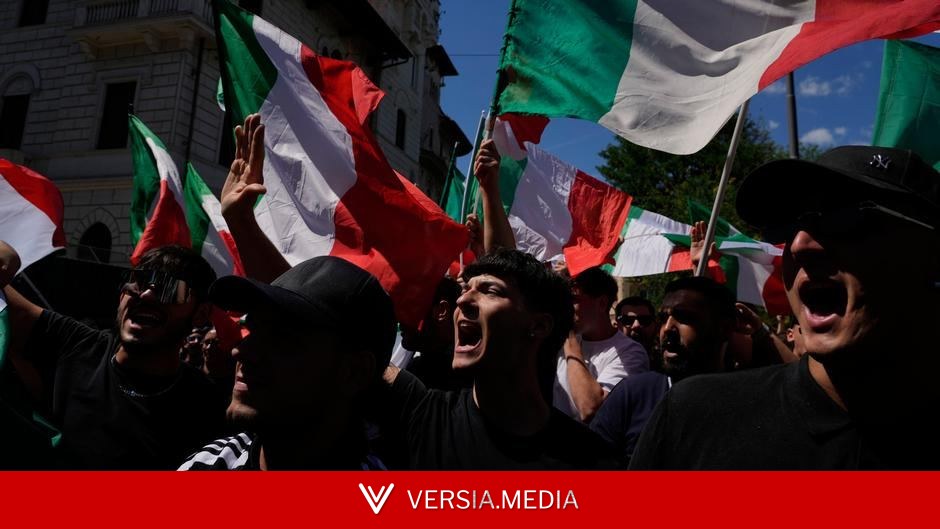
Tens of thousands of individuals gathered in Italy's capital for competing protests. The demonstrations followed a proposed bill targeting migrants, which garnered sufficient support to be introduced in parliament.
On Saturday, tens of thousands of people filled the streets of Rome, Italy's capital, for opposing rallies—one against migration and another in favor of it.
Several thousand demonstrators from across Italy participated in the right-wing, anti-migration march.
Why were the right-wing protesters in Rome?
The march took place after a citizen-led initiative called "Remigration and Reconquest," which aims to implement broad measures against immigrants, collected the 50,000 signatures required for it to be presented to Parliament.
Many demonstrators raised their arms in the fascist salute and shouted "Duce," a reference to Benito Mussolini, the fascist dictator who governed Italy from 1922 until his removal in 1943.
In recent years, far-right groups across Europe have used the term "remigration" as part of efforts to curb immigration and reduce the number of foreign migrants, including through deportation.
What is known about the counter-demonstration supporting migration?
On the opposite side of Rome, tens of thousands of people from various left-wing groups and trade unions joined a rival, pro-migration rally.
Thousands of police officers were deployed "to facilitate the spaces of freedom and freedom of expression," according to Rome's police commissioner, Roberto Massucci. No violence was reported.
The migration debate has become a political balancing act for Prime Minister Giorgia Meloni's right-wing coalition.
While the right-wing populist and anti-migration Lega ("League") party has welcomed the discussion sparked by the "remigration" bill, Meloni's Brothers of Italy and its centrist coalition partners are more cautious.
Critics of the citizens' initiative raise concerns about the bill's legality, arguing it discriminates against individuals based on their ethnic origin and thus violates Italy's constitution and EU law.
Since taking office, Meloni's government has actually sought to expand legal migration to address labor shortages in various critical sectors. From 2023 to 2025, Italy permitted 452,000 non-EU workers to enter the country.
The rival marches in Rome occurred a day after the European Union introduced new regulations on how its member states handle irregular migration and asylum seekers.
New EU migration pact: Will the bloc deliver on promises?
To view this video please enable JavaScript, and consider upgrading to a web browser that supports HTML5 video
Edited by: Karl Sexton
Don't let the algorithm hide the news. If you rely on our team for trusted reporting, please take a moment to select us as your Preferred Source on Google by clicking here and hitting the "star" or "preferred" button , so you'll always see our verified news first.
Your feedback