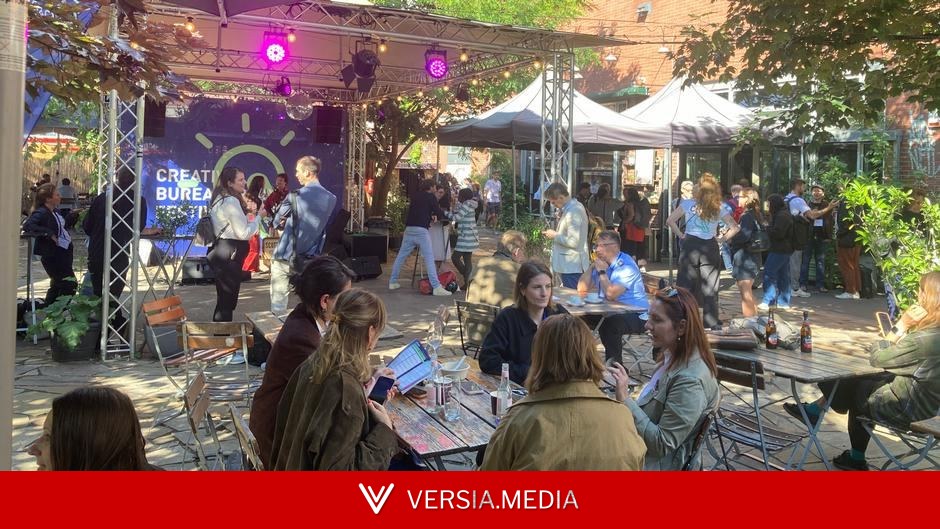
Berlin hosted the ninth annual Creative Bureaucracy Festival this week, where highly driven public service employees explained why a functioning state is essential for a healthy democracy.
On most evenings, Festsaal Kreuzberg serves as a concert location in one of Berlin’s trendier neighborhoods, but this week it was occupied by bureaucrats. Yet these weren’t ordinary bureaucrats—they were “creative bureaucrats,” a phrase that seems more contradictory than it ought to be, given the public sector’s significant innovation in recent years.
That is at least the perspective of those attending Berlin’s Creative Bureaucracy Festival, now in its ninth edition, which bills itself as the world’s largest gathering for public service innovation. Some might note the irony that the event has settled in Berlin, whose outdated and underfunded bureaucracy has become a tired joke.
But the setting feels appropriate, as the venue was filled with young, optimistic people: The Creative Bureaucracy Festival featured a sunny garden where an acoustic guitar duo performed summery tunes, workshops on making bureaucracy more empathetic, and special “Creative Bureaucrat” pins for attendees to wear.
“Here at this festival you’ll find people who want to do administration better,” said Theresa Twachtmann, CEO of PD, a German in-house consultancy for the public sector serving the federal government, states, municipalities, and institutions. “It’s an intrinsic motivation. A lot of the people here could be working in business and probably make more money, but they consciously chose to make a contribution in public administration.”
Beyond that, Twachtmann was among many participants emphasizing how crucial a functioning bureaucracy is for a democratic state: “Against the background of Germany’s competitiveness and the question of how big people’s trust in democracy is, of course a functioning bureaucracy is the be-all and end-all,” she told DW. “Roads that you can drive on, bridges you can cross, the building of a new school, the simple digital application form.”
Can bureaucracy be creative?
Accordingly, the festival’s many stages featured keynotes and panel discussions showcasing examples of public servants getting things right (for once): Florian Kling, Social Democrat mayor of the southern German town of Calw, was praised for his apparently successful efforts to digitalize bureaucratic decision-making, leading other local authorities to seek his advice. Among other changes, he eliminated his own personal office and introduced new multifunctional “creative” workspaces, making Calw’s town hall resemble what local newspapers called a co-working space.
His talk began with a well-rehearsed anecdote about how one of Calw’s old town halls nearly collapsed under the weight of paper files it had to store. Now, he said, almost every process is paperless.
“I’m always very concerned about our democracy when the perception increases that our state isn’t functioning anymore,” he told DW. Some of the innovations Kling introduced were forced by demographic shifts, as a third of his staff retired during his first term. “I had to create new processes, I had to digitalize, so that the employees I still could perform better quality work for the citizens, and are not occupied with serving envelopes and boxes of files.”
Bureaucratic frustration equals political frustration
But scaling the Calw model to fit a country of 83.5 million people is clearly a different challenge. When Chancellor Friedrich Merz announced an “autumn of reforms” last year, he was effectively promising to breathe new life into all of Germany’s public systems: From health care to unemployment benefits to pensions to taxes, everything was to become more efficient, more “digital,” and save the state more money.
A series of expert commission reports and some new draft laws followed, but when the big announcements failed to bring immediate noticeable improvements to people’s lives, and in some cases merely amounted to budget cuts, Germany ended up stuck in what Twachtmann calls a “reform jam”—in other words, governments at every level are attempting many things simultaneously: Modernize the state, digitalize processes, build new infrastructures. And while the public grows more impatient, the main challenge at the moment, she said, was “expectation management.”
Not only that, she added, there’s a certain fatigue that sets in when people hear words like “reform,” “sustainability,” or “digitalization.” Reform has become a kind of negative buzzword, she explained: “When they hear it, there’s a certain negative perception.”
But despite everything, Twachtmann was eager to emphasize that “there is a lot more happening than people see.” Bureaucratic systems in Germany, for example, had already become more digital in recent years, thanks to the necessity created by the COVID pandemic. “I really do feel a spirit of optimism among colleagues in administrations eager to use this momentum,” she said.
Berlin under pressure to fix pensions, health care and taxes
To view this video please enable JavaScript, and consider upgrading to a web browser that supports HTML5 video
What works: More empathy, less judgment
The festival offered examples from abroad: Ott Velsberg, chief data officer for the Estonian government, delivered a speech highlighting the many efficiency gains from introducing AI-driven bureaucracy. But, as Twachtmann pointed out, digitalization, however advanced, does not automatically improve everything. “A bad digital process is still a bad process,” she said. That can be especially true when citizens feel alienated by digitalized processes that leave them without any human interaction.
Perhaps one of the simplest innovations came from Harry Kruiter, whose Netherlands-based Institute for Public Values (IPW) has developed what it calls the “Breakthrough Method,” adopted in 100 of the Netherlands’ 300 municipalities and helping, by his estimate, 10,000 vulnerable people navigate state bureaucracy. The “breakthrough” he achieved? Listening to the people involved.
Kruiter’s research into vulnerable individuals in society—homeless people, addicts, school leavers—found that such people could cost the state up to €100,000 ($115,000) a year in benefits and other expenses without “really helping them.” “It’s an insane amount,” he told DW.
Having discovered that their academic studies were being overlooked, Kruiter and his colleagues decided to take a practical approach: “Basically we went to these families, knocked on the doors, and said, ‘you know, we’ve spent €100,000 a year on you—what would you do with that money?” he said. “And mostly the answer came: ‘Nobody ever asked us before,’ and within moments they would sketch out their entire set of problems. Mostly, they then pivoted to one provision, and say, ‘this is what we really need’.”
Then Kruiter and his team would return to the authorities, often finding that simple solutions existed that required no new rules or digitalized approaches—just a different interpretation of existing rules and an open-minded, non-judgmental attitude from the bureaucrat involved. And political leaders were pleased too: Not only because it saved money, but because it avoided the need for major “reforms.” “They loved it when we said that,” said Kruiter, and laughed.
Edited by Kyra Levine