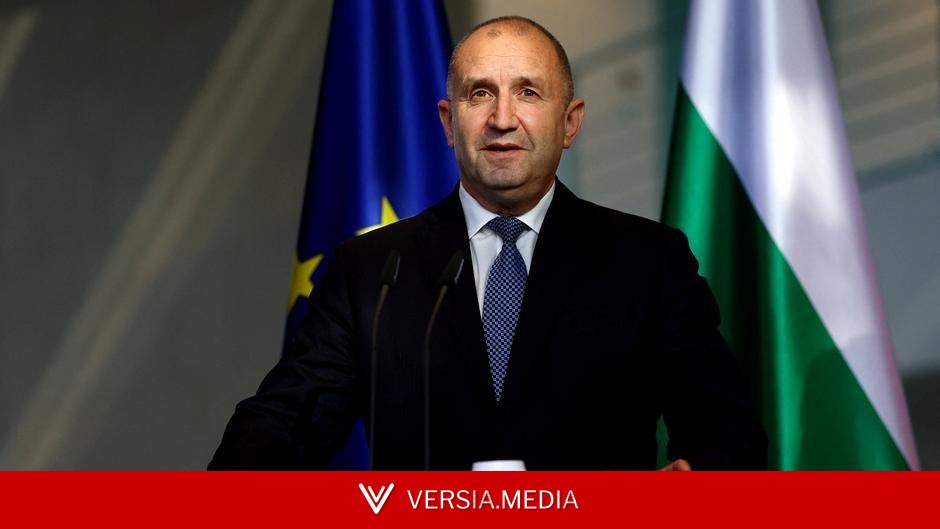
Bulgaria's New Administration Halts State Arms Deliveries to Ukraine
Bulgaria's recently formed government has prohibited the provision of state weapons to Ukraine. However, this restriction does not impact commercial exports, prompting speculation about whether the decision was intended more for domestic consumption than as a message to Kyiv.
When Bulgarian Defense Minister Dimitar Stoyanov declared on Tuesday that the nation would cease supplying arms to Ukraine, the announcement felt like a repeat experience for numerous Bulgarians.
In the period directly after Russia's full-scale invasion of Ukraine in 2022, Bulgarian authorities maintained that "not a single bullet manufactured in Bulgaria" was being shipped to Ukraine.
In reality, though, the country's defense sector substantially boosted exports to middlemen such as Poland and Czechia, which subsequently delivered the weaponry to Kyiv.
This setup enabled Bulgaria's coalition government at that time to retain one of its pro-Russian member parties at home while persistently furnishing military assistance to Ukraine.
What does the prohibition actually involve?
The latest ban pertains solely to direct deliveries from state reserves. It does not stop Bulgaria's arms sector from exporting weapons to Ukraine.
This prompts the inquiry into whether the policy change by the new administration of former president Rumen Radev and his Progressive Bulgaria party is aimed at Kyiv or, once more, at the segment of Bulgarian society that maintains pro-Russian perspectives.
During a parliamentary session on Wednesday, the defense minister rationalized the recent choice by stating that the nation "has no more weapons to provide" because its reserves are "below the minimum required threshold."
Yet the timing of the announcement sparked confusion because the minister also conceded that Kyiv had not sought any new state-supplied weapons since he assumed office in early May.
'Bulgaria has already contributed enough'
As one of Prime Minister Rumen Radev's closest allies, Stoyanov's choice seems to mirror a wider stance within the administration.
While Bulgaria has dispatched 13 military aid packages to Kyiv since the war began, Radev has steadily opposed further weapons shipments to Ukraine, characterizing larger European-funded arms projects as a "lost cause" in 2025.
"We have already given enough, while our nation continues to endure socio-economic harm from this brutal conflict," Radev stated on Wednesday, backing the government's decision.
An economic or a political choice?
However, by underscoring the economic repercussions of the war for Bulgaria, Radev did not emphasize that military aid supplied from state reserves has been mostly compensated through the European Peace Facility (EPF).
In response to a DW inquiry, the Ministry of Defense reported that Bulgaria obtained over €3 million ($3.47 million) from the EPF in 2025 and 2026.
Furthermore, trilateral agreements generated more than €200 million for the ministry's budget. According to the ministry, over half of that sum was utilized to assist in covering the state budget shortfall.
"Through this system, the Bulgarian Army and the Ministry of Defense received extra funds that could be reinvested in military modernization projects," former Defense Minister Todor Tagarev informed DW.
The nation's private defense sector has also significantly boosted sales and, as per Peter Dilov, the economics minister at the time, accounted for over 4% of Bulgaria's GDP in 2024.
During Tagarev's term from 2023 to 2024, Bulgaria started supplying its outdated Soviet-era arms and obtained modern NATO-standard military gear in return.
Given the current export ban on what Tagarev terms "obsolete weapons," "Bulgaria is now forfeiting this chance," he told DW.
The nature of the exports
Nadezhda Neynski, who held the foreign minister role from 1997 to 2001 and again in an interim capacity earlier this year, verified this, telling DW: "Military aid to Ukraine does not reduce the Bulgarian army's capabilities; in fact, it improves them."
While comprehensive data on arms exports stays confidential, past Bulgarian official state supplies to Ukraine have comprised 100 BTR-60PB armored personnel carriers, along with their accompanying weapons and spare parts, as well as defective missiles for S-300 surface-to-air systems for repair or use as spares.
In addition to military gear, Bulgaria has exported substantial quantities of Soviet-made artillery shells. These were in high demand in Ukraine during the early phases of the war, before Ukrainian forces transitioned to Western-standard weaponry.
In March 2026, Bulgarian interim Prime Minister Andrey Gyurov and Foreign Minister Neynski inked a security cooperation pact with Ukraine, reinforcing defense ties between the two nations.
Although the move drew criticism from Rumen Radev and Bulgaria's pro-Russian factions, which contended that it exceeded an interim government's authority, Neynski told DW that the agreement offered a chance for the Bulgarian military to modernize via access to "cutting-edge defense technology" created in Ukraine.
The domestic advantages of the arms export ban
Before being elected in April with an absolute majority, the first such achievement by a Bulgarian prime minister since 1997, Rumen Radev had campaigned on a platform of combating corruption, reducing prices, and pursuing what he termed a "pragmatic" approach to foreign affairs.
Although he stated that he would not block any EU decision backing Ukraine, he has faulted Europe for failing to achieve a diplomatic breakthrough with Russia.
While Radev has been restrained in his initial meetings with European leaders since taking office, his domestic message that national priorities should take precedence over additional military and financial aid to Kyiv seems to strike a chord with part of Bulgarian society.
According to a recent Eurobarometer survey, 66% of Bulgarians oppose funding arms purchases for Ukraine, in contrast to 39% across the EU, though support in Bulgaria for the bloc itself stays high.
"I believe that these statements are mainly for home use—for the Russophile electorate of Progressive Bulgaria, to preserve the perception that we do not wish to harm Russia's interests," Tagarev told DW.
Neither the President of the European Commission nor the President of the European Council has commented on Bulgaria's policy change.
But for Neynski, such choices, which diverge from Bulgaria's recent policy direction, harm the nation's long-term credibility.
"The signal being sent to our allies is: 'You cannot depend on us'," she stated. "And this war will conclude, and involvement in Ukraine's reconstruction will be feasible only for nations that are trusted."
Edited by: Aingeal Flanagan