The leaders of the world's most affluent nations are convening in France, with the conflicts in Iran and Ukraine taking center stage on the global agenda. The United States has pledged to bring peace to Iran, while other leaders maintain a cautious sense of optimism. DW provides the most recent updates.
Key points to know
Heads of state from the Group of Seven (G7) major industrialized nations are assembling in Evian-les-Bains, France, from June 15 to 17 to address matters of worldwide significance
The discussions are anticipated to be largely shaped by the wars in Iran and Ukraine
The summit commences amid scrutiny following Sunday's declaration of a preliminary peace agreement between the US and Iran
Member countries will seek to manage their relationship with US President Donald Trump, who has accused them of exploiting the US on trade and failing to support American military operations in Iran
Host Emmanuel Macron has additionally extended invitations to leaders from Egypt, Qatar, Ukraine, and the United Arab Emirates to participate in the session
Scroll down for the most recent headlines, videos, and analyses regarding the G7 summit on Monday, June 15, Tuesday, June 16, and Wednesday, June 17, 2026.
Tired of overlooking our live updates? Click here to set us as a Preferred Source on Google. Then tap the "Star" or "Preferred" option to keep DW News at the top of your feed.
Trump threatens France with 100% tariffs before arriving for G7
US President Donald Trump stated on Monday that he would be left with "no choice" but to impose 100% tariffs on French wine if Paris does not comply with his demands and eliminate its digital tax on American technology firms.
Trump, speaking to the New York Post, indicated he had directly warned French President Emmanuel Macron, insisting that Macron repeal France's 3% levy on US tech giants or else face duties in the American marketplace.
"I requested that he not charge American companies, and if they do, I have no alternative but to impose a 100% tariff on all champagnes and all wines coming out of France," Trump told the publication.
"All [Macron] has to do is abolish the sales tax, and he wouldn't face that kind of pressure," he added.
Neither officials from the White House nor the Elysee have offered further remarks on Trump's threat.
French wine and spirits exporters described it as detrimental to their export-reliant sector as Trump persists in disrupting global trade relations with his tariffs.
Alcohol represents one of the EU's leading exports to the US, generating approximately €9 billion ($10.5 billion) in trade in 2024.
EU wines and spirits currently face a 15% import tariff in the US—a rate that Paris has been working to reduce to zero since Trump and European Commission President Ursula von der Leyen finalized a US-EU trade agreement last summer.
France implemented a 3% tax on digital services revenues earned within the country back in 2019.
The tariff applies solely to companies with revenues exceeding €25 million in France and €750 million globally.
"This digital tax, decided upon by Europeans, implemented by several nations, is part of our legislation," French President Emmanuel Macron said in an interview on French TV channel TF1, responding to Trump's threat. "It is not the United States that determines the Europeans' laws."
G7 Summit in Evian: Macron's global stage—and all eyes on Trump's arrival
The G7 summit serves as the major platform for French President Emmanuel Macron this year. The initial guests have already arrived at the historic Hotel Royal in Evian, including Brazilian President Luiz Inacio Lula da Silva and European Commission President Ursula von der Leyen.
Brazil is not a member of the exclusive G7 club, which comprises France, the United States, Germany, the UK, Japan, Italy, and Canada. However, Macron has purposefully invited several key partners beyond the group, expanding the table for some meetings at this summit.
Red carpets, bright sunshine, a sweeping panorama of the Alps, and the deep blue waters of Lake Geneva—the setting is ideal. There is also a feeling of relief: just hours before the summit, US President Donald Trump and Iran announced a framework agreement aimed at ending their conflict.
That deal is expected to dominate conversations in Evian, particularly because of its implications for Europe. The focus will be on how European nations can support the agreement and help stabilize the region.
For Trump, the deal represents a political victory. The unpredictable summit participant could therefore arrive in a positive frame of mind. European leaders will aim to capitalize on that momentum, with the goal of redirecting the US president's focus back to Ukraine.
How new peace negotiations between Russia and Ukraine can be initiated, with the US and European allies working collaboratively, will be a crucial question. Ukrainian President Volodymyr Zelenskyy is anticipated to arrive in Evian on Tuesday morning, adding urgency to those discussions.
The elegant conference hotel itself is fully secured. Here, leaders have the time and space to concentrate on major global challenges away from public scrutiny and political commotion.
Around the Hotel Royal, security is at its maximum level. Without proper authorization, there is no entry. Checkpoints block roads within a radius of several kilometers.
For local residents, daily life has come to a standstill. "Everything is blocked," says one restaurant owner. Residents, he adds, are frustrated by constant checks and are largely staying at home.
Evian-les-Bains, the town hosting the G7 summit
The lakeside town of Evian-les-Bains, which French President Emmanuel Macron selected as the venue for his final G7 summit as host, is situated at the base of the Alps on Lake Geneva.
It is a spa town in eastern France's Haute-Savoie region, located on the southern shore of Lake Geneva, directly across from Switzerland.
It has a population of just under 10,000.
Despite being such a small town, Evian's thermal springs, lakeside setting, and Belle Epoque architecture have drawn visitors for centuries.
It was also here that the Evian Accords ending France's war in Algeria were signed, along with the recognition of Algerian independence.
Evian-les-Bains is perhaps most renowned for the eponymous mineral water brand sourced from its springs—which originate from rainwater and snowmelt naturally filtered through glacial moraine and alpine rock layers.
The Evian mineral water brand is owned by French company Danone, which produces some 6 million bottles per day. Evian last hosted a G7 summit in 2003—when the group included Russia and was known as the G8—where leaders gathered hoping to mend transatlantic relations strained by the US invasion of Iraq.
Read: Protests underway ahead of G7 summit
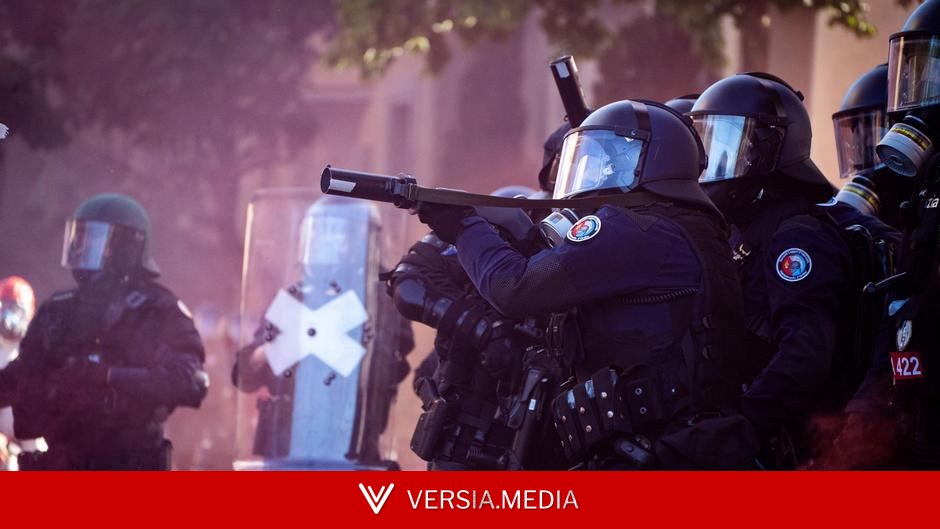
As is often the case when world leaders convene for major summits—think World Economic Forum or G20—this G7 is no different, with protesters throwing projectiles clashing with police firing tear gas in nearby Geneva, Switzerland, ahead of the meeting.
You can read Natalie Mueller's story on what is expected to be days of clashes here: Police fire tear gas at anti-G7 protesters in Geneva
Has Trump really gotten a deal on Iran?
The war in Iran is set to dominate this week's G7 summit.
US President Donald Trump on Sunday announced that a previously elusive "framework peace deal" with Iran had been reached, writing on social media: "Ships of the world, start your engines. Let the oil flow!"
That would be positive news if accurate, but no details have been disclosed publicly so far.
However, both Tehran and Trump later stated that the strategic Strait of Hormuz will only reopen after the deal is signed in Geneva, Switzerland, on Friday.
Washington and Tehran have remained tight-lipped about the specifics of the agreement, which reportedly includes two months of discussion on the future of Iran's nuclear program—which Trump previously claimed had been "obliterated."
Trump has faced criticism from the G7's European leaders—French President Emmanuel Macron, German Chancellor Friedrich Merz, Italian Prime Minister Giorgia Meloni, and British Prime Minister Keir Starmer—for failing to consult them before making his decision to go to war with Iran.
In turn, Trump has publicly rebuked those same leaders for not being supportive of his "excursion."
This week's G7 will see these disagreements on full display.
Initial US-Iran deal 'should not be overestimated'
To view this video please enable JavaScript, and consider upgrading to a web browser that supports HTML5 video
G7 leaders arrive in France as Trump promises peace in Iran
Leaders from the G7—which brings together some of the world's wealthiest nations—are gathering in Evian-les-Bains, France, on Monday to begin a three-day summit that will be dominated by the wars in Ukraine and Iran.
Russia's invasion of Ukraine has been on the agenda for over four years now, with no end in sight, but the security and economic consequences of that war have been overshadowed by those stemming from Iran, which the United States and Israel attacked on February 28.
The nearly 15-week war has kept global markets in turmoil as Iran maintains a stranglehold on the world's oil supplies by blockading the critical Strait of Hormuz—through which roughly 20% of global supply normally flows.
The situation has cut off access to oil, gas, and fertilizer, driving prices for everything from food to household goods through the roof worldwide.
Beyond the leaders of Canada, Germany, Italy, Japan, the UK, and the US, host Emmanuel Macron has also invited the heads of Egypt, Qatar, Ukraine, and the United Arab Emirates to participate in the session.
Trump promised to end the war in Ukraine on his first day back in office (January 20, 2025), but a lasting resolution to the conflict has so far eluded him.
While Iran is expected to lead the agenda on Monday, Tuesday has been set aside for discussions on the situation in Ukraine and what this means for European security.
Other issues scheduled for discussion during the event include the sourcing of critical minerals as well as growing economic instability. Brazil, India, Kenya, and South Korea have all been invited to join in these conversations.
War, climate, inequality drive Geneva anti-G7 protests
To view this video please enable JavaScript, and consider upgrading to a web browser that supports HTML5 video
Welcome to our coverage
Good morning from the DW newsroom in Bonn, where we are just beginning our coverage of this week's G7 summit in France.
Leaders from the world's Group of Seven (G7) top industrialized nations are assembling in Evian-les-Bains on Monday for a meeting scheduled to conclude on June 17.
The event, hosted by French President Emmanuel Macron, will see him and leaders from Canada, Germany, Italy, Japan, the UK, and the US discuss an international agenda set to be dominated by the wars in Iran and Ukraine.
US President Donald Trump, fresh from celebrating his 80th birthday, will arrive on Monday and is scheduled to meet with Macron one-on-one in the late afternoon (5:45 p.m. local time, 1545 GMT) before joining the others for a working dinner.
Ahead of the summit, protests were held in nearby Geneva, Switzerland, amid heavy criticism from rights and advocacy groups over massive cuts to humanitarian aid by G7 countries in favor of boosting arms investments as AI begins to take more jobs and resources while the world's richest get richer?