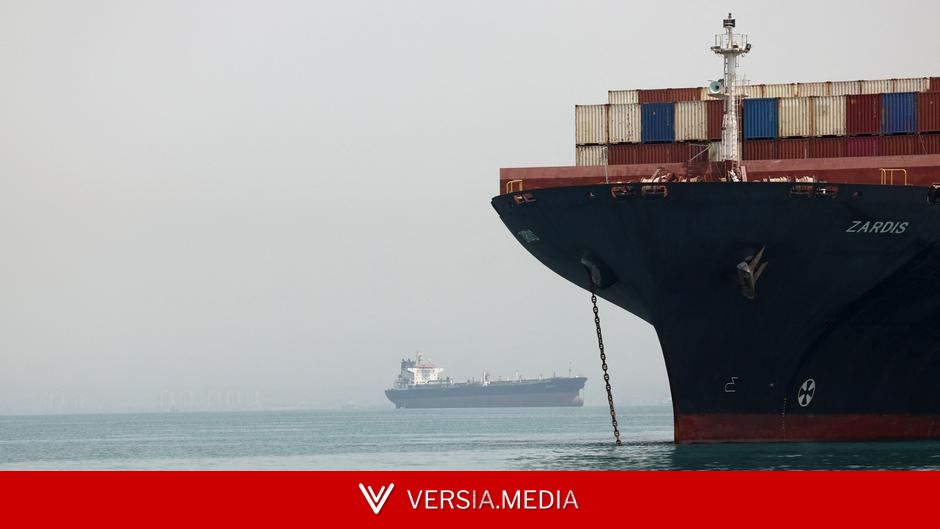
World leaders have expressed support for a peace agreement expected to reopen the Strait of Hormuz to global maritime traffic, though many specifics remain unconfirmed. DW provides further details.
Key developments
The United States and Iran have declared a provisional ceasefire agreement, scheduled for signing later this week
US President Trump stated the accord would reopen the Strait of Hormuz, but other specifics are still unclear
Global leaders have praised the announcement as a significant initial move
Oil prices dropped following the declaration
Trump posted: 'Ships of the world, start your engines!'
Israel has stated it will not pull back from territory captured in Lebanon
Continue reading here for updates on the Iran conflict on Monday, June 15.
Missing our live updates? Click here to add us as a Preferred Source on Google. Then tap the "Star" or "Preferred" to keep DW News at the top of your feed.
WATCH: German Foreign Minister Johann Wadephul praises the US-Iran agreement
Iranian and Turkish foreign ministers discuss ceasefire declaration
Iranian Foreign Minister Abbas Araghchi spoke by phone with his Turkish counterpart Hakan Fidan on Monday, addressing the ceasefire announcement.
According to a statement on Telegram, Araghchi said that under the agreement, Israeli attacks on Lebanon must cease.
Fidan expressed hope about the announcement but cautioned against any possible "provocations" that might disrupt the accord.
Araghchi also held separate conversations with the foreign ministers of Egypt and Iraq, his office confirmed.
Additional Israeli strikes reported in Lebanon
Despite news of the provisional ceasefire deal, Israel continued to carry out artillery and air strikes in southern Lebanon overnight.
Lebanon's state-run National News Agency (NNA) reported new Israeli attacks near the southern city of Nabatiyeh.
On Monday morning, local officials in Nabatiyeh advised residents not to return to the city "under any circumstances," citing ongoing security threats.
Israel did not immediately respond to the reports, but the Israeli military stated it intercepted a drone from Lebanon overnight.
Hezbollah has not formally commented on the announcement, but Lebanese parliament speaker Nabih Berri, a Hezbollah ally who serves as a go-between for the group and the US, thanked both sides for including "an essential and binding clause on halting the Israeli aggression on all of Lebanon."
Lebanese President Joseph Aoun stated on Monday that he hoped the peace deal would bring a "definitive end" to the conflict between Israel and Hezbollah.
Aoun commended the US-Iranian memorandum of understanding for recognizing that "Lebanon's security and safety are an integral part of any effort to consolidate stability in the region."
Meanwhile, an unnamed Lebanese security source informed the AFP news agency that "Lebanon was not informed of the terms of the agreement or the time of the ceasefire."
UN rights chief welcomes announcement at 'fragile moment'
UN human rights chief Volker Türk welcomed news of a provisional ceasefire deal and urged all parties to "exercise maximum restraint" during what he described as a "fragile moment."
"I welcome the announcement that the United States and Iran have agreed on a peace deal that provides for an immediate and permanent ceasefire, the reopening of the Strait of Hormuz, and a framework for further negotiations," Türk said in a briefing on Monday morning.
"At this fragile moment it is clear all sides need to exercise maximum restraint and work to implement the agreement reached quickly and in good faith," Türk added.
Türk also called for an immediate halt to hostilities in Lebanon, where Israel and Hezbollah are engaged in conflict, and urged Israel to withdraw from the south of the country. He called for an investigation into whether the parties involved had breached international law.
Saudi Arabia, Qatar react to news of regional ceasefire
Saudi Arabia welcomed the ceasefire announced by the United States and Iran as a foundation for launching detailed peace negotiations.
The kingdom's Foreign Affairs Ministry emphasized that the final agreement should "take into consideration the security interests of regional states, sticking to the principle of non-interference in the interior affairs of other countries."
Iran has targeted Saudi Arabia multiple times during the conflict, mainly striking US bases in the Gulf nation.
Neighboring Qatar, which relies on the Strait of Hormuz for gas exports, also welcomed the announcement.
In remarks published by the state-run Qatar News Agency, Doha's Foreign Ministry described it as "an important step toward consolidating sustainable peace and promoting economic growth regionally and internationally."
European leaders express cautious optimism
European leaders welcomed the news of a ceasefire deal between the United States and Iran but stressed that the announcement must be followed by concrete action.
EU chief Ursula von der Leyen stated that the "priority now is its swift and full implementation."
She called for the immediate resumption of toll-free transit through the Strait of Hormuz, an end to Iran's nuclear program, and the extension of the ceasefire to Lebanon, where Israel has been conducting strikes against Hezbollah.
"Of course there can be no peace in the Middle East while Lebanon is in flames," von der Leyen said. "Once again Europe calls on all parties to respect Lebanon's sovereignty and territorial integrity and implement a genuine ceasefire."
British Prime Minister Keir Starmer also welcomed the announcement but noted that more work is needed to secure a lasting peace.
"Obviously, nothing is guaranteed, but it is, I think, a significant breakthrough, a very significant breakthrough," Starmer told a press conference on Monday morning.
"Hopefully, something which as we work together we can turn into that enduring peace that we all want to see."
The comments on Monday follow earlier reactions from figures such as Germany's Friedrich Merz, who emphasized the deal must be implemented with "determination," and France's Emmanuel Macron, who similarly called for the "swift and full implementation" of the agreed terms.
China hopeful for Strait of Hormuz reopening
China has responded positively to the news of a ceasefire deal between Iran and the United States that would reopen the Strait of Hormuz to international trade.
"China welcomes the agreement ... and expresses appreciation for the mediation efforts made by Pakistan," a Foreign Ministry spokesperson said on Monday.
China "hopes that safe and free passage through the strait will be restored as soon as possible," the spokesperson added.
Mediator Pakistan hails 'historic step towards peace'
Pakistani Prime Minister Shehbaz Sharif declared that "the sun of peace has risen" on Monday after earlier announcing a provisional ceasefire deal between the United States and Iran.
"Today, the world has seen a historic step toward peace," Sharif told Pakistani lawmakers. "After the darkness of war, the sun of peace has risen."
Pakistan has acted as the primary mediator between Washington and Tehran throughout the conflict.
Israeli defense minister says no withdrawal from Lebanon
Israel will not withdraw from the land it seized in southern Lebanon, Defense Minister Israel Katz said on Monday.
Katz's remarks were the first official Israeli comments after the United States and Iran announced a provisional peace deal overnight, set to be signed on Friday.
Iran has linked the deal to a cessation of Israeli strikes against Hezbollah in Lebanon, although the exact terms have not been disclosed.
However, in his remarks on Monday, Katz stated that if Iran attacked Israel due to its actions in Lebanon, Israel would retaliate by striking Iran with "great force."
What to know about the tentative deal to end the Iran war:
The detailed terms of the agreement, scheduled for signing in Switzerland on Friday, have not yet been made public. Here is what is known so far:
The Strait of Hormuz would reopen after the deal is signed on Friday, according to Trump. Tehran confirmed that timeline.
A broader agreement is to be negotiated during a 60-day ceasefire period.
The 60-day period would address Iran's nuclear program.
Relief from Iranian sanctions would also be negotiated.
Pakistan, which announced the deal, has insisted it includes Lebanon. Israel, which has continued its fight against Hezbollah, has yet to comment.
On Saturday, Trump had suggested the deal would not include Iran handing over its enriched uranium. This had been a key demand of Israel, which was not part of the talks.
EU's Kallas welcomes 'potential breakthrough'
On Monday, the European Union's high representative for foreign affairs, Kaja Kallas, welcomed the preliminary deal between the US and Iran to end the war.
"This marks a potential breakthrough," Kallas wrote on X. "It can give much needed space for deeper negotiations on Iran’s nuclear program and other critical issues. Once implemented, the deal should also ease the global energy crisis."
Kallas said she had spoken with her Iranian and Gulf counterparts in recent days. She added that EU Foreign Ministers meeting later on Monday will discuss how the bloc can be closely involved in the coming phase.
"From economic leverage to nuclear expertise and longstanding relationships with Gulf partners, the EU stands ready to contribute to a sustainable resolution," Kallas said.
Oil prices fall, stocks rally after ceasefire announcement
Oil prices declined and shares rose on Monday after the United States and Iran announced a provisional peace deal that would reopen the Strait of Hormuz.
Brent crude oil — the international benchmark — fell over 4% to $83.82 per barrel in early trading.
"Ships of the world, start your engines. Let the oil flow!" Trump posted on his Truth Social platform.
Stock markets also reacted positively to the news. In Asia, Japan's Nikkei and South Korea's KOSPI each gained more than 5%. On Wall Street, futures for the S&P 500 were up 1% and for the Dow Jones Industrial Average up 0.9%, pointing to likely early gains.
But it could still take months for oil prices to stabilize, while shipping and insurance companies will also want to be confident that this latest ceasefire announcement will hold.
"Markets are likely to be cautious in not over-extending optimism as they watch for an actual resumption of traffic across Hormuz," analysts from Japan's Mizuho Bank said in a commentary.
Meanwhile, as Europe woke up on Monday, European Central Bank President Christine Lagarde told France Culture radio that the ceasefire agreement reached with Iran was "good news."
Welcome to our coverage
Good morning and welcome to DW's coverage of the Iran conflict as we follow the announcement of a peace deal between the United States and Iran.
On Monday, the EU's foreign policy chief, Kaja Kallas, hailed the "potential breakthrough." She said she hoped it would help with the global energy crisis.
Oil prices fell immediately after the announcement, but analysts believe it will take months for prices to truly stabilize if this latest announcement holds.
Your feedback