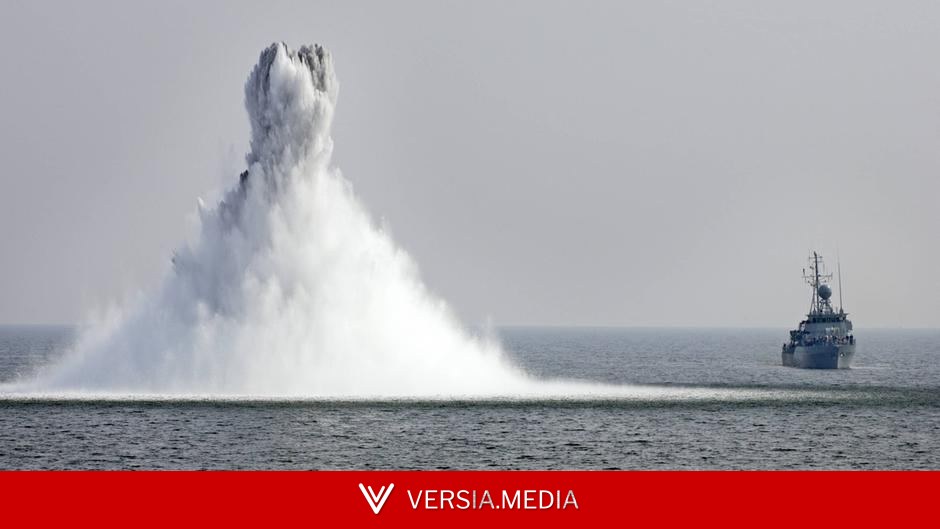
Mines remain in the Strait of Hormuz, delaying its reopening for commercial shipping. How hazardous are naval mines, and what methods exist to remove them?
Many world leaders and heads of state welcomed a proposed peace agreement between the United States and Iran.
Germany, France, the United Kingdom, and Italy suggested the possibility of easing sanctions on Iran, highlighting the need to urgently reopen the Strait of Hormuz.
In a joint declaration, the four nations stated they were "committed to doing our part [...] — including through a strictly defensive and independent mission to reassure commercial shipping and conduct mine clearance operations."
A threat to merchant vessels
However, even if the Strait of Hormuz is reopened for shipping, the Persian Gulf and neighboring areas will stay hazardous for merchant ships. In early April, the Iranian Revolutionary Guard announced that Tehran had placed mines in the Strait.
"We are not even sure that mines exist [in the Strait of Hormuz]," said Johannes Peters, an undersea warfare specialist at Kiel University's Institute for Security Policy. "But the implied threat is enough [to prevent passage]. For now, no one in the war zone can actually go to verify."
How dangerous are naval mines and how can they be cleared?
To view this video please enable JavaScript, and consider upgrading to a web browser that supports HTML5 video
How do sea mines function?
Naval mines are low-cost underwater explosive devices intended to detonate when triggered by nearby ships. They come in three primary types, categorized by their positioning:
Drifting mines that move freely on or near the water's surface
Moored mines that hang beneath the water's surface and are anchored to the seabed
Bottom mines that sit on the ocean floor.
During World War II, moored mines with switch horns that caused an explosion on physical contact with a vessel were the standard British naval mine – copied from captured German mines developed in World War I. "Modern mines have very little in common with those," Peters told DW.
The firing mechanisms on newer devices no longer require direct contact; instead, they can be activated by specific magnetic fields, underwater acoustic waves, or reduced underwater pressure from passing ships.
To calibrate such a mine for a specific ship type, "submarines can help determine the acoustic signature of an enemy vessel," Peters explained. "These hostile ships will set off the mines with their acoustic profiles, while friendly ships can pass through the mined area safely."
Lengthy search for potential explosives
The mine clearance process, which includes mine hunting and mine sweeping, can be protracted. To hunt a mine, suspicious items must first be located, and then experts must assess whether it presents a danger.
If it does, several options exist: specialists can retrieve the mine, disarm it, or set off a controlled underwater blast. Peters likened this to "an underwater ordnance disposal service."
However, recent advancements offer new ways to clear mines without endangering lives. "When possible, we use drones to locate objects, then identify and destroy them," Ukrainian soldier Mykola told DW earlier this year. He is part of a Ukrainian team clearing naval mines in the Black Sea that Russia laid as part of its war of aggression.
How Iran's Navy wields power in the Strait of Hormuz
To view this video please enable JavaScript, and consider upgrading to a web browser that supports HTML5 video
German Navy: drone-based mine hunting
Germany's navy has also adopted drones for sea mine detection. "We primarily use autonomous systems to scan the seabed," Frigate Captain Andreas of the 3rd Minesweeping Squadron of the German Navy told DW. For security reasons, only his first name can be published.
"In the past, boats with sonar systems had to pass directly over suspected mine areas to detect them," Andreas continued. "Autonomous systems mean those 40 lives no longer face direct risk."
They also significantly reduce the need for human personnel. The drones independently send seabed footage back to their base for review. But humans still must examine the footage to differentiate harmless debris from deadly sea mines and decide how to handle explosives once found.
Andreas noted that using drones to search the seabed made the Navy more efficient overall, but it could still take decades, or longer, to clear a maritime area of mines after a conflict. Artyom, another Ukrainian mine sweeper in the Black Sea, confirmed this based on his own experience.
"We are still finding mines from World War II, and even some from World War I," he said. "That shows how many years of work we still have ahead of us."
Strait of Hormuz: drone deployment too challenging?
The battery life of drones used by Germany's navy still limits how long they can operate in open waters. For now, they must be launched relatively close to the area they are intended to survey.
"You always have to be nearby," Andreas explained. "That would be difficult in a sensitive area like the Strait of Hormuz. Iran[ian weapons have] a long range, and we need to protect our personnel."
Several companies are developing drones capable of longer operations. One such firm is Euroatlas from Bremen in northern Germany. The company reports that its underwater Greyshark drone can currently sustain 10 knots (18.5 kilometers per hour, 11.5 miles per hour) for 6 hours, or 4 knots for three times as long.
Euroatlas has announced that the autonomous, battery-powered version will enter production in September 2026. Series production of a subsequent model equipped with a fuel cell system enabling week-long deployments is expected by the end of the year.
Greyshark drones could soon be utilized
Markus Beer is the Chief Sales Officer for so-called autonomous underwater vehicles (AUV) at Euroatlas. He explained to DW how Greyshark drones could be valuable in the current crisis off Iran's coast.
"Ships in the Strait of Hormuz are at risk of being fired upon from land," he said. "That includes minehunting vessels. But underwater [drone] reconnaissance could still be carried out, without risk and without escalating the situation."
He added that Greyshark drones offer the benefit of greater range, allowing them to be launched from a safe distance. "The small drones currently used for mine hunting can only last a few hours," the sales officer explained. "Greyshark drones can travel much farther," he said, while also capturing high-resolution images and independently identifying objects found on the seabed.
Last September, Euroatlas showcased the capabilities of its Greyshark underwater drone at a leading event for testing uncrewed maritime systems, the Robotic Experimentation and Prototyping using Maritime Unmanned Systems (REPMUS), held off Portugal's coast.
This article was originally written in German. It was originally published on April 19, 2026, and updated on June 15, 2026.