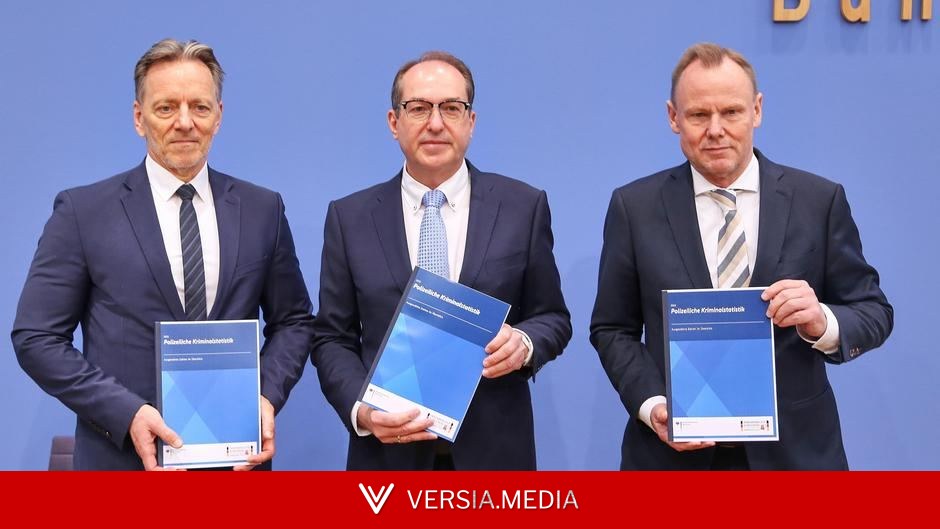
Germany's regional interior ministers are holding their biannual conference with immigration, deportations and benefits high on the agenda. Meanwhile, Germany and Poland are marking 35 years of cooperation. DW has more.
What you need to know
German interior ministers meeting in Hamburg
Hamburg minister calls for lower deportation threshold for refugees
Germany and Poland marking 35 years of cooperation
This blog is now closed. Below you can read DW's coverage of what made the news in Germany on Wednesday, 17 June, 2026.
Tired of missing our real-time updates? Click here to add us as a Preferred Source on Google . Then tap the "Star" or "Preferred" to keep DW News at the top of your feed.
Contract awarded to connect 2-gigawatt offshore wind park to grid
German electricity grid operator 50Hertz said Wednesday that it had awarded a contract to connect offshore wind farms in the North Sea to the network to Siemens Energy and offshore wind infrastructure manufacturer Neptun Smulders Offshore Renewables (NSORe).
The project, called "North Sea Connector 2," includes an offshore platform, which will be built by NSORe and outfitted with transmission technology by Siemens Energy, and onshore station in northern Germany.
The project will convert power from offshore wind farms on a platform and then feed it to the German grid via undersea cables. It will handle up to 2 gigawatts of power, equivalent to the electricity needs of around 2 million households.
Negotiations are still underway regarding a second, identical project. If this project materializes, the contract value for just NSORe would amount to approximately €2.5 billion ($2.9 billion).
Are floating wind farms more efficient?
To view this video please enable JavaScript, and consider upgrading to a web browser that supports HTML5 video
The announcement comes as Germany and other European countries work to create climate-friendly offshore wind power to achieve greater energy independence from foreign suppliers and move away from fossil fuels .
Economy Minister Katherina Reiche welcomed the deal.
"Against the backdrop of a changed geopolitical environment and growing trade conflicts, it has become clear how important resilient supply chains and technological sovereignty are," she said.
Siemens Energy said in a statement that most of its work on the project, including key electrical equipment, will be carried out in Germany, with transformers and converters produced in Nuremberg and switchgear supplied from Berlin.
NOSRe said the offshore platform would mainly be built at a shipyard near the northern German city of Rostock.
The companies said the project would create some 500 jobs in the northern German state of Mecklenburg-Western Pomerania.
"This is outstanding news for Mecklenburg-Western Pomerania," the state's premier, Manuela Schwesig, said. "The two concrete large-scale projects stand for industrial value creation, good jobs, and future technologies. They strengthen our state as a major shipbuilding and industrial hub and demonstrate that Mecklenburg-Western Pomerania plays an important role in the energy transition."
The North Sea Connector 2 is scheduled to go online by the end of 2034.
Merz praises G7's pledge of for Ukraine
German Chancellor Friedrich Merz called the G7 's joint declaration of support for Ukraine a "real success," particularly because leaders were able to convince US President Donald Trump to sign on as well.
"This is the first time since President Trump took office that we have issued a joint declaration at a G7 summit and found common language on the major foreign and security policy issues of our time," Merz said from the summit at Evian-les-Bains, France. "I consider that a real success."
The G7 leaders agreed "to increase the delivery of air defence capacities, additional systems and interceptors, and long-range capabilities," their statement said.
As Russia's war in Ukraine continues, the German leader also praised the G7's appeal for even more sanctions and increased economic pressure on Russia, calling it a success that "sets a new tone, including regarding transatlantic unity and resolve."
Germany and Poland to sign scaled-down defense deals
German Foreign Minister Johann Wadephul welcomed his Polish counterpart, Radoslaw Sikorski, to Berlin on Wednesday as the two countries marked the 35th anniversary of their 1991 "Treaty of Good Neighborship and Friendly Cooperation" with a series of defense agreements.
"Aware of the tragic history of the 20th century, we bear a particular responsibility towards our region and our continent — as allies within NATO and partners in the European Union ," the two ministers said in a joint statement.
Notably, the pair denounced " Russia 's aggressive actions, particularly of a hybrid nature and in the field of disinformation," the aim of which they said is "to divide our societies, destroy public order, and undermine confidence in the state and its institutions."
Sharing borders with Ukraine , Russia (via the exclave of Kaliningrad ) and Russian ally Belarus , Poland has placed significant emphasis on defense and security and recently signed major treaties with Europe's two nuclear powers: France in May 2025 and the United Kingdom in May 2026.
According to the Polish Defense Ministry, the new agreement with Germany will update an existing framework signed in 2011 and mainly covers military mobility, infrastructure, cooperation in the Baltic Sea , cybersecurity and space.
It reportedly does not include additional new security guarantees, which remain limited to NATO's existing commitments ( Article 5 ) and those of the EU.
Reports in Polish media suggest there had been plans for a more ambitious pact but, expecting opposition from nationalist president Karol Nawrocki and the conservative Law and Justice (PiS) party, the government opted for a scaled-down version.
NATO front-line nations push for 'drone wall,' expert says
To view this video please enable JavaScript, and consider upgrading to a web browser that supports HTML5 video
Germany commemorates 1953 GDR uprising
German politicians on Wednesday commemorated the 1953 uprising in the former German Democratic Republic (GDR) which was brutally put down by the East German authorities with the help of occupying Soviet troops.
"On 17 June, 1953, brave people – workers, teenagers and disillusioned people from across the GDR – took their destiny into their own hands and rose up against the SED regime," said Culture Secretary Wolfram Weimer.
"The courage of those people to stand up for a free Germany moves me deeply."
On this day 76 years ago, around one million people took to the streets of what was then East Berlin and 700 other locations across East Germany in protest against an increase in production quotas ordered by the ruling communist SED (Socialist Unity Party).
Protesters also called for better living conditions, free elections and German unification rather than the process of "Sovietization" which was being accelerated in the Russian occupation zone at the time.
But East German and Soviet troops and tanks were deployed to the streets in a violent clampdown which saw at least 55 people killed and 15,000 more arrested – around 1,500 of whom were later convicted.
"Unity and justice and freedom can only survive together," said Weimer, quoting the opening line of the German national anthem. "Brave people lost their lives for this in the GDR. Their names must never be forgotten."
Later on Wednesday, Berlin city mayor Kai Wegner and Head of the Chancellery Thorsten Frei were set to lay a wreath at a memorial for the victims of the uprising in the northern Berlin district of Wedding.
In future, a permanent memorial for all victims of the SED dictatorship is planned in central Berlin.
GDR assets: Part 1 — the mystery of the missing billions
To view this video please enable JavaScript, and consider upgrading to a web browser that supports HTML5 video
Germany facing heatwave
Germany is gearing up for a heatwave in the second half of this week and into the weekend, with temperatures set to soar well above 30°C (86°F) and an increased likelihood of heat-induced storms.
Temperatures of between 30°C and 33°C were already expected in western and southwestern Germany on Wednesday and are set to rise to 36°C on Thursday, according to the German Meteorological Service (DWD), which said highs of 38°C could be reached by the end of the week.
"The first nationwide heatwave is coming from the southwest and it's packing a punch," said DWD meteorologist Marcel Schmid, explaining that warm, damp air was arriving over Germany from northwest Africa.
"The humid, hot weather is set to stay with us into the weekend with storms in some regions," he said.
People looking to avoid the heat are advised to head north for the weekend, where temperatures are predicted to remain in the mid-20s.
World Cup: Germany shirts run out of letter V
Almost a week into the tournament, World Cup fever has very much taken hold in Germany , with the Nationalmannschaft's 7-1 thumping of minnows Curacao on Sunday looking all the more impressive in light of Spain's goalless draw with Cape Verde on Monday.
These group-stage games against smaller nations clearly aren't as easy as one might think!
Strikers Deniz Undav and Kai Havertz both scored against Curacao, but there's been some bad news for any Germany fans wanting to have those names printed on the backs of their replica shirts after the official kit provider ran out of letter Vs – with midfielder Aleksandar Pavlovic also affected.
Bavaria: AfD may be surveilled by domestic intelligence
The far-right Alternative for Germany (AfD) party may legally be surveilled by the state's domestic intelligence agency (or Verfassungsschutz in German), the State Office for the Protection of the Constitution ( Landesamt für Verfassungsschutz ), in the southern state of Bavaria , a court ruled on Wednesday.
The court in Munich rejected an AfD request for appeal against an earlier ruling, and the decision is now final.
In 2025, the AfD was officially classified by the BfV as a "confirmed right-wing extremist endeavor" on the federal level, a designation which permits authorities to increase surveillance and monitoring of activities. However, this classification was then suspended following a court injunction earlier this year.
According to the latest surveys, the AfD is currently polling at around 29%, far ahead of Chancellor Friedrich Merz 's conservative Christian Democrats (CDU) on 20% and the opposition Green Party (14%).
The next federal election isn't until 2029.
Around 4 million refugees in Germany — statistical agency
Approximately 4 million refugees were living in Germany in 2025, almost half of whom were from Syria or Ukraine, according to new figures released by the Federal Statistics Office on Wednesday.
The figures include 713,000 older people who are still technically considered refugees having fled to Germany from former German territories in eastern Europe between the end of the Second World War and 1950.
Of the 3.3 million other refugees, 55% are male and 45% are female, with an average age of 39, according to the figures. One quarter (25%) were born in Ukraine while 22% were born in Syria .
Refugees make up the highest proportion of the population in the small western states of Bremen (7.3%), Hamburg (6.3%) and the Saarland (5.7%).
The highest proportions of refugees in Germany's more populated states can be found in Hesse (4.8%) and North Rhine-Westphalia (4.6%). In the capital, Berlin , 4.5% of the population are refugees.
Refugees make up the lowest proportion of the population in the eastern German states of Saxony (3.1%), Mecklenburg-Western Pomerania and Brandenburg (2.5% each) – areas, counter-intuitively, with some of the highest support for the anti-immigration and anti-refugee Alternative for Germany (AfD) party.
The total population of Germany at the end of 2025 was around 83.5 million.
Hamburg minister calls for lower deportation threshold
The regional interior ministers of Germany 's 16 federal states are meeting in the northern city of Hamburg on Wednesday to begin their three-day biannual Interior Minister Conference ( Innenministerkonferenz or IMK).
The conference, which is also being attended by federal Interior Minister Alexander Dobrindt ( CDU ), is being chaired by Hamburg's Interior Minister Andy Grote ( SPD ), who has called for a lower threshold for the deportation of refugees who commit crimes in Germany.
"When it comes to the deportation of criminals, we have to lower the legal hurdles for people with protected status – regardless of their country of origin," Grote told the RND news network ahead of the IMK, adding that this applies to refugees from Syria , Afghanistan and also Ukraine .
"We can't explain to our population why some people who repeatedly commit serious crimes are still allowed to stay," he said. "If people who enjoy protection here don't lose their right to residency even after serious crimes and jail sentences, the overall acceptance of protection for refugees will also suffer, especially if a recognized refugee then goes on to commit a serious crime such as murder or a terror attack."
Germany relies on Syrian workers amid return debates
To view this video please enable JavaScript, and consider upgrading to a web browser that supports HTML5 video
Welcome to our coverage
Guten Morgen! Welcome to our coverage of what Germany is talking about on Wednesday, 17 June, 2026.
Germany's regional interior ministers are meeting in Hamburg for their biannual conference on domestic affairs. High on the agenda at the three-day gathering: immigration and state benefits.
To coincide with the Interior Minister Conference (IMK), we are also expecting the latest refugee figures from the Federal Statistics Office.
Meanwhile, Germany and neighbors Poland are marking 35 years of cooperation with a series of events in Berlin and Warsaw.