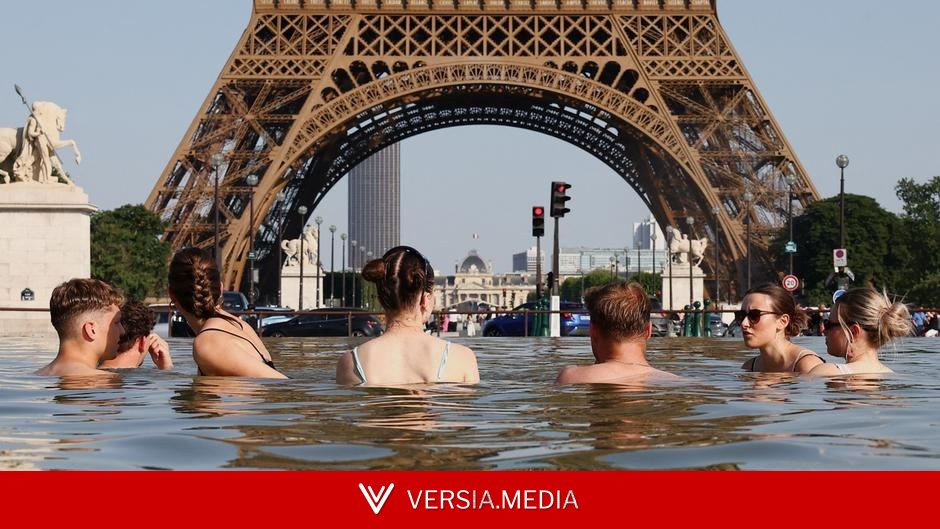
A new study says Europe's current heat wave would have been nearly impossible without human-driven climate change. And Germany is expecting things to warm up even more. DW has the latest.
What you need to know
A new rapid study says Europe’s record heat wave would have been 'virtually impossible' without man-made climate change
The World Weather Attribution group said such extreme heat is now up to 200 times more likely than it was two decades ago
Millions across Europe have faced temperatures above 40 C, with hot nights making recovery harder
Researchers sasd nearly half of 850 European cities analyzed have reached or are expected to reach record heat-stress levels
Tired of missing our real-time updates? Click here to add us as a Preferred Source on Google. Then tap the "Star" or "Preferred" to keep DW News at the top of your feed.
Follow along for more through the day and this week for the latest developments on the June 2026 European heat wave:
More events canceled as heat wave worsens
It's not just Paris Pride that has been canceled or cut short because of the heat, but a string of other events, too.
Organizers of the Defqon.1 festival in the Netherlands ended the event early, asking around 50,000 campers to leave overnight as temperatures neared 40 degrees Celsius.
Authorities also halted a planned reenactment of the Battle of Waterloo in Belgium, citing safety concerns for participants and visitors.
In Paris, police called for the cancellation of a Diamond League athletics meeting and other large gatherings, warning emergency services must focus on protecting vulnerable people.
The disruptions come as a record heat wave grips large parts of Europe, with the Netherlands issuing its first-ever nationwide code red alert.
German hospitals lagging behind on air conditioning
Air conditioning is still uncommon in patients' rooms at German hospitals, a leading medical association said on Friday.
"Most intensive care units in Germany are now air-conditioned, but that's about as far as it goes. Only a third of hospitals have air-conditioned patient rooms," Susanne Johna, chair of the Marburg Association, told public broadcaster ZDF.
At the same time, there are clear guidelines for installing air conditioners for operating rooms or radiology departments, where equipment cannot withstand the heat.
"We often ask relatives to bring things like ice packs from home, which provide temporary relief," Johna said, calling on politicians, architects and hospital chains to take into account the rise in temperature when designing and planning buildings.
"Even with new buildings, we're seeing that sometimes appearances seem to matter more than common sense," Johna said, stressing the amount of risks the heat poses on patients.
"We simply have to be realistic and acknowledge that people die more frequently during such heatwaves. Statistically, this is clearly the case, and it also applies to the people in hospitals," she said.
Paris Pride parade postponed until September
The Paris Pride march , which was originally slated for Saturday, has now been pushed back to September, as officials across Europe put more and more public events on hold due to extreme heat.
Lyon's Pride march will also not be happening this Saturday.
Authorities warned against overwhelming healthcare and emergency services.
"Despite adjustments made by the organizers and their efforts to increase their internal first-aid response, several hundred thousand people going to these events will create a high risk of excessive strain on a healthcare system already stretched to its limits," the police said.
A series of concerts at a Paris racetrack and an athletics meeting are also affected.
Too hot to trot: Dutch music festival falls victim to the heat
Organizers of this weekend's electronic music festival Defqon.1 in the Netherlands canceled the event on Friday due to the extreme heat.
Temperatures are expected to hit 40 degrees Celsius (104 degrees Fahrenheit), prompting the Dutch weather service to issue the highest "code red" warning for the first time ever.
Around 50,000 festivalgoers were informed of the cancelation at midnight last night while already camped out at the site some 70 kilometers (43 miles) northeast of Amsterdam.
The news did not go down well initially, with police reporting several cases of vandalism. However, the electronic music fans are now leaving peacefully, according to the organizers.
Defqon.1 is one of the world’s largest hardstyle and hardcore festivals, and was scheduled to run from Thursday until Sunday.
France records over 50 drownings amid heat wave
French Sports Minister Marina Ferrari has urged people to remain vigilant when seeking relief from the extreme heat.
Her comments come as authorities report 55 deaths in swimming accidents in France since the start of the heat wave.
In an interview with public broadcaster FranceInfo, Marina Ferrari said "more than 65% of these drownings occurred at swimming spots that are unsupervised or not authorized."
The minister said she understood that people head to the water during heat waves, but warned that it was "essential to follow safety rules."
She also warned that the death toll could rise further.
France's EDF allocates €80 million to cool classrooms
With thousands of schools closed due to the record-breaking heat wave in France, state-owned utility EDF pledged to allocate €80 million ($91.2 million) for cooling systems for schools, nurseries and daycare centers.
EDF has said that more than half of the funds will be used to install around 100,000 fans, misting devices and air conditioning units across 10,000 institutions by the end of September 2026.
The facilities will receive the rest of the funds, about €10,000 per establishment, to help finance cooling systems until the end of June 2027.
CEO Bernard Fontana said in a statement that the measure is part of EDF's "concrete action" to help the institutions "equip themselves with both immediately available cooling solutions and longer-term improvements."
In a strike on Thursday, French teaching unions had denounced the working conditions as "unacceptable." Some parents used emergency blankets to cover schools windows, or spread chalk-based coatings on the glass to help isolate classrooms from the heat.
Berlin orchestra relaxes dress code for end-of-season concert amid heatwave
Berlin's Philharmonic Orchestra will perform its famous end-of-season concert on Saturday evening in a relaxed dress code due to the scorching heat , a spokeswoman for the orchestra has announced.
"The men will perform without a jacket, but will wear a black shirt as their top," said the spokeswoman, adding that they may also roll up their sleeves.
For the women, their tops do not have to be long-sleeved as long as they reach the elbow.
Despite the ongoing heat wave, with temperatures forecast to rise as high as 41 degrees Celsius (105.8 Fahrenheit) in the German capital on Saturday, the spokeswoman emphasized that the stage in the Waldbühne will be in the shade in the evening.
"We're used to playing outdoors," she said.
READ: European summer heat wave is 'not normal'
Hot summers aren't unusual in some European countries.
However, the deadly record-breaking heat that's causing power outages, forcing school closures and sending people scrambling for relief, is "exceptional," a new study has found.
The analysis by ClimaMeter, a scientific platform for analyzing extreme weather, says global temperature rise linked to the burning of oil, coal and gas, has made it 2 to 4 degrees Celsius (3.6 to 7.2 degrees Fahrenheit) hotter.
Read our full story here .
European heat wave 'virtually impossible' without man-made climate change
Europe's record-breaking heat wave would have been "virtually impossible" without climate change , according to a rapid study published on Friday by the World Weather Attribution group.
The researchers said the extreme temperatures are now up to 200 times more likely than just two decades ago.
Millions across France, Italy, Spain and the UK have faced temperatures above 40 degrees Celsius (104 Fahrenheit), with high nighttime heat preventing recovery. Researchers said a similar event in 1976 would have been around 3.5C cooler by day and significantly cooler at night.
The study found that nearly half of the 850 cities analyzed across Europe have reached or are expected to reach record heat-stress levels, combining temperature and humidity.
How Europeans cope with the record-breaking heat wave
To view this video please enable JavaScript, and consider upgrading to a web browser that supports HTML5 video
"Scientists like me are beginning to sound like a broken record," said Friederike Otto, professor of climate science at Imperial College London.
"We put out similar quotes year after year, reacting to heat extremes that climb ever higher."
"Yes, this is climate change, yes, it's us, no, it's not El Nino. Yes, we have the solutions. No, we're not implementing them fast enough."
We're resuming our coverage
Join us on this sweltering Friday morning as we resume our coverage of the record-breaking heat wave still gripping Europe.
A new rapid study found that nearly half of the 850 cities analyzed across Europe have reached or are expected to reach record heat-stress levels, combining temperature and humidity.
Researchers say the current heat is 200 times more likely now than just 20 years ago — and this is due to global warming.
Meanwhile, a ban on the consumption of alcohol in public in Paris is due to go into effect from midday.
We will be bringing you the latest updates across Europe as the continent tries to stay cool.
We've paused our coverage
As people in Europe settle in for another hot night, we're pausing our coverage of the heat wave.
We will be back in the morning for what is forecast to be another day of scorching temperatures.
French authorities ban public consumption of alcohol in Paris starting midday Friday
French authorities have decided to ban the public consumption of alcohol in Paris starting midday on Friday.
"I will publish an edict this evening which will ban the consumption of alcohol in public from tomorrow midday onwards. As you know, drinking alcohol with the sun beating down can have a devastating effect," Paris police chief Patrice Faure told French media.
Faure said we are "reaching a saturation point in hospital facilities," while adding that the "number of hospitalizations keeps increasing."
The order prohibits public booze consumption from noon on Friday to 7 a.m. Saturday and 12 p.m. Saturday to 7 a.m. Sunday.
Takeaway alcohol purchases would also be banned during those time frames. The degree is also relevant for stores which exclusively sell alcoholic beverages.
Restaurants and bars holding the necessary permits are not impacted by the ban, Paris police said.
Extreme heat pushes number of life-threatening emergencies in London to record high
London Ambulance Service (LAS) said Thursday it had recorded its highest ever number of life-threatening emergencies in one day because of "extreme heat" across the capital.
"We have seen the highest number of life-threatening emergencies in our history, driven by the extreme heat across London," Chief Executive Jason Killens KAM said.
The service said that it responded to 642 "Category 1" calls on Wednesday, when the UK experienced its hottest June day on record, which was surpassed again on Thursday.
Category 1 incidents include the most serious, life-threatening injuries and illnesses, including cardiac arrests and patients who are not breathing.
Meanwhile, Britain's Met Office extended its red heat alert into Friday — the first time such warnings have been issued for three consecutive days.
"Significant disruption to daily life is likely and the public should take every effort to adapt their daily routines to cope with these levels of heat, which up to now have been extremely rare for the UK," said Andy Page, a chief meteorologist at the Met Office.
France shuts down nuclear reactors amid heat
France 's electricity utility EDF has shut down two more nuclear reactors as river temperatures have risen to the extent that discharged cooling water causes them to go beyond environmental limits aimed at protecting plant and animal life.
This means three reactors are now out of operation in France.
For similar reasons, Switzerland has said it is reducing operations at its Beznau plant, adding that it would shut down reactors if the extreme heat continued.
101 million to see temperatures above 35 C on Thursday — AFP
At least 101 million people in Europe will continue to experience extreme heat above 35 C (95 F) on Thursday, according to an analysis by the AFP news agency.
Those sweltering will include some 50 million in France and 18 million in Germany .
More than 380 million people — nearly two-thirds of the population — will have to endure temperatures above 30 C across Europe excluding Turkey.
That includes 70 million people in Germany, 63 million in mainland France, 48 million in Italy and 38 million in Britain .
The analysis is based on forecasts from the German weather service and 2025 population projections from the Joint Research Centre.
On Wednesday, the German weather service said 94 million people were hit by temperatures exceeding 35 C.