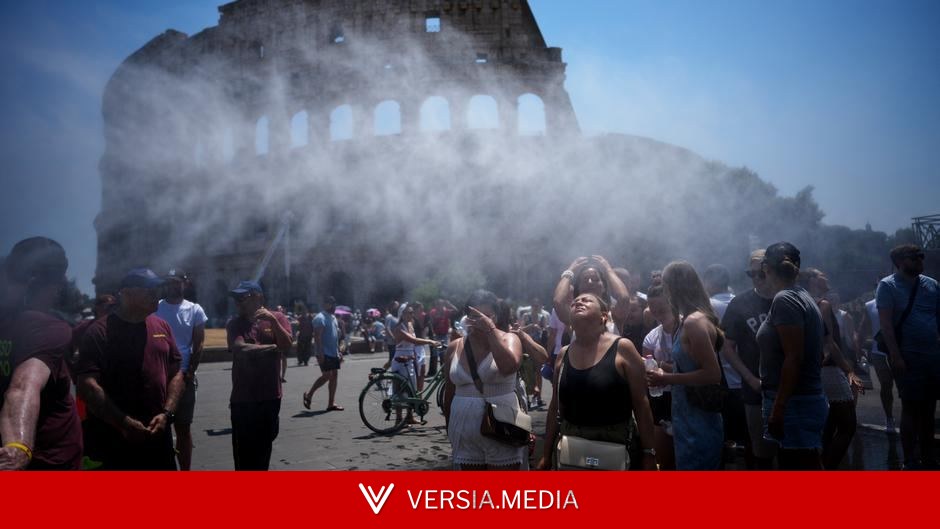
Europe’s heat wave is expected to move east after causing record temperatures in several countries. But Germany still has a couple of torrid days ahead. DW has the latest.
What you need to know
The 'heat dome' currently over Western Europe is forecast to move to Central Europe and the Balkans
The 'heat dome' currently over Western Europe is forecast to move to Central Europe and the Balkans
A new rapid study says Europe’s record heat wave would have been 'virtually impossible' without man-made climate change
A new rapid study says Europe’s record heat wave would have been 'virtually impossible' without man-made climate change
The World Weather Attribution group said such extreme heat is now up to 200 times more likely than it was two decades ago
Millions across Europe have faced temperatures above 40 C, with hot nights making recovery harder
Tired of missing our real-time updates? Click here to add us as a Preferred Source on Google. Then tap the "Star" or "Preferred" to keep DW News at the top of your feed.
Follow here for the latest developments on the June 2026 European heat wave:
Germany set for another scorcher
A record set on Friday for the highest June temperature in Germany could potentially fall just a day later, with the German Weather Service (DWD) saying the mercury could climb to 42 C (107.6 F) in some places on Saturday.
On Friday, 41.3 C was recorded in the western city of Saarbrücken, according to preliminary data.
For Saturday, the DWD has forecast temperatures of between 36 and 41 C, and on Sunday, eastern and southeastern regions could see peak temperatures of 39 to 41 C.
The eastern Lausitz region could even see 42 C on Sunday, according to the forecasters.
The rest of Germany is expected to see — slightly — milder temperatures ranging from 32 to 38 C.
However, thunderstorms with strong winds and, possibly, hail, are also likely over the weekend, the DWD says, particularly in central and northern Germany.
The heat wave is predicted to move eastward toward the start of next week, with temperatures in Western Europe sinking to be more in keeping with normal summer levels.
The hot weather is being caused by a "heat dome" of trapped air from north Africa, according to the EU's Copernicus Climate Change Service.
However, climate scientists say the heat wave has been supercharged by human-induced global warming .
Heat dome expected to move east over weekend
The ongoing heat wave currently affecting Western Europe will move on to Central Europe and the Balkans toward the end of the month, the World Meteorological Organization has said.
The Czech Republic and Hungary are on red alert for the weekend, with temperatures of up to 40C (104 F) forecast.
Hungary's Prime Minister Peter Magyar said millions of bags of drinking water were being prepared for distribution if necessary.
A planned Pride March in the capital, Budapest , is, however, to go ahead, with organizers asking those at risk from the extreme heat to support the event from their homes.
In Serbia , huge political rally by the ruling nationalist Serbian Progressive Party (SNS) is also to take place.
Welcome back to our coverage
The DW newsroom in Bonn is picking up its coverage again of the extreme weather affecting Germany and much of Euope as another day of high temperatures is forecast.
Like Britain, France and Switzerland, Germany has seen June temperature records broken during the heat wave — 41.3 C (106.34 F) was recorded on Friday in the western city of Saarbrücken, according to preliminary data.
But some relief is in sight for Western Europe at least, with the zone of extreme temperatures expected to move eastward over the weekend into the start of next week.
DW will bring the latest as Europe experiences what climate scientists say is an inevitable consequence of human-induced global warming.
We're pausing our coverage
We are pausing our coverage of the heat wave that's sending temperatures soaring in Europe. We will be back with more on the effects of the scorching temperatures on Saturday morning.
Some of Friday's top headlines included:
Germany records provisional all-time high of 41.3 degrees Celsius (106.34 degrees Fahrenheit)
France records over 50 drownings amid heat wave
European heat wave 'virtually impossible' without man-made climate change
IN DEPTH: What southern Europeans know about surviving heat
Most northern Europeans are used to cold winters and relatively mild summers, and perhaps an annual beach vacation in countries like Greece, Spain and Italy.
But as humans continue to burn oil, gas and coal, releasing greenhouse gas emissions causing climate change, Europe is becoming the fastest-warming continent.
And deadly heat waves are becoming more intense and frequent — even in once-cool countries like Germany and Ireland.
People living in warmer southern European countries have more experience in managing hotter conditions.
Germany records provisional all-time high of 41.3C
The German Weather Service (DWD) has recorded a provisional temperature of 41.3 degrees Celsius (106.3 Fahrenheit) in the south-western state of Saarland — the highest ever measured in the country. Several locations in the country also saw temperatures break 40 degrees Celsius on Friday, according to preliminary weather service data, surpassing the previous record high of 39.6 degrees Celsius for June.
Germany is expected to continue sweltering under record heat over the weekend, with the DWD warning that local temperatures in parts of the country could hit 42 degrees Celcius on both Saturday and Sunday.
WATCH: Europe hits record temperatures: Is this the new normal?
Europe has been roasting for days with record-breaking temperatures across the continent.
To understand what's going on, DW talked to Armel Castellan, the Extreme Heat Services Technical Advisor at the World Meterological Organization and Theodore Keeping, the lead author of a new so-called "rapid study" by the World Weather Attribution that says the heatwaves Europe is now experiencing are driven by climate change and would not have been possible 50 years ago.
IN DEPTH: As Europe bakes, does sunscreen help?
Millions of people across Europe are dealing with temperatures above 40 degrees Celsius (104 degrees Fahrenheit).
While many recognize the need to use sunscreen to protect themselves from the sun, some, particularly on social media, have been discussing whether it could actually be harmful.
The discussion centers around the question of whether sunscreen could increase the risk of skin cancer rather than reduce it.
And while the debate is not new, it does seem to be resurfacing more frequently, as global temperatures continue to rise and droughts and extreme heat become the new normal.
UK: Hottest June day record broken for third day in a row
The United Kingdom experienced its hottest June day on record for the third consecutive day on Friday, the Met Office reported.
Temperatures reached a new high of 36.9 degrees Celcius (98.4 Fahrenheit) in Wattisham, Suffolk, in southeast England, narrowly surpassing Thursday's record of 36.7 degrees Celcius.
The weather agency extended its highest-level "extreme heat" warning through 9:00 am (0800 GMT/UTC) Sunday morning for southwest and southeast England, including London — the fourth consecutive day such an alert has been in place.
The Met Office warned of "population-wide adverse health effects" as medical professionals, teachers, and climate scientists said that the country is not prepared for increasingly intense and frequent heat waves due to climate change.
Balkans brace as heatwave moves from Western Europe
A heatwave is forecast to move from Western Europe to the Balkans from Friday.
Across the region, heat alerts have been issued for the days ahead.
High temperatures of up to 39 degrees Celsius (102 degrees Fahrenheit) are expected in some parts of Croatia, Bosnia, Kosovo, Montenegro, North Macedonia and Serbia.
The past three summers have been Serbia 's hottest since record-keeping began in 1951.
Despite the hot weather, an outdoor rally organized by the ruling nationalist Serbian Progressive Party (SNS) is planned in Belgrade on Saturday.
Much of the Adriatic coast across the Balkans is under red weather warnings, with temperatures expected to climb above 35 degrees Celcius.
The sea is also affected. Water temperatures in Pula, Croatia, topped 27 degrees Celsius on Friday morning.
In Croatia , very high temperatures are forecast to spread inland on Sunday.
More events canceled as heat wave worsens
It's not just Paris Pride that has been canceled or cut short because of the heat, but a string of other events, too.
Organizers of the Defqon.1 festival in the Netherlands ended the event early, asking around 50,000 campers to leave overnight as temperatures neared 40 degrees Celsius.
Authorities also halted a planned reenactment of the Battle of Waterloo in Belgium, citing safety concerns for participants and visitors.
In Paris, police called for the cancellation of a Diamond League athletics meeting and other large gatherings, warning emergency services must focus on protecting vulnerable people.
The disruptions come as a record heat wave grips large parts of Europe, with the Netherlands issuing its first-ever nationwide code red alert.
German hospitals lagging behind on air conditioning
Air conditioning is still uncommon in patients' rooms at German hospitals, a leading medical association said on Friday.
"Most intensive care units in Germany are now air-conditioned, but that's about as far as it goes. Only a third of hospitals have air-conditioned patient rooms," Susanne Johna, chair of the Marburg Association, told public broadcaster ZDF.
At the same time, there are clear guidelines for installing air conditioners for operating rooms or radiology departments, where equipment cannot withstand the heat.
"We often ask relatives to bring things like ice packs from home, which provide temporary relief," Johna said, calling on politicians, architects and hospital chains to take into account the rise in temperature when designing and planning buildings.
"Even with new buildings, we're seeing that sometimes appearances seem to matter more than common sense," Johna said, stressing the amount of risks the heat poses on patients.
"We simply have to be realistic and acknowledge that people die more frequently during such heatwaves. Statistically, this is clearly the case, and it also applies to the people in hospitals," she said.
Paris Pride parade postponed until September
The Paris Pride march , which was originally slated for Saturday, has now been pushed back to September, as officials across Europe put more and more public events on hold due to extreme heat.
Lyon's Pride march will also not be happening this Saturday.
Authorities warned against overwhelming healthcare and emergency services.
"Despite adjustments made by the organizers and their efforts to increase their internal first-aid response, several hundred thousand people going to these events will create a high risk of excessive strain on a healthcare system already stretched to its limits," the police said.
A series of concerts at a Paris racetrack and an athletics meeting are also affected.
Too hot to trot: Dutch music festival falls victim to the heat
Organizers of this weekend's electronic music festival Defqon.1 in the Netherlands canceled the event on Friday due to the extreme heat.
Temperatures are expected to hit 40 degrees Celsius (104 degrees Fahrenheit), prompting the Dutch weather service to issue the highest "code red" warning for the first time ever.
Around 50,000 festivalgoers were informed of the cancelation at midnight last night while already camped out at the site some 70 kilometers (43 miles) northeast of Amsterdam.
The news did not go down well initially, with police reporting several cases of vandalism. However, the electronic music fans are now leaving peacefully, according to the organizers.
Defqon.1 is one of the world’s largest hardstyle and hardcore festivals, and was scheduled to run from Thursday until Sunday.
France records over 50 drownings amid heat wave
French Sports Minister Marina Ferrari has urged people to remain vigilant when seeking relief from the extreme heat.
Her comments come as authorities report 55 deaths in swimming accidents in France since the start of the heat wave.
In an interview with public broadcaster FranceInfo, Marina Ferrari said "more than 65% of these drownings occurred at swimming spots that are unsupervised or not authorized."
The minister said she understood that people head to the water during heat waves, but warned that it was "essential to follow safety rules."
She also warned that the death toll could rise further.