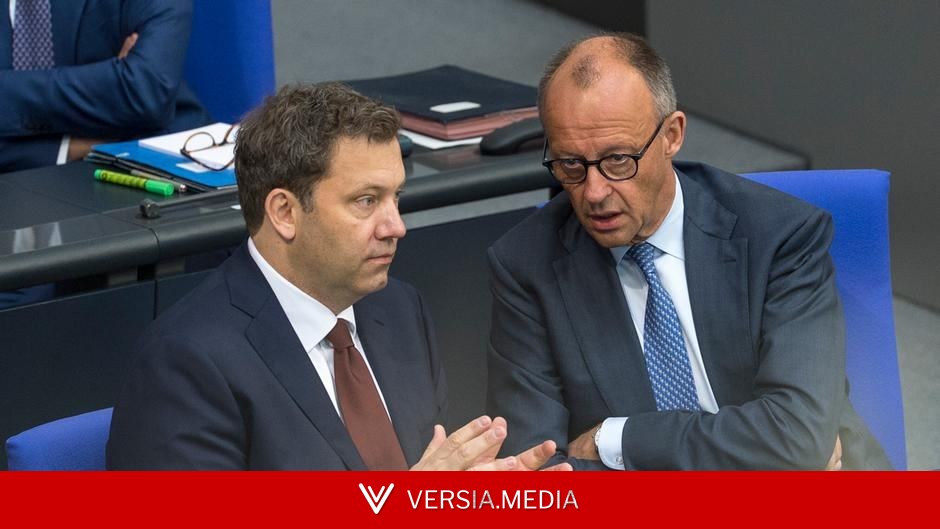
The budget draft provides for more borrowing than initially planned, as well as a big increase in defense spending. Meanwhile, three men are facing trial over a massive stash of illegal weapons. Follow DW for more.
What you need to know
Germany's federal Cabinet is set to approve the draft budget for 2027
Three men are standing trial over the discovery of one of Germany's biggest-ever illegal weapons caches
German companies see democracy as crucial for economic success but fear it's being weakened, according to a survey
Read on for a roundup of the headlines from across Germany on Monday, July 6:
Tired of missing our real-time updates? Click here to add us as a Preferred Source on Google. Then tap the "Star" or "Preferred" to keep DW News at the top of your feed.
TKMS sub contract would bring Canada closer to Europe, German official says
A German government official has said that if Canada decides to buy German submarines instead of South Korean ones, it would bring Ottawa closer to Europe for decades into the future.
German warship builder Thyssenkrupp Marine Systems (TKMS), along with partner Norway, are competing with South Korean shipbuilder Hanwha Ocean for the contract to build 12 submarines.
Canadian Prime Minister Mark Carney is expected to announce the winning bidder on Monday, shortly before he heads to a NATO leaders' summit in Turkey, the Globe and Mail reported.
The German official said a win for TKMS would be a good starting point for strategic cooperation and "would have a genuine transatlantic dimension."
The official added that German Chancellor Friedrich Merz has invested a significant amount of political effort toward the deal in recent months.
"We'll see in the coming days whether this effort bears fruit," the official said.
TKMS is one of the world's leading companies in the construction of non-nuclear-powered submarines.
German factory orders rebound in May
Germany 's struggling manufacturing sector showed signs of recovery in May, with factory orders rebounding stronger than expected after a decline in April.
New business rose by 1.9% in May compared with the previous month, figures from the Federal Statistical Office showed.
The recovery is mainly thanks to a jump in large-scale transport orders, including aircraft, ships, trains and military vehicles. These orders were 85% higher than the previous month due to several major contracts.
"Incoming orders in the manufacturing sector appear to have resumed the upward trend that began in the second half of 2025," said the Economy Ministry in a statement.
It also warned that "developments remain highly volatile," adding that "geopolitical uncertainty remains elevated until peace negotiations between the United States and Iran are finally concluded."
The war in the Middle East , higher oil and gas prices and economic uncertainty had previously dampened demand.
"Up one month, down the next — the zigzag in orders continues," said Alexander Krüger, chief economist at ABN Amro Germany. "All in all, the order situation is better than it was a year ago."
Thomas Gitzel, chief economist at VP Bank, urged caution.
"These are not easy times for the German economy," he said. "The automotive industry is undergoing downsizing, creating difficulties for many supplier industries. This is particularly true of the mechanical engineering sector. Although it recorded an increase in orders in May, the overall picture remains bleak."
Germany's top diplomat suggests Iran should pay for Hormuz mine clearance
German Foreign Minister Johann Wadephul has raised the possibility of Iran helping to pay for a potential European mission to clear mines from the Strait of Hormuz .
"Iran has unlawfully mined an international shipping lane," Wadephul told the Handelsblatt newspaper.
He said Tehran should foot the bill, given that the damage was caused by the regime.
Wadephul added that, although Germany currently had no plans to seek fees for the European mission, such a measure would be justified.
Shipping activity through the Strait of Hormuz — a major waterway for the transport of oil, gas and fertilizer — has picked up in recent days. But there are still some 80 naval mines around the central part of the strait, according to the International Maritime Organization.
Experts have said that clearing the mines is a complex task that could take several weeks.
A decision on Germany's participation in the mine-clearning operation is expected to be made before the end of the summer.
Democracy important for business location, say companies in Germany
Companies in Germany believe democracy is the foundation for economic success, according to a survey of about 900 firms by the Bertelsmann Foundation, German Economic Institute and the University of St Gallen.
At the same time, many companies said they feared democracy was weakening amid growing social polarization and loss of trust in democratic institutions.
Some 93% said democracy was key in Germany as a business location, with advantages such as the rule of law, planning certainty and entrepreneurial freedom.
More than 90% said they saw lack of trust in democratic institutions as a threat.
Around 30% said social divisions had also seeped into their companies and were taking a toll on the working environment.
"Social tensions do not stop at the factory gates," said Dominik Hierlemann of the Bertelsmann Foundation. "Yet the vast majority of companies are able to deal with this effectively. They help to stabilize democracy."
The survey also showed that companies are increasingly reflecting on "whether political engagement is becoming riskier under changing geopolitical or domestic political conditions."
For instance, around 21% of those surveyed said they would expect to face disadvantages for taking a stand against political forces in Germany aligned with US President Donald Trump.
Around 60% of companies said they also see themselves as having a democratic responsibility. Many take action internally, for example, by highlighting democratic values in their mission statements.
"Public stances are significantly less common and, above all, controversial among smaller companies," Bertelsmann said.
German economy under pressure
To view this video please enable JavaScript, and consider upgrading to a web browser that supports HTML5 video
Trial over Remscheid weapons cache to open
Three men are standing trial after the discovery of a huge stash of illegal firearms in the western city of Remscheid last year.
The defendants, aged 60, 38 and 35, have been charged with breaching the War Weapons Control Act, according to court documents cited by German press agency dpa.
The 60-year-old is accused of storing weapons and ammunition for sale. He allegedly sold six submachine guns and a revolver to his 38-year-old co-defendant, who then allegedly resold some of the weapons together with the 35-year-old.
Police conducted raids in central Remscheid in October 2026 after undercover officers were offered weapons for sale.
They found almost 100,000 rounds of ammunition, as well as around 300 firearms, including 125 machine guns, 67 submachine guns, 51 pistols, 32 long guns, 11 revolvers and 13 anti-tank weapons.
The public prosecutor's office said it was one of the largest discoveries of military-grade weapons in recent German history.
The prosecutor's office has accused the 60-year-old of dealing in war weapons on a large scale, but he claims most of the arms are part of his private collection and that he had no intention of selling them.
Ten days of hearings are scheduled in Wuppertal until the end of September.
German Cabinet to approve draft for 2027 budget
The federal Cabinet is set to approve the government's draft for the 2027 budget on Monday.
The government plans to spend €555.4 billion ($634.8 billion) next year, significantly more than the current year's €524.5 billion.
New borrowing is expected to total more than €200 billion, according to the draft seen by news agencies. That would be a bigger increase than initially planned.
A significant spending boost is planned for the Bundeswehr , Germany's armed forces. The draft includes around €109.7 billion for defense — about a third more than the 2026 budget.
Total investment will be €117.5 billion, almost €40 billion more than originally planned. This increase comes after the approval of a €500 billion fund for infrastructure and a rule change that allows defense spending to be excluded from debt limits.
Social Democrat leader and Finance Minister Lars Klingbeil defended the planned increase in new borrowing.
"You cannot defend yourself against Putin with a balanced budget," he told public broadcaster ARD on Sunday, referring to the Russian president and his war in Ukraine.
Budget discussions are set to commence in parliament in September after the summer recess. Final approval is expected by the end of the year.
Welcome to our coverage
Guten Morgen from the DW newsroom on the banks of the Rhine River in Bonn.
You join us as Germany's Cabinet is expected to approve the first draft of the 2027 federal budget.
The draft envisages higher levels of debt and spending than originally planned, with a particular boost for defense.
Meanwhile, three men are set to stand trial over the discovery of one of Germany's largest illegal arms caches in the western city of Remscheid.
Your feedback