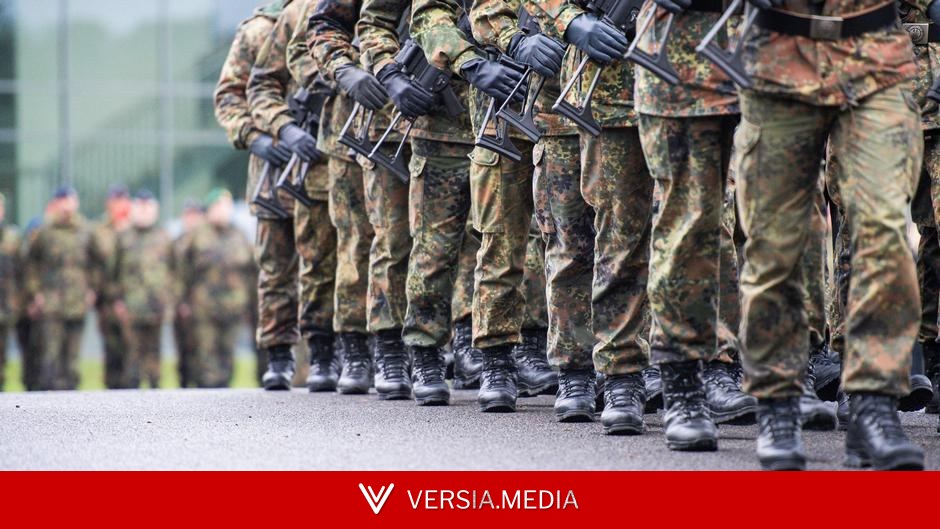
The number of people applying for conscientious objection to military service has risen sharply and there were around 5,100 heat-related deaths recorded in June alone. DW has more.
What you need to know
Number of conscientious objections to military service rises sharply
New data confirms that deaths spiked during the June heat wave
Police conduct searches over alleged prison drug smuggling
Below you can read a roundup of the top stories from and about Germany on Tuesday, July 14.
Tired of missing our real-time updates? Click here to add us as a Preferred Source on Google. Then tap the "Star" or "Preferred" to keep DW News at the top of your feed.
Hapag-Lloyd criticizes Trump's Strait of Hormuz fee plan
German international shipping company Hapag-Lloyd has criticized plans announced by US President Donald Trump to charge ships for the transit of the Strait of Hormuz .
It would be "fundamentally wrong" to levy fees through international waters, the company told the Reuters news agency.
The Hamburg -based shipping giant said it could not reliably quantify the financial impact of tensions in the Gulf region on its business.
Trump said on Monday that he would charge 20% on all cargo shipped through the Strait of Hormuz "for any and all costs necessary to do the job of providing safety and security."
Police search prison and homes as part of misconduct investigation
Police have been searching the Rheinbach Correctional Facility along with residences in North-Rhine Westphalia and Rhineland-Palatinate .
Bonn police said the searches formed part of an investigation into several correctional services officers being probed for alleged misconduct.
Inmates and former inmates are understood to be part of the investigation with German news agency DPA, reporting that the case involves, among other things, smuggling drugs into the prison.
DPA reported that officials are alleged to have smuggled cell phones and drugs into the prison in return for money.
A total of nine search warrants were to be executed on Tuesday — six in North Rhine-Westphalia and three in Rhineland-Palatinate.
Significant spike in conscientious objection to German military service
There has been a sharp rise in applications for conscientious objection to military service , according to data from the Federal Office for Family Affairs and Civil Society Functions (BAFzA).
A BAFzA spokeswoman told Germany's RND media group that 5,862 applications had been received during the first half of 2026.
In 2025 alone, there were 3,867 applications while in 2024 there were 2,998.
The latest figures follow the introduction of a new military service law that took effect in January.
It introduces mandatory screening for young men born in 2008 or later, aimed at boosting voluntary military recruitment. Parliament would be able to activate compulsory service if recruitment targets are missed.
Compulsory military service was suspended in Germany in 2011 but it remains enshrined in the constitution.
The BAFzA said the right to refuse military service on grounds of conscience is protected under Article 4 of the Basic Law.
New military service rules
To view this video please enable JavaScript, and consider upgrading to a web browser that supports HTML5 video
Sharp rise in deaths recorded during June heat wave
On Tuesday, the Federal Statistics Office announced that 23,900 people died during the week of June 22-28 — around 7,100 more deaths compared to the two weeks prior.
Tuesday's report revised a previous estimate which put the excess death toll at around 6,800.
Meanwhile, Germany's public health body, the Robert Koch Institute (RKI) , estimated last week that there had been around 5,120 heat-related deaths in June.
According to these figures, more than 4,300 people died in the last week of June alone, that being June 22 to 28.
The heat wave brought new record highs in Germany and with the rising mercury there appears to have been a correlating trend of a rise in deaths during that specific period.
Germany, along with much of western Europe, sweltered in the late June heat wave that saw temperatures climb above 40 C (104 F) in several regions.
Extreme heat: Can Europe adapt to climate change?
To view this video please enable JavaScript, and consider upgrading to a web browser that supports HTML5 video
Welcome to our coverage
Guten Morgen from a warm DW newsroom here in Bonn.
We're following the main stories and trends coming out Germany this Tuesday morning, with a federal agency reporting a sharp rise in conscientious objection to military service.
Russia's war in Ukraine has impacted government's position on security significantly and with it the need for a state of readiness in matters of defense.
But judging by the latest figures, it evidently has become a cause for concern among those who could ultimately be impacted by any change to laws governing compulsory military service.
There was also a significant spike in deaths recorded during the June heat wave as temperature records tumbled, amid sweltering heat.
We're tracking these stories and more. Thank you for joining us.