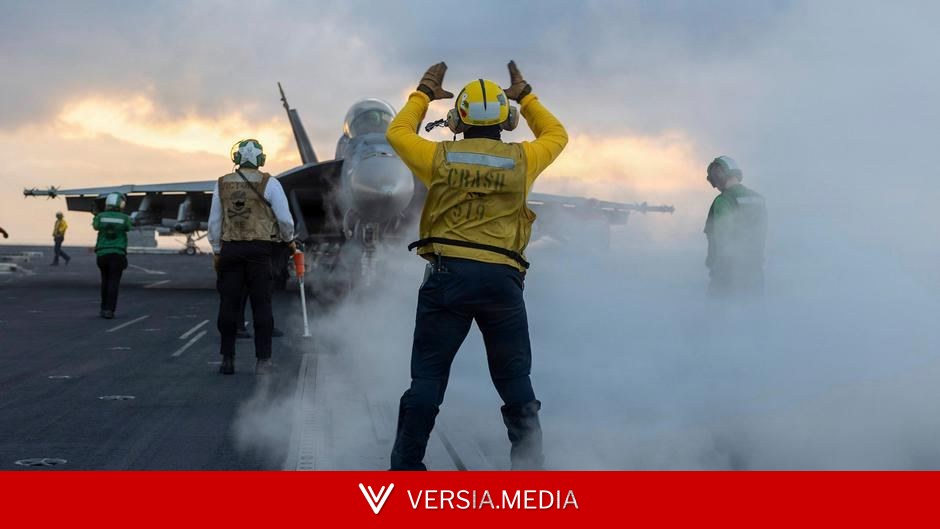
The US military announced a new wave of attacks on Iran, it says is aimed at "degrading" Iranian military capability. The strikes come after the US military said it would begin enforcing a naval blockade. DW has more.
What you need to know
US military launches fresh wave of strikes on Iran 'to further degrade' Iranian military capability
US military launches fresh wave of strikes on Iran 'to further degrade' Iranian military capability
Earlier, Trump threatend strikes on Iranian infrastructure, saying 'next week it gets really bad' if no deal made
Earlier, Trump threatend strikes on Iranian infrastructure, saying 'next week it gets really bad' if no deal made
US reimposes its naval blockade on Iranian ports amid continuing strikes on shipping
US reimposes its naval blockade on Iranian ports amid continuing strikes on shipping
Iran's Revolutionary Guards say the Strait of Hormuz will remain closed
Follow DW's coverage of the war between the US and Iran on Wednesday, July 15.
Tired of missing our real-time updates? Click here to keep DW News at the top of your feed.
WATCH: Gulf Nations caught between Iran and the US as war escalates
Weeks after a brief de-escalation, Iran and the US are once again locked in confrontation. As missiles and drones cross the Gulf, what are the implications for regional security and stability?
Gulf Nations caught between Iran and the US as war escalates
To view this video please enable JavaScript, and consider upgrading to a web browser that supports HTML5 video
CENTCOM: Strikes on Iran lasted around 90 minutes, targeted island of Greater Tunb
US Central Command (CENTCOM) issued an update on its "morning round of strikes" against Iran , saying that they lasted for around 90 minutes and were completed by 7:30 Eastern Time (1100 UTC/GMT).
That means the strikes took place early in the afternoon local time, from around 13:30 to 15:00.
The military repeated its claim that the strikes "further degraded Iran's ability to attack commercial shipping in the Strait of Hormuz."
It also gave details on the supposed targets and location of the strikes.
"CENTCOM launched precision munitions against coastal defense systems and cruise missile storage and launch sites on Greater Tunb Island during the 90-minute wave," it said.
Greater Tunb is an island south of Iran's coastline in the Persian Gulf near the entrance to the Strait of Hormuz, north of the United Arab Emirates' coast. It's home to an airbase and passenger airport.
US begins launching new wave of strikes on Iran
The US military announced that it has started a new wave of daytime strikes on Iran.
"At 6 a.m. ET today, U.S. Central Command forces began launching a wave of strikes against Iran," the military's Central Command (CENTCOM) said in a statement on X.
"The strikes are designed to further degrade military capabilities Iranian forces have used to attack commercial shipping in the Strait of Hormuz," CENTCOM added.
No further details on damage or casualties were immediately available. Iran has not yet commented on the latest wave of US strikes.
WATCH: Back at War? Why the US struck Iran again
DW's Anthony Howard speaks to military expert Marina Miron of King's College London about some of the latest developments. DW Business reporter Stephen Beardsley explains what the crisis could mean for global trade, oil prices and the wider economy.
Israeli soldier imprisoned for sending missile intercept videos to Iranian agent
Israel 's military said that an active-duty soldier from the Israel Defense Forces (IDF) has been sentenced to five years in prison for sending material to an Iranian agent during the 12-day war in 2025.
The IDF said in a statement that the Israeli soldier was had sent videos showing missile interceptions to an Iranian agent and "received payment for them."
The footage was sent from civilian areas including a missile strike that had been found online.
"Eventually, after feeling pressured, the defendant informed someone in his military unit that he had been in contact with a foreign agent," the military said.
"The following day, he was arrested by the Shin Bet," it said, without giving specifics as to when the arrest took place.
"The court sentenced the defendant to five years' imprisonment, along with a suspended prison sentence, a fine of 1,000 shekels ($335), and reduction in rank to Private."
In June 2025, Israel launched strikes on Iran in a war that lasted 12 days and drew retaliatory strikes from Tehran.
Iran state media reports Bushehr hit by US strikes
Iran's IRNA state news agency reported that US strikes hit the southern port city of Bushehr, which houses the country's only civilian nuclear power plant complex.
"The American enemy attacked three locations in Bushehr today," city governor, Mohammad Mozafari told IRNA. There were no immediate reports of any damage.
Reports of the strikes came hours after US Central Command said it had completed strikes against Iran.
State media on Tuesday also reported explosions in the southwestern city of Ahvaz and the southern port city of Bandar.
WATCH: Iran war explained: Can the US control the Strait of Hormuz?
The latest fighting between the United States and Iran has shifted attention away from Iran's nuclear program and towards one of the world's most strategically important waterways: the Strait of Hormuz.
President Donald Trump says the US will reimpose a blockade on Iran and ensure commercial shipping can continue through the strait.
After first proposing a 20% transit fee, he later abandoned the idea in favor of trade and investment agreements with Gulf states. Iran rejects any US role in managing the waterway and insists it remains the guardian of the Strait of Hormuz. So who actually controls one of the world's busiest maritime chokepoints?
Can the United States realistically keep it open? And what would a prolonged confrontation mean for the Gulf, global trade and the prospects for diplomacy?
DW News spoke to Thomas Juneau, Professor at the University of Ottawa's Graduate School of Public and International Affairs in Canada.
Iran says at least 30 civilians killed in strikes in past days
Iranian government spokeswoman Fatemeh Mohajerani said at least 30 civilians have been killed in US attacks over the past few days.
The deaths were reported following US strikes on southern Iran.
Separately, Iran's military said seven of its personnel were killed in the country's southeast on Wednesday.
They were killed in a missile attack on a barracks close to the city of Iranshahr, in the southeast of the country, the military said in a statement.
The claims by Iranian state media and its military cannot be independently verified.
What is happening in the Strait of Hormuz?
Iran has been demanding that ships use a route that runs near its coastline, while another southern route runs along the coast of Oman. This corridor is protected by the US military.
Currently, there are at least 19 US warships in the Arabian Sea, including two aircraft carriers and an amphibious assault vessel with at least 1,000 marines on board.
US Central Command (CENTCOM), responsible for military operations in the region, said in a social media post that there are "hundreds of military aircraft operating across the Middle East."
In the latest escalation — following Iranian attacks on commercial vessels transiting along the route near Oman — the US has been hitting Iranian port facilities, among other targets, saying the attacks are to degrade Iran's ability to continue attacks on commercial shipping.
On Wednesday, the US said it would begin enforcing a blockade on Iranian ports and Iran threatened in response to halt all energy exports from the Middle East.
There had been an improvement in global crude supplies in the weeks following the signing of the interim peace agreement between the US and Iran, with a flurry of tankers taking the opportunity to pass through the strait.
Despite the recent escalation, some vessels have still making their way though the strait.
Commodity intelligence firm Kpler said that vessels had been transiting before the US blockade came into effect.
According data from commodity intelligence Kpler, nine of the 11 vessels that passed through the strait on Tuesday had sailed via the Iranian route.
The Strait of Hormuz is a vital shipping chokepoint between the Persian Gulf and the Arabian Sea, through which around 25% of the world maritime traded oil travels through.
The vital waterway is the primary export route for oil produced by Saudi Arabia, the UAE, Kuwait, Iraq, Qatar, Bahrain and Iran.
Disruption in the strait has also impacted the global fertilizer trade where about a third of global fertilizers travel.
Jordan says it intercepted Iranian missiles
Jordan 's military said it shot down three missiles launched by Iran that were heading toward the kingdom.
The announcement came after Tehran claimed responsibility for the attack amid escalating tensions in the region. According to Jordan's state-run Petra news agency, the missiles were intercepted without causing damage.
Petra also quoted a military source as saying the armed forces would respond to "any breach or threat to Jordanian airspace in accordance with the approved rules of engagement" and would take all necessary measures to protect the kingdom's sovereignty and security.
Iran claims strike on US Fifth Fleet facilities in Bahrain
Iran's Islamic Revolutionary Guard Corps (IRGC) said it targeted facilities linked to the US Navy's Fifth Fleet in Bahrain.
In a statement, the IRGC said the attack was aimed at command-and-control centers, logistics facilities, fuel depots and military equipment sites.
Tehran described the move as a response to recent US military strikes on Iranian targets.
The Revolutionary Guards also warned that if Washington attempts to restrict oil and gas exports by controlling regional shipping routes, other export routes serving US and allied interests could be shut down as well.
The statement said energy exports in the region would be "for everyone or for no one."
Earlier on Wednesday, Bahrain's Interior Ministry said air raid sirens had sounded and urged residents to remain calm and seek shelter.
Iran says Strait of Hormuz to remain closed
Iran's Revolutionary Guards (IRGC) said early Wednesday that shipping through the Strait of Hormuz would remain closed until the US ends "acts of aggression."
The announcement came after President Donald Trump said the US would reimpose a blockade on Iranian-aligned shipping through the strait.
"Oil and gas exports from the region will either be available for everyone or for no one," the IRGC said in a statement.
Iran's newly established "Persian Gulf Strait Authority" said it would issue "permits" for passage once "stability and calm are restored."
The US maintains that international shipping routes through the strait remain open , although traffic has dropped significantly in recent days from the wartime high seen in June.
US Central Command (CENTCOM) says it has hit dozens of Iranian military targets near the strait and elsewhere along the Iranian coastline to "degrade Iran's ability to threaten commercial shipping and civilian crews."
Indian seafarers pay the price in US-Iran war
To view this video please enable JavaScript, and consider upgrading to a web browser that supports HTML5 video
US completes new wave of strikes on Iran
The US military said it completed another round of strikes against Iran, targeting dozens of military sites near the Strait of Hormuz and along Iran's southern coast.
US Central Command, or CENTCOM, said fighter jets, drones and naval vessels took part in the seven-hour operation, hitting missile and drone sites, naval assets and coastal defense systems.
According to CENTCOM, the strikes were intended to further reduce Iran's ability to threaten commercial shipping and civilian crews in the region.
The attacks took place on the same day that the United States reinstated its naval blockade on vessels travelling to and from Iranian ports.
US Central Command said American forces remain ready to carry out further operations if ordered.
US launches new wave of strikes on Iran
To view this video please enable JavaScript, and consider upgrading to a web browser that supports HTML5 video
Kuwait intercepts Iranian drones
Kuwait 's military said it was intercepting what it described as hostile Iranian drones, as regional tensions continue to escalate.
In a statement, the Kuwaiti armed forces said air defenses were responding to "hostile drone attacks following the nefarious Iranian aggression."
Meanwhile, neighboring Bahrain activated air raid sirens and urged residents to seek shelter.
Bahrain issues air raid alert
Authorities in Bahrain sounded an air raid siren on Wednesday and urged people to seek shelter.
In a post on X, Bahrain's Interior Ministry said: "The siren has been sounded. Citizens and residents are urged to remain calm and head to the nearest safe place."
The warning came after the United States carried out another round of strikes against Iran and reimposed its naval blockade on Iranian ports.