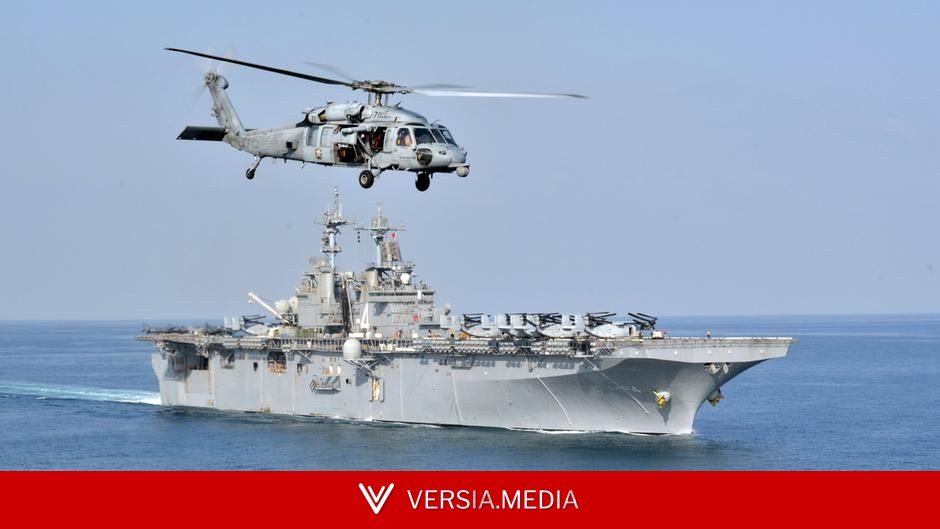
Two days have passed without any strikes by the US and Iran. Fighting between Yemen's Houthis and Saudi Arabia has added another layer to the complex Middle East crisis. DW has the latest.
What you need to know
US has not hit Iran for a second day after a nearly-two week streak of nightly strikes
Iran has also not announced any new attacks
The Middle East war which spread to the Red Sea this week, has also reached the Caspian Sea with Tehran accusing Ukraine of a deadly attack on its vessel.
Here are the lastest developments concerning the Iran war and the wider Middle East on Sunday, July 26.
Tired of missing our real-time updates? Click here to add us as a Preferred Source on Google. Then tap the "Star" or "Preferred" to keep DW News at the top of your feed.
Yemen's Houthis say they downed Saudi reconnaissance drone
Iran-backed Houthi rebels on Sunday said they had shot down Saudi Arabia's reconnaissance drone over the northwest of Yemen.
The Houthis "successfully shot down a Turkish-made... armed reconnaissance drone belonging to the Saudi enemy while it was carrying out hostile operations," the Yemeni group's military spokesman Yahya Saree said in a statement on X.
It comes a day after the Houthis claimed responsibility for attacks on oil facilities in Saudi Arabia.
The rising tension in the Red Sea has heightened concerns over further disruptions to global shipping.
The Houthis have said they would close the Bab el Mandeb strait, the southern gateway to the Red Sea , to Saudi-linked shipping, in retaliation for the Gulf kingdom's blockade on Yemen and a recent attack on the international airport in Sanaa, Yemen's rebel-held capital.
Iran war: Analyzing the Houthi blockade against Saudi Arabia
To view this video please enable JavaScript, and consider upgrading to a web browser that supports HTML5 video
WATCH: UN report condemns Israeli military action in Gaza
In a recent UN report, the organization said that dozens of Palestinians have been killed or injured in the past days.
Gaza's civil defense agency and witnesses said Israeli strikes killed 12 people, including a family of six, in the Palestinian territory in one day alone.
Despite a fragile ceasefire, violence in the Gaza Strip hasn't stopped, and efforts to secure a lasting agreement to end the war have stalled.
UN report condemns Israeli military action in Gaza
To view this video please enable JavaScript, and consider upgrading to a web browser that supports HTML5 video
Israeli settlers accused of setting fire to West Bank mosques after deadly clash
Israeli settlers set fire to two mosques in the occupied West Bank, Palestinian officials said on Sunday.
Since the Gaza war began with Hamas's attack on Israel on October 7, 2023, settler violence against Palestinians in the West Bank has increased sharply.
Abdel Azim Wadi, mayor of the town of Qusra, south of the city of Nablus, told AFP and Reuters news agencies that settlers had torched a mosque in his village.
He added that the attackers sprayed slogans in Hebrew on the mosque's walls, including the word "revenge."
"The village has faced repeated attacks since 2011, and these attacks have increased since the war," he told Reuters by telephone.
In a separate incident, "groups of settlers burned a mosque in the village of Kour in Tulkarem governorate and wrote racist slogans on its walls," according to the Palestinian Ministry of Endowments and Religious Affairs.
The attacks followed clashes in the village of Tell on Friday, which left two Israelis and four Palestinians dead.
Under international law, Israeli settlements in the West Bank are illegal — a position Israel rejects.
Middle East war could widen if US continues attacks, Iran's army warns
Tehran warned on Sunday that the Middle East war would "expand further" if Washington chose to continue attacking Iran.
"I believe that if the Americans (...) insist on continuing the war, particularly through air strikes, geographically this will expand further," army spokesman Mohammad Akraminia told state television.
He argued that the conflict had already expanded to the Bab al-Mandab strait, the narrow waterway between the Arabian peninsula and the Horn of Africa, citing recent hostilities involving Yemen's Iran-backed Houthi militias and Saudi Arabia .
Iran war: Analyzing the Houthi blockade against Saudi Arabia
To view this video please enable JavaScript, and consider upgrading to a web browser that supports HTML5 video
"The scope of our operations now encompasses the entire region, from US bases in Jordan to the countries along the Persian Gulf," he said.
The situation in the Middle East is "difficult and unsettled" for the United States, Akraminia noted, adding that Washington was now looking "for a new strategy."
The army spokesperson also said that the military is also prepared for "scenarios that appear likely."
The remarks come ahead of Israeli Prime Minister Benjamin Netanyahu 's visit to the White House, which is scheduled for Tuesday.
Iran accuses Ukraine of deadly attack on vessel in Caspian Sea
Iran on Saturday accused Ukraine of attacking one of its merchant ships in the Caspian Sea, adding that it resulted in a sailor's death and another being injured.
Iran's foreign ministry said the attack had caused the ship "to explode."
The ministry summoned Ukraine's charge d'affaires in Tehran to lodge its protest over what it called a "hostile and criminal" attack, according to Iran's state news agency IRNA.
In talks with the European Union's foreign policy chief Kaja Kallas, Iranian Foreign Minister Abbas Araghchi called for a "firm response" by the EU and the United Nations Security Council to this attack, the IRNA added.
Tehran said that it would defend its national interests and accused Kyiv of seeking to expand the war in Ukraine.
Iran "has never intervened in the conflict between Russia and Ukraine," the IRNA cited the foreign ministry as saying.
Zelenskyy had said earlier on X that Ukrainian forces conducted long-range strikes in the Caspian sea, targeting vessels "involved in transporting military cargo from Iran, and a warship."
In follow-up posts, he said that since the beginning of July Ukraine had recorded "active Russian satellite surveillance of the Gulf states and US military facilities located there."
Zelenskyy said there was a "clear correlation between Russia's satellite imagery of these sites and Iranian strikes," as he referred to attacks in Bahrain, Jordan and Kuwait.
Another silent night as US reports no attacks against Iran
No US strikes were reported on Iran on Saturday and Sunday after the US military mounted a 13-night volley of escalating bombardments.
There were also no reports of attacks by Iran on its Gulf neighbors.
The silence is resuscitating hopes of the two sides returning to the negotiation table with the war between them reaching the five-month mark on July 28.
The US military did not announce any new strikes on Sunday but said that a "naval blockade against Iran remains in full effect."
It is not immediately known why the US is holding fire against Iran.
US President Donald Trump, on Thursday told US news-outlet Axios that he was mulling "a massive attack" on Iran which he described as being "bigger than ever before".
But he also says that talks with Iran are pressing ahead.
"We're talking to them right now. I think they're getting more and more serious," Trump told journalists on Friday, adding that Tehran faces a choice between a deal and strikes at a "much higher level".
The US President "has always been clear that his preference is diplomacy, but he has shown Iran what will happen if they fail to come to the table in a serious way," Reuters quoted , a senior official in Trump's administration.
Stockpile pressure?
The lull in attacks also comes as US media reports concerns over depleting munitions in the expanding conflict.
CNN cited a US official as saying that Vice President JD Vance and Chairman of the Joint Chiefs of Staff Dan Caine both raised concerns about the US defense stockpile with Trump during a White House meeting on Friday.
The official told CNN that Washington’s operations against Tehran were "on a hold.
While the US and Iran are holding back, retaliatory strikes between Yemen's Iran-backed Houthi rebels and Saudi Arabia have opened a new front in the Middle East war.
Welcome to our coverage
The US has seemingly hit a pause button as the Iran war comes closer to completing its fifth month.
Iran woke up to another day without US airstrikes after 13 consecutive nights of an intensified bombing.
Meanwhile, the war has spread to new waters — the Red Sea and the Caspian Sea.
But first, here is a recap of how the Middle East war has fared over the weekend:
Yemen's Houthi rebels fired missiles and drones at Saudi Arabia in retaliation to Saudi strikes on the Yemeni port city of Hodeida, which the Iran-backed rebel group holds.
Saudi Arabia's strikes were the kingdom's response to the Houthis attacking its tankers in the Red Sea amid a maritime blockade.
Ukraine's President Volodymyr Zelenskyy alleged that Russia was giving Iran satellite data to help direct attacks in the Middle East.
Stay with us for more updates.